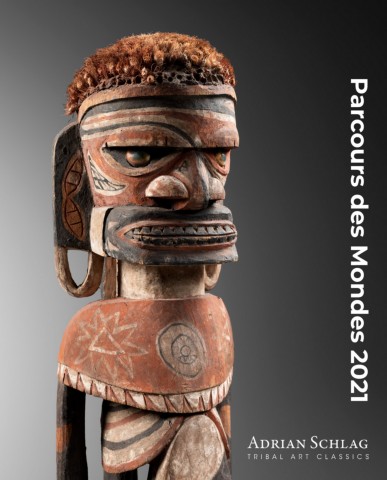
Parcours des Mondes 2021
Didagur mask Civilization Blackwater River, Kapriman People Papua New Guinea, East Sepik Province Basketry, cassowary feathers, white and red pigment Estimated period: end of 19th century Height: 55 cm Provenance Collection Schleipper, Brussels In Belgium since the 1920´s Didagur is a male or female spirit that inhabits the water or the hollows of trees, and it could be induced to inhabit this mask during the times it was being worn (Schmid 1985,p. 198, no.120) It is possible to tell which sex is represented in such masks by the length of the nose, that of a female being short and as here, that of a male being much longer. This mask form is believed to have originated among the Iatmul. Because there was much trade of objects and sharing of art styles along the Sepik River and its tributaries, the type came to be used not only by the people of the Blackwater River but by those of the Karawari River as well (Gathercole eta. 1979, p. 310, no 22.28) All such masks have wide gaping mouths through which the wearer could look, circular eyes, pronounced noses, small ears, and some form of extension at the top of the head. They are extraordinary examples of the basket weaver´s art, even in an area known for excellent work in this medium. (Wardwell, Allen, Island Ancestors, Oceanic Art from the Masco Collection, University of Washington Press in association with the Detroit Institute of Arts, 1994)
3 ADRIAN SCHLAG - TRIBAL ART CLASSICS
Figure Civilization Tolokiwa Eastern Sepik Province; Papua New Guinea Wood Estimated period: 19th century or before Height: 90 cm Provenance Michael Hamson, Palos Verdes Private collection, Milan John Friede, Rye This ancient figure was field collected by Michael Hamson on the remote island of Tolokiwa.
5 ADRIAN SCHLAG - TRIBAL ART CLASSICS
7 ADRIAN SCHLAG - TRIBAL ART CLASSICS
Standing male figure Civilization Sawos Eastern Sepik Province; Papua New Guinea Wood Estimated period: 19th century or before Height: 65 cm Provenance Wayne Heathcote London Dr. Andreas Lindner, Muenchen Germany Suspension hooks were made in all parts of the Middle Sepik river region. They were hung from the rafters of both cult houses and dwellings and were used to protect food and other possessions from the depredations of rats and other vermin. To prevent animals from climbing down, a large disk was attached to the fiber rope from which the hook was hung between it and the roof. Net bags were suspended from the prongs. As here, the shafts of the hooks are usually of human form, but representations of fish, reptiles, and birds were also made. There are many different kinds of hooks, and without specific collection information, it is difficult to know whether an example might have been utilitarian or may also have had religious significance. (Wardwell, page 16)
9 ADRIAN SCHLAG - TRIBAL ART CLASSICS
Standing male figure Civilization Biwat Papua New Guinea, East Sepik Province, Yuat River, Biwat People Wood, traces of red and white pigment Estimated period: end of 19th century Height: 61 cm Provenance Walter Randel, New York/Deauville Anne and Jacques Kerchache, Paris Wayne Heathcote, London Masco Corporation, Detroit Sothebys 17 May 2002, Arts of Africa, Oceania and the Americas Stefan Herzog, Muenchen Published Island Ancestors, Oceanic Art from the Masco Collection, 1994, The Detroit Institute of Arts Founders Society, page 50 Eloquent Silence, Herzog Stefan, number plate 67 The human figure sculptures from the Sepik River and its tributaries sometimes represent spirtits of the water or the forest, but usually depict legendary or recently deceased ancestors. Often the latter was individually named and recognized as such by the family or community group to which it belonged. Except in rare instances, the name of the figure and the stories that were told about the being it represents have not been preserved. Smaller figure , like this one, were kept in the house of their owner and could be seen by women and children. Although they were privately owned, they could also be used to benefit the entire community. (Wardwell, page 50)
11 ADRIAN SCHLAG - TRIBAL ART CLASSICS
13 ADRIAN SCHLAG - TRIBAL ART CLASSICS
Mask Civilization Ramu Mask attached to a flute, or a bag Papua New Guinea, Ramu area Wood, bark Estimated period: end of 19th century Height: 15 cm Provenance German private collection While miniature masks and figures were protective forces, embodying the ancestral spirits, they were utilized in ways different from the larger versions. Reflecting the personal, rather than the community, they were often attached to net bags and other personal objects or worn directly as beard or hair ornaments. This small mask would have been worn probably as a chest pectoral or it was attached to a bag. Eventually human hair was added and the mask was highly charged.
15 ADRIAN SCHLAG - TRIBAL ART CLASSICS
Mask Civilization Wosera/Abelam Papua New Guinea Wood, pigments Height: 14 cm Estimated period: end of 19th, beginning 20th century Provenance Michael Hamson, Palos Verdes John Friede, Rye Due to the lightness of the wood the Southern Abelam artists from the area known as the Wosera often fashioned very sensitive yam masks such as this. Often the volumes are full and the details of forehead, brow, eyes and nose are delicately carved. Looking at the reverse one sees both a good aged patina and numerous small holes where the mask was probably lashed to a woven or wood headdress when it adorned a long yam. (source: Michael Hamson, www.oceanicart.com)
17 ADRIAN SCHLAG - TRIBAL ART CLASSICS
19 ADRIAN SCHLAG - TRIBAL ART CLASSICS
Standing male figure Civilization Ramu Eastern Sepik Province, Papua New Guinea Wood, bark loincloth Estimated period: end of 19th century Height: 16 cm Provenance German private collection Small figural carvings were the personal charms of men and represented clan ancestors. Amongst their many functions, they were invoked for rites of initiation, to assure a good hunt and to ensure male potency. These figures are generally called kandimbong and often represent important ancestral beings. Figures of this size were mostly kept in domestic houses, they can depict clan ancestors, recent or mythical. It seems that the main purpose of kandimbong figures was to connect to their owners or, in the case of larger figures, their clan elders, with the ancestral spirits beings for which these figures where designated to be “canoe-bodies”. When the spirit was present at important ritual events, it could speak through an elder acting as the spirits´s medium. More often, the spirit appeared in the dreams of its owner to sing and speak. (Ramu Sepik Art, page 58)
21 ADRIAN SCHLAG - TRIBAL ART CLASSICS
23 ADRIAN SCHLAG - TRIBAL ART CLASSICS
Brag mask Civilization Ramu Eastern Sepik Province, Papua New Guinea Wood Estimated period: end of 19th century Height: 38,5 cm Provenance Ex Philip Goldman Gallery, UK E M. Sobczyk collection, USA Ex Bruce Frank gallery, New York To better appreciate the arts of te Sepik-Ramu delta it is important to understand the concept of canoe-bodies. The Murik see the human body as a canoe, gai´i in which a person´s soul journeys during their lifetime. Spirits use certain animals, birds and fish as their canoes in which to travel. Carved masks and figures also function as canoes, not just for brag spirits but also the ghost spirits of ancestors. Each mask represents a specific brag spirit. When taking the form of a mask worn by a performer, the brag can control or possess the wearer. Brag are male, and stories connected to each spirtit often have themes of sexual appetite and conquest. Masks with an elongated nose, considered by David Lipset to be phallocentric imagery, can be called brag sebug, relating tho the magical glamour, sexual desire, and aggressive nature of the brag spirit. (Conru, Ramu Sepik art, page 60)
25 ADRIAN SCHLAG - TRIBAL ART CLASSICS
Brag mask Civilization Guam Eastern Sepik Province, Papua New Guinea Wood Estimated period: end of 19th century Height: 48,5 cm Provenance Collection Philip Goldman, UK John Friede, New York The power of masks permeated the cultural fabric of the Sepik-Ramu delta people. Craig notes that brag spirits could divine a person´s illness. Food would be offered to a mask, after which the brag spirit would possess an elder clansman and speak through them to reveal the cause of the illness. Many brag spirits have volatile unpredictable personalities. They could inflict sickness and death through sorcery, becoming a damaging force to members of their own community, particularly if they had not been accorded the correct respect. Comparable masks Conru, page 275, plate 165/166
27 ADRIAN SCHLAG - TRIBAL ART CLASSICS
Mask Tatuana New Ireland Wood, vegetable fibre, pigment and shell (turbo petholatus opercula) Estimated period: end of 19th century Height: 42 cm Provenance Marie-Ange Ciolkowska (1898-1992), Paris The tatanua mask is worn by men in ceremonies to honour the dead. In 1907 Richard Parkinson published a description of a ceremony that he witnessed on a visit to New Ireland. The masked dancers performed, accompanied by drumming, wearing garlands of leaves and a leaf garment covering the lower body. Men prepared the masks and the performance away from women. The masks are preserved between performances, to be rented out by one of the few remaining skilled carvers. This extraordinary Tatanua mask distinguishes itself by its great age and usage. Wheras most of the masks where worn only once and then left in the forest, this object was obviously highly estimated by its owners who gards and repainted it for a long time to reuse it again and again.
29 ADRIAN SCHLAG - TRIBAL ART CLASSICS
Standing male figure Malangan New Ireland Wood, vegetable fibre, pigment and shell (turbo petholatus opercula) Estimated period: end of 19th century Height: 76 cm Provenance Colonial collection, Leipzig, Germany By heritage from the grandfather who acquired the object in Neu Mecklenburg This figure was made for malangan, a cycle of rituals of the people of the north coast of New Ireland, an island in Papua New Guinea. Malangan express many complex religious and philosophical ideas. They are principally concerned with honouring and dismissing the dead, but they also act as affirmation of the identity of clan groups, and negotiate the transmission of rights to land. Malangan sculptures were made to be used on a single occasion and then destroyed. They are symbolic of many important subjects, including identity, kinship, gender, death, and the spirit world. They often include representations of fish and birds of identifiable species, alluding both to specific myths and the animal’s natural characteristics.
31 ADRIAN SCHLAG - TRIBAL ART CLASSICS
33 ADRIAN SCHLAG - TRIBAL ART CLASSICS
35 ADRIAN SCHLAG - TRIBAL ART CLASSICS
Standing male figure Malangan New Ireland Wood Estimated period: end of 19th century, beginning 20th century Height: 122 cm Provenance Collection Kerbouc’h, Paris Han and Nina Simonis Private collection Munichired the object in Neu Mecklenburg Exceptional tall Malangan figure. The beautiful designed head with traces of red, white and black polichromy wears two feathers. The chest with a big kapkap the figure standing on one leg on a shell holding a flying fish with his two hands. The style, patina and the colour of the wood suggest that this Malangan is a particularily old sample.
37 ADRIAN SCHLAG - TRIBAL ART CLASSICS
39 ADRIAN SCHLAG - TRIBAL ART CLASSICS
War shield Civilization Kwoma (or April river) Eastern Sepik Province, Papua New Guinea Wood and pigments Estimated period: end of 19th century Height: 135 cm Provenance John Friede, Rye War shields were the ultimate emblem of power in New Guinea society. Often decorated with clan or ancestor emblems, they defended the warriors not only from actual harm, but from spiritual harm as well.
41 ADRIAN SCHLAG - TRIBAL ART CLASSICS
Drum Kuliangua village, Sepik plains Eastern Sepik Province, Papua New Guinea Wood and pigments Estimated period: end of 19th century Height: 78,5 cm Provenance German private collection Michael Hamson, Oceanic Arts, California Ex Jolika collection Rye, New York Published Masterpieces of New Guinea, Art from the Jolika Collection Illustrated page 325 A stone carved hourglass shaped “Kundu” drum. A large, genial face dominates the upper chimney. The drum was collected in Suandagum village but was war booty from Kuliangua village to the south. This kind of drum has no handle, just two lugs for attaching a strap. Locally it is called a “flute-playing kundu” because one hand is free and can hold a bamboo flute to the player´s mouth (personal communication from Michael Hamson obtained in Suandagum village). Page 136, New Guinea Art, Masterpieces of the Jolika collection, Fine Arts Museums of San Francisco in Association with 5 Contintents Editions, 2005
43 ADRIAN SCHLAG - TRIBAL ART CLASSICS
Standing figure The commanding and masterful interpretation of the male torso contributes to the exceptional mystery, force Civilization Turumarubi and beauty of this figure. Its shoulders and collarbone are Eastern Sepik Province, Papua New Guinea minimally indicated by a single linear inverted chevron, and Wood, shells, mother of pearl, pigments, plant the chest displays traditional body ornamentation incised fibre in low relief and painted. The carving of the wood is finely Estimated period: 19th century or earlier (C14 executed and the surface is pristine. Small circles are used dating by National Isotope Centre, GNS Science, to denote the nipples and the navel. The head is defined by New Zealand) a darkened forehead and a wide coiffure traditionally worn Height: 151 cm by adult men. While the mouth is an upturned crescent, the eyes are signified by concentric and elongated ovals with Origin red Abrus kernels. (Probably missing here).The slight tilt of Collected 1966 by Thomas Schultze-Westrum in the eyes renders the expression simultaneously fierce and the Kerewo village of Goare. The figure had a welcoming. This rare sculpture, commanding and dynamic name and was called “imunu”. in conception and its precise execution, is an outstanding example of Papua New Guinea art. Provenance Thomas Schultze-Westrum, Munich Otoia collection, Munich (collection name for the objects given to the Munich exhibition by Thomas Schultze-Westrum) John and Marcia Friede, Rye Antonio Casanovas, Madrid Dr. Andreas and Kathrin Lindner, Munich Published Published in the catalogue World cultures and Modern Art. The encounter of 19th and 20th Century European Art and Music with Asia, Africa, Oceania, Afro –and Indo-America (exhibition on the occasion of the games of the Twentieth Olympic Games;Munich 1972) Munich, Haus der Kunst, June 16-September 30, 1972) Exhibited This object was the official object of Papua New Guinea in the exhibition ”World cultures and Modern Art. The encounter of 19th and 20th Century European Art and Music with Asia, Africa, Oceania, Afro –and Indo-America” (exhibition on the occasion of the games of the 20th Olympic Games; Munich 1972)
45 ADRIAN SCHLAG - TRIBAL ART CLASSICS
47 ADRIAN SCHLAG - TRIBAL ART CLASSICS
Gope, spirit board Civilization Kinomere village Gulf of Papua, Urama Island, Papua New Guinea Wood, pigments, with five bullet holes Estimated period: end of 19th, beginning 20th century Height: 114,5 cm Provenance Collected by Thomas Schulze-Westrum in 1966 Published New Guinee Art, Masterpieces from the Jolika collection, 2005, Fine Arts Museum of San Francisco, No 464 This gope was displayed in a shrine with human skulls in recesses above and pig skulls below. It was located on the right as one entered the great men´s house (dubu weneh) in Kinomere village. It is shown in situ in two unpublished photographs by Frank Hurley. C. 1920s, though the bullet holes do not appear in these photographs. These boards were repositories of spirits, imunu, and were kept with many other similar boards in the men´s houses. They were part of shrines that were dedicated to a family´s wealth and well-being. The symbols refer to clan emblems and the owners were aware of the prestige they reflected within the community.
49 ADRIAN SCHLAG - TRIBAL ART CLASSICS
Search