INSIDE FRONT COVER
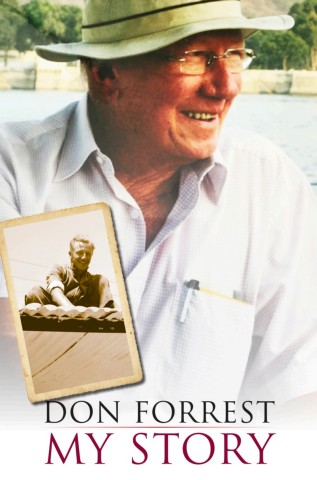
Don Forrest MY STORY
Text © Marie Forrest and Wilma Mann, 2019 Photographs © The Forrest family ISBN 123-4-5678901-2-3 My Story First published in 2019 ALL RIGHTS RESERVED No part of this publication may be reproduced, stored in a retrieval system or transmitted in any form or by any means—electronic, hard copy, recording or otherwise—without the prior written permission of the copyright owner, via: [email protected] First printed in Australia by Vanguard Press www.vanguardpress.com.au
DEDICATION A tribute to Don’s grandchildren Seven years ago, Don began writing his memoir with the assistance of Wilma Mann. The memoir was created from transcripts of many hours of voice recordings focused on Don’s life experiences. And, although it has taken much longer than anticipated, I’m delighted to be able to present Don’s life story, in his own words. Marie Forrest October 2019 3
Blank
Contents Prologue i The Fourth Child 1 The Reluctant Jackaroo 18 Not a Manager’s Bootlace 28 Managing Minderoo 43 Ownership of Minderoo 75 Changes 87 Coming Home 97 Epilogue 99
Blank
Prologue On 10 April 1996, dark skies lay low off the Pilbara coast. Distant thunder rumbled. Fluorescent lightning forked over a restless, swollen sea. The wind picked up. A big blow was imminent. When she came, Olivia, as the Met people named her, swept shamelessly across the Pilbara, ravaging Mardie, Barrow Island, and Onslow, leaving widespread devastation in her wake. Inland, her relentless deluge turned parched, arid country into vast red seas. At Minderoo, the Ashburton broke its banks, flooding paddocks for ten kilometres on either side. Trees were stripped bare, saplings and shrubs uprooted, roads and fences washed away, and clay pans turned into red mud baths—death traps for native fauna, sheep and cattle stuck fast as violent winds and torrential rain took their toll. The aftermath of Olivia left communities shocked and saddened but as resilient as ever. Despite the loss of ten lives and damages to property assessed at more than $2,000,000, very few Ashburton people thought seriously about leaving. Buildings and fences could be rebuilt, water would subside and trees would grow again. This was their home and had been for generations. These stalwart nor’westers lost no time in picking up their lives and making reparation in the wake Mother Nature’s wilful daughter. As it turned out, Olivia had been the most violent cyclone the Pilbara had experienced in more than half a century with i
winds gusting up to 285 kilometres per hour. Scientists made it known that the district was unlikely to see her ilk for another 500 years but for Don Forrest, owner of Minderoo Station, Olivia was the deciding factor in a heartbreaking dilemma. He was close to seventy years of age. He had worked on Minderoo for fifty years. He had lived through many a gut-wrenching drought and cleaned up after more cyclones than he cared to think about. Although Olivia had not caused serious damage to any of the buildings on his property, further south windmills and dams had been destroyed and many miles of fencing had been brought down. For Don, the cost of reparation caused by Olivia’s onslaught was the last straw. He had grown weary of the weight of an ever-increasing financial burden. In Olivia’s wake, Don and his adult children, David, Jane and Andrew, began protracted discussions focussed on keeping Minderoo in the family. But, after two long years, it seemed to Don there was only one way out. In June 1998, he called a halt to family negotiations and put his sheep station in the hands of auctioneers. Three months later, on the eve of the auction, Don wrote to each of his children acknowledging that the sale of Minderoo was a very bitter pill for them to swallow. He commiserated that losing the land both he and they knew and loved, the land they all felt part of, the land they identified with, was losing something intangible that lived inside each of them. Then he reminded them that for the last half-century financial returns throughout the pastoral industry had fluctuated between +/- 10%. Minderoo was no longer a viable enterprise. He was convinced the wool industry was dying and Minderoo was too big a burden to allow his sons to shoulder. He urged them not to dwell on the auction, but to look forward to a bright, unburdened future. ii
The Fourth Child Some people are born leaders. I am not one of them. I was born in the Forrest family home at 29 View Street, Cottesloe, on 4 May 1928. In those days, it was normal for babies to be born at home. My mother missed out on her annual escape to Minderoo because of my birth but she took me with her the following year. We were at Minderoo when the Great Depression fell. My father named the Cottesloe house Waralee after a clay pan on the station. It was a big homestead-style of house. He’d bought it a few years earlier, in 1925, after a particularly good return on the price of wool. Unfortunately, he had to sell it during the Depression. After the house had been sold, we stayed at a boarding housed called Brecon, on the corner of Richardson Avenue and Colin Street in West Perth during the summer months. My first memories are going to kindergarten across the road at St Mary’s when I was about three and a half. I was the only boy there and I didn’t like it much. I spent my fourth birthday at Minderoo. I had a nursemaid named Janie. I think she found me a bit of a handful because my older siblings were either at school or doing something else. I was always left behind because I was the youngest. Shirley was five years older than me, David was eight years older and Lizabee nine years older so I always seemed to be by myself. One of my favourite pastimes was collecting the eggs up in the chook yard. I didn’t collect them for very long because I 1
Don Forrest - My Story was seen dropping the eggs to see the splash. The native women were horrified and, although they laughed, they also reported me to my mother who soon put a stop to that. In the summer of 1935, when I was about six, we stayed at Keane’s Point, the future site of the Royal Freshwater Bay Yacht Club. It was a boarding house at the time and had a couple of flats on one side that we used to rent. Mrs Tout was the landlady. Her son John and I became good friends. John and I still go to Probus to this day. Other station families at the boarding house were the Gooches and the Craigs. We had some very happy days there. Only one unhappy time stands out in my memory, and it was my own fault really. I’d been given a Hornby speedboat that went quite fast in the water. I’d wind it up and set the rudder and away it would go out into the river, do a nice circle and come back. But along came the two Brinsden boys. They were a bit older. Later, one of them became a dentist practising in Chicago and the other one became a QC. They said, ‘Here, give us a go. We’ll show you how to work it.’ I said, ‘No, look, you’ve got to set the rudder right.’ ‘It’s okay, we’ll look after it,’ they said. Needless to say, they didn’t set the rudder properly and, as it was a windy morning, my motorboat went straight out to the middle of the river and out of sight. Gilbert, the elder one, said, ‘don’t worry I’ll hop in my canoe. I’ll soon get it’. So he went out in his canoe, but the water got rougher and rougher and, sure enough, he capsized. So there was Gilbert hanging on to his canoe, causing a hell of a stir because he was half a mile out over near the spit, and a launch had to be sent out for him. Gilbert and the canoe were rescued but my brand new Hornby speedboat was gone forever. I was seven when I started at Guildford Prep in 1936. I only stayed a year but it was the most miserable year of my life. 2
The Fourth Child The headmaster, Mr Todd, was cold and unfriendly and his henchwoman, Matron Hart, behaved as if she was a warden in a reform school. Her style was to publicly ridicule little boys if they offended her. Poor Andy Barr, aged six, had trouble keeping his shirt tail tucked into his trousers and she made him wear it out for a week with a big blue ribbon around his waist, and a placard saying, ‘I’m learning to keep my shirt tail in.’ Likewise, another little boy who forgot to change his dirty handkerchief was made to wear it around his neck for a week. Matron Hart was bad news. I ran away three times, but Cottesloe was a long way away and each time I went back. The first time, I got as far as the big school and a prefect asked what I was doing there. I told him I was going for a walk and he shook his head and said I’d better go back with him, so I did. The second time, I got as far as this side of Guildford before I got cold feet. The third time, I got to the start of the Great Eastern Highway and I thought, ‘Gee, it’s a long way to Cottesloe yet.’ So I turned around and went back. Another reason I hated Guildford was because a boy who came from Geraldton used to bully me. I was on a swing one day and he came along intending to tip me off, but I gave him the biggest kick in the shins. He never tried that again. The first term curriculum included swimming lessons in the river, and I couldn’t swim. Mr Woolgar was the sports master, a big man with a walrus moustache and popping-out eyes—a nice enough fellow, but I was wary of him. His method of instructing the boys was terrifying, involving a tyre attached to a fishing rod that supported the boy in the water. I could see the eight feet down to the bottom of the river through the deep green water and I refused to have a bar of it. I bawled and carried on so much that I was allowed to get out of the tyre and give it a miss. I didn’t learn to swim for another two years. 3
Don Forrest - My Story I was in the sickroom most of second term. Guildford is in a low-lying area and I wasn’t used to the dampness so I got whooping cough and respiratory problems. When I went back to Minderoo in August my parents decided to keep me at home for the third term. It was the best thing that could have happened. Lizabee, my elder sister, had recently left school so she became my tutor and I took certain advantage of that, like not doing homework, not learning poetry. I found tables boring. Despite these setbacks and frustrations, Lizabee survived, and she did teach me some worthwhile things. I like poetry now, but at that time there were too many chances for diversion. There were always much more interesting things going on outside. The station had a staff of about ten. Firstly there was Joe Joseph, the Malay cook who came to work at the station in 1938 and stayed until 1950. He was five foot nothing and he had teeth just on one side of his mouth, on his upper jaw. He had only one eye. Joe managed the Aboriginal staff with much pidgin talk and hilarity. Sometimes before dinner I’d go down to the kitchen, which was a rough old, unlined corrugated iron building with bush timber posts and a big black Metters stove at one end where a large cistern always boiled, and there would be Joe at the middle table under the light with a soup pot, picking out the blowflies before sending up the soup for the homestead table. It was a very common occurrence. The house girls, Jessie, Lyn and Annie, clad in white starched jinna jinnas, would carry the meals up to the homestead dining room. The meals consisted of mutton—roasted, stewed, curried or minced with veggies and potatoes that were either roasted or boiled, and gravy—along with the odd fly that had escaped early detection. Pudding would be stewed fruit and custard, or custard and jelly, or rice pudding. ‘All velly good’ Joe would say. After serving the family, Joe would feed the 4
The Fourth Child girls and they would do the washing up for the kitchen, and from our table, in the scullery. Adjoining the kitchen was Joe’s little room. Behind that was the meat house, where the sheep carcasses were brought down each afternoon from the killing pen situated over the sand hill. A sheep a day was the norm. The yardman would cut the sheep down, and the following morning Joe would set to and cut it up into legs, chops, brisket, neck, and shanks et cetera. Old B.P. Hack always called his chops three-six-fives and his smoko buns seven-thirties because we had chops every day of the year and smoko buns twice a day, every day of the year! Near the meat house was a bucket of meat scraps and veggie stalks that would be boiled up twice a week for the chooks and turkeys, my mother’s hobby. The old man had built her a large poultry yard adjoining an equally large turkey yard, both enclosed with mesh. The yardman would fill large feeding trays and water troughs. His other jobs included killing, gardening, watering, wood chopping, and milking. The yardman was usually one of the older blackfellas whose woman would be sitting down on the lawn, sweeping up the leaves. She’d be sitting on the lawn in one place with a bush broom and she’d sweep up all round her then she’d move across and sit down in another place and sweep up the leaves in another circle. Once a week this old girl and some others would help Missy with the laundry in the morning, and in the afternoon they’d do some ironing. They were fun-loving and happy people to have around. Annie was given the job of looking after me during the day. In the afternoons we’d go out walking. ‘Got to watch out for that Jersey bull,’ she’d say. One time that same Jersey bull waylaid our neighbour, Mrs De Pledge and her daughter, Pat, near the homestead when they were driving in to say hello. 5
Don Forrest - My Story When they were two hours overdue the overseer was sent out to search for them. He discovered them up a tree near the shearing shed with the Jersey bull snorting below. Needless to say the bull became no more, to the great relief of all. The following year, I became a boarder at Hale School. My experiences at Hale were considerably better than Guildford, although I still suffered homesickness. At Hale everyone had a nickname. My brother David’s had been ‘Pans’ and my two Loton cousins were ‘Red’ and ‘Pinky’. Brian got his name from being a red rider and his little brother became Pinky through association. My nickname, devised by Trevor Roelands, the sports masters, and based on my initials DK, was ‘Doorknob’. My unofficial one of ‘Dumbbell’, used by my peers, was no better. It had been my cousin, D. B. Forrest’s nickname until he left school. I disliked it every bit as much as ‘Doorknob’. I was not an extrovert by any means and not an avid team player, although I did enjoy being part of the rowing team and I did achieve some success as a rower. Many of the friends I made at Hale are still good friends particularly Peter Atkins, or ‘Attie’, who eventually became my best man. Attie reminded me recently that I always wore a greatcoat over my jacket no matter what time of year and that reminded me of how cold schooldays were. I could never get warm. Peter’s father was Leo, nicknamed ‘King’ Atkins, and his company had been responsible for constructing the first concrete jetty in the State at Onslow. Auntie Vi was my father’s older sister who lived with Granny Forrest at Minderoo Claremont. She was a plain woman and had pretty awful teeth, so whenever she laughed, she kept her mouth closed. She had a fairly red face like a number of 6
The Fourth Child my Forrest ancestors, and pale ash blonde hair. She used to look after me as if I’d been her own son. Throughout my early schooldays Auntie Vi was the linchpin, not only for me, but, for all my country cousins who boarded at schools in the city. We were always welcome at Minderoo Claremont on Sundays, and to stay over on the three free weekends we had each term. On those weekends we’d be allowed to catch a train from Guildford, or a bus from Hale, and she would always drive us back to our schools, come hell or high water. I can recall more than one occasion when it was raining cats and dogs and she drove up Guildford Road peering through the misted-up windscreen, with no thought of the inconvenience we’d caused her. She drove a 1930 Chrysler, a beautiful old square-shaped car with velvet lining. The tennis court at the old Claremont house was overgrown and had pomegranate trees growing on it. There was an old hothouse with almond trees outside. The tennis court posts were still there. At the back there was an enormous old wooden tank stand with vines and a thick Bougainvillea. A flock of forty or more white pigeons used to breed there. Just alongside that there was a windmill and a well and over on one side grape vines grew in a long line. When I was at Hale, I discovered you could make a telephone out of two matchboxes with a piece of cotton in between, and you could speak over fifty yards. We used to string it out across this grapevine line. I remember there was a cocky hanging up near the veranda. It was supposed to be ninety years old and very partial to little boys’ fingers. The building was a rambling single-storey house, fairly unprepossessing set in a big garden. It had enormous great Moreton Bay fig trees out the front, and a driveway in and a driveway out. The front fence was made of old type criss-cross 7
Don Forrest - My Story panels. The gates had ‘Minderoo’ written on them in polished brass letters and right over on one side was a coach house, where the nameplates of my grandfather’s two horses, Brutus and Cassius, were fixed. There were also a couple of other rooms where the coach man used to live but at the time I was there were used as storage places for all the papers and diaries and everything else that came down from Minderoo. Later, they all vanished. I believe that, after Auntie Vi died, there was a fire and all the records were destroyed. Auntie Vi was a spinster for most of her life. She was dedicated to looking after her parents. Old David Forrest had died in 1917, but Granny Forrest lived a long life and died in 1942, when she was well into her eighties. After a respectable time, Vi married Canon McLemans. Old Bill McLemans had been a widower for many years. He was the founder of Christchurch Grammar School. My father used to say that, just after that, he left his family in Perth and cleared out to Southern Cross and never came back for many years, but I’m not sure that he didn’t go to war as a chaplain for at least some of those years. Auntie Vi loved old Bill McLemans so it was right that she should enjoy the last four years of her life in his company. She died in 1946, when I was a jackaroo at Minderoo. I never went to her funeral, but I hope she knew how much she was appreciated and loved. My school days in Perth would have been much duller without her. I went to Auntie Vi’s home until about 1943. By then I was an adolescent and was encouraged to go to the Sanderson’s home instead, where I could mix with other boys my own age. Lachy Sanderson, and his wife, Moppy, station people themselves, welcomed boarders to their home. Lachy and my father were lifelong friends. They’d been friends for as long as they could remember and used to swim down at Freshwater Bay, 8
The Fourth Child down the end of the street where there was one old building and a little jetty. They became good swimmers—as did Don, the uncle I never knew, who died on his way to Gallipoli in 1915. Don became a champion swimmer at Geelong Grammar in 1911. I’ve still got all his medals that have been passed down to me. Dick and John Vincent lived next door to the Sandersons. Jeff and Doug Craig from Merrigoolia Station, Ron Saw, and I enjoyed each other’s company—and we liked being looked after by Mrs Sanderson. She would make the beds for us and she’d go to the trouble of making cakes, often a double layer cake with cream. If we particularly liked something, she would make the same thing the following week. She spoilt us sick. Like most adults in those days, she used to enjoy the occasional drink and smoking cigarettes. There was always a cigarette hanging out of her mouth, and she was always laughing. She used to like talking and we enjoyed her relaxed, friendly ways. She and Mr Sanderson had two daughters, Peg and Debbie, and Mrs Sanderson made sure that her guests and her daughters were just good companions. Her elderly mother also lived with the family. Most of the time the old lady stayed in her room alongside the kitchen, but occasionally she would come out and say good day. Mop would laugh and take her back into her room. I count myself fortunate to have had Mop Sanderson in my life during my secondary school years as a boarder. I had a crush on Debbie Sanderson that developed into an infatuation over a long time, but was destined to fail because she had no interest in me except as a friend. She was besotted with John Vincent. Then Debbie became interested in Brian Vivian for a while, until she met Tim Bennison, who would become her husband. During my senior school years, I took Judy Manford to a school dance or two. One night we had been to Bernie’s after 9
Don Forrest - My Story the school dance and we missed the last train home. We had to walk around to the Perth train station from Bernie’s, the fish and chip place at the bottom of Jacob’s Ladder, and we missed the midnight train. I didn’t have enough money for a taxi and nor did Judy, so she rang her mother. By this time it was 2 a.m. and her mother had to get out of bed and get dressed and drive to Perth to pick us up. I can tell you, we weren’t too popular. Lizabee, my sister was much older than me so we never had a lot to do with one another. She’d been to Perth College and had completed her leaving the year before she tutored me at Minderoo. She was not good at maths but she was fond of the Arts. She liked artists and writers, and was particularly keen on languages. She became a kindergarten teacher because she was very fond of kids. Funnily enough, I hadn’t put her off. She taught at various places, including East Perth. I was at home with my parents at 3 Hamersley Street in Cottesloe, the day Lizabee brought a little girl from the East Perth School to our house. To my mother’s horror the girl’s hair was covered in lice. I was sent to the chemist to buy a lice comb then she and Lizabee gave this girl a good bath and washed her hair over and over then ran the lice comb through it. Lizabee used to tell us stories of how she would go to some of these homes, how she’d be asked in for a cup of tea and discover that some of the habits of the mothers were a bit different from hers. On one visit, the mother looked for a teaspoon to stir Lizabee’s tea, found one, licked it and put it in her own tea and stirred it, then passed it to Lizabee saying, ‘Here you are dear’. As far as I’m aware she kept teaching until she and Sam got married. My relationship with Shirley was totally different because she was more my age. She could be really bossy, but I could 10
The Fourth Child tease her—and I did, more often than not, until I made her cry then she’d say how she hated me. I think hate was about the worst word she could say. Shirley loved animals. She loved cats, dogs and horses. She was quite a good rider, more so than Lizabee. They both used to help with the mustering on the station, but never out on the run. They’d never camp out of course because our old man didn’t believe in girls camping out. They were never exposed to the seamier side of life so they were not allowed down at the sheep yards until they were mature adults. The yards were out of bounds because the old man didn’t want them to see sheep being castrated, or lambs being tailed. They were also sheltered from any bad language. If there were any women around, the men would no more swear than fly over the moon, likewise the shearers. The call in the shearing shed, if a woman was approaching was ‘ducks on the pond’. Shirley had a grey horse called Peggy. She dearly loved Peggy. She loved to bring her school friends up from Perth College during the winter break and take them out on the horses. She also loved writing and eventually studied and became a journalist. She took the name Kay from our grandfather, Edward Kay Courthope. When she joined the army in 1943, she became a driver. I believe she was disappointed that her job seemed to be simply driving officers from one pub to another, but I think during her training she met up with a lot of tougher girls and found it hard to adjust. One girl, who was particularly menacing and callous towards Shirley, was also called Shirley. After twelve months, my sister was manpowered to work at Minderoo. From then on she called herself Kay Forrest. The only people allowed to call her Shirley were her best friends and her family. She worked at Minderoo for about a year with Lizabee, who had been working on the station since Sam had 11
Don Forrest - My Story gone to the war, because there was need of station hands since most of the men had joined up. It was an interesting time to be at Minderoo when an air defence system was being planned. The Americans were inspecting airstrips in the district because the Japanese were getting closer, and I managed to play a part in helping them make their selections, or so I liked to think. It was 1942. Sergeant Holt was the mechanic. Captain Raven was the surveyor and Lieutenant Barney B was the pilot. The team was based at Minderoo while they surveyed possible sites for aerodromes. I was about fourteen and on school holidays when the Captain asked my father if I could go with them. He agreed, so I was allowed to go out with these fellows as they surveyed the area. One of our station vehicles had been commandeered as a support vehicle to carry the swags and supplies for the four and a half days. It was a big deal for me. When we got back the Captain, who had the use of my father’s office, began writing in an enormous chequebook with ‘United States of America’ stamped across the top. I was amazed when he handed me a cheque and I tried to hand it back. The Captain pushed his chair back and told me that no one works for Uncle Sam for nothing! He had paid me £4.10/-, an enormous amount of money in those days when my old man was only getting £5 a week. At dinner that night I flashed my cheque in front of everybody. My father was astonished and said that I’d got more money than he had, but he didn’t insist I hand it back. I’d never felt so rich. The Captain selected the site for an aerodrome about forty miles upriver because it had good drainage, a natural gravel surface, and was flat. The site was duly pegged out but when our Air Force came along a few months later, they shook 12
The Fourth Child their heads. They said it was no good because it would be found too easily being so close to the river. The RAAF selected a more discreet site on Yanrey in the most God forsaken place nicknamed Death Valley. Mrs De Pledge didn’t like it being called Death Valley and complained bitterly so the RAAF renamed it to ‘The Valley’. Fuel to service the aircraft was carted from Onslow to Yanrey across the Minderoo Bridge. Our windmill man stopped for a yarn and these blokes and the Air Force boys would offer him as much fuel as he wanted for a quid a drum, but he knew better than to accept. The old man would never have bought fuel on the black market. Once the aerodrome at The Valley was underway, another at Learmonth, then called Potshot, was surveyed and built. And later, as part of their exercise sorties pilots would fly over the Minderoo homestead to check out the two girls that lived there. When Shirley and Lizabee heard a plane fly over, they’d race down to the stables, get on the roof to wave to the pilots about fifty feet overhead, and break the boredom for both the girls and pilots. Later, when the American pilots began to land at The Valley they began to socialise with the De Pledges and the Forrest girls. It was during one of these R and R trips that Shirley met a submarine commander called Ben Jarvis and fell in love. But as is the nature of wartime romances, Ben returned to America after the war and Shirley carried on with her life by enrolling in a course to study journalism. Shirley had always been interested in writing. She used to write poetry and had several scrapbooks of her own poems. Our mother had always been an ardent letter writer, and Shirley did quite a lot of letter writing too. She used to write in a distinct fine, spindly hand. I don’t know what triggered her interest in 13
Don Forrest - My Story journalism but she wrote articles for The Broadcaster, which was the weekly radio paper, and she wrote pieces for the Western Mail as well as articles for the Mail about station life. She managed to make a living out of journalism while she boarded in Ord Street, where she mixed with a lot of young people returning from the war and became one of the carefree flappers of the time. Eventually, Shirley met and married John Hands. John had been one of the prisoners of war forced to work on the Burma railway. He had returned to Perth and a career in banking. He and Shirley set up home on a farm at Boyup Brook where they raised three sons. About the mid-1960s she began researching material for a book on the history of the northwest of Western Australia. Twenty or so years later she finished the book and had it published. During the whole time she was beavering away she never mentioned her work to anyone. I don’t think any of the family realised how interested she was in the history of the northwest, but the whole family is very proud of the fact that she wrote her book. I’m sorry that she never cared about promoting it. Shirley’s only aim was to write a book about the northwest, and that is what she did. She produced a history based on information that had never been written up before. It’s possibly more of a research book, and has been cited, over the years by Western Australian historians. Her good friend, David Gregson, designed the cover that she loved. Dad must have made a few bob from the sale of Waralee because he bought a block just in front of St Hilda’s School that ran from one street to another facing along Bayview Terrace. It comprised three house blocks. He sold them before World War II, for £9,000 and made a reasonable profit. Today they’d be worth $9 million each. After Waralee was sold we became renters for the summer months when we lived away from the station. 14
The Fourth Child The first place we rented was near St Mary’s Church in West Perth, and not far from Pinehurst, where Nana Courthope lived. St Mary’s Church is where we all used to go on Sundays, with threepence to put in the plate, and woe betide anyone who kept that threepence. St Mary’s was where all the boarders from Hale School used to go, and is where my brother’s commemorative window is installed. It is also where my first wife Judy and I were married in 1956, and where my mother and her family went to church service every Sunday throughout their lives. Nana Courthope lived at 20 Colin Street, West Perth. The house was always a hive of activity, full of my aunts and uncles and cousins coming and going. Nana Courthope thrived on the company of her ‘wee chicks’. She carried her head at an odd angle because she had a stiff neck that was always bent to one side. I suppose it was something that could be easily cured these days, but not then. She had been a widow for a long time. My grandfather Edward Kay Courthope had died in 1899. He had been a businessman and owned Central Arcade in the later part of the 19th century. He had owned a very nice two-storey house, also called Pinehurst, on the corner of Colin Street and Hay Street where the big chemist shop is now. After he died, my grandmother came into more straitened circumstances and moved to the house in Colin Street. Nana Courthope’s three sisters, my great aunts—‘the Aunts’—lived in a little house on the corner of Hamersley Street in Subiaco. Their brothers, Uncle Willie and Uncle Jim, lived there too. Every Thursday my mother would take them a little box of cakes and a bottle of wine—always a bottle of wine. Sherry or Port, or something like that. For as long as I can remember my mother’s seasonal journey south from Minderoo was by ship from Onslow, 15
Don Forrest - My Story because she suffered severe car sickness, aggravated by the rough roads. The roads between Minderoo and Perth were only two-wheel-drive dirt tracks. Travellers would take the inland track because it was a bit firmer and a bit better going. There were also more stations on that road where travellers could break their journey. In the 1920s, they’d take at least five days to drive down, and in the 1930s they’d take about four days. By the 1940s, they could do it in three. Today of course, it’s about one day, mainly due to road improvements. Cars have also improved, but even in my early days cars weren’t too bad. One time my brother did over one hundred miles an hour while the old man was sleeping in the back. Just north of Moora there was a long, straight stretch down the railway line and Shirley, and I egged Dave on to put his foot on the gas while the old man slept. We had a Buick Tourer at the time. It had a fold-down roof, but I never saw it folded down. We always had the canvas cover over, but it was open on the sides. The Buick was a self-starter, but you could crank most cars with a handle until about 1965, which was very handy for travellers to and from the northwest. It was a great car and was very reliable. My father was a stern figure. He treated his men respectfully but when he barked out orders each morning on what to do, by gee they’d do it. He would see them quite often one by one, and then he’d talk to the overseer for a quarter of an hour or more on the edge of the verandah. If I tried to interrupt, he’d tell me to be quiet. No matter how badly any of us wanted to talk to him, we had to wait until he was ready, then annoyed at the interruption to his time, he’d ask what we wanted. I’ve never been like that. If ever I was discussing things with my overseer and one of my kids came up, I’d excuse myself, remind them that they shouldn’t interrupt, and be much kinder in the way I’d ask then to wait until I’d finished my conversation. 16
The Fourth Child My father’s behaviour was nothing less than dictatorial while we were growing up. He dictated every facet of our lives and we obeyed without question. Lizabee was the golden child who could do no wrong. She was the light of his life, and she seemed to be the peacemaker. Yet, despite my tainted childhood memories, my cousin Julia has fond memories of her Uncle Mervyn during visits to Minderoo when she was growing up. She remembers him telling great stories and jokes around the dining table and everyone laughing and joining in. Outside the family home, my father was the life and soul of the party. When I was an adult, his friends used to tell me what a wonderful fellow he was, how good he was at telling the greatest stories. They thought he was a marvellous fellow who could entertain them for hours. I’d always considered myself as the child who had no rights. I thought that because of the way my old man ignored me. He had no time for me. He never talked to me, never asked my opinion, and never invited any sort of relationship. 17
The Reluctant Jackaroo When I was thirteen or fourteen, I spent some time at home being nursed by my mother. I had a spot on one of my lungs, which didn’t mean anything to me, but apparently, it was the first sign of tuberculosis, so I was being ‘pampered’. My brother was just going off to war, and for the first time in my life, I began to think about my future. I didn’t know what I was going to do after school, because you don’t think about those sorts of things when you’re young. Perhaps because David was going off to war I’d begun to think I needed some idea of the direction my life might take. It seemed to me that there were no such doubts about David’s future, but I was wrong. One day, I said to him that, as he was going to go on the station when he got back from the war, had he any idea what walk of life I could follow? He said, ‘What makes you think I’m going on the station, Duck? Oh no, I’ve no intentions of doing that. After my experiences at Mootoroo, I knew I wasn’t cut out for station work.’ He said that he’d been studying Chemistry and Physics in his spare time in the Air Force, and, as he already had Latin and Greek, he was planning to be a doctor when the war was over. ‘You’re going to be the one to go on the station,’ he said. I didn’t know what to think. I had never considered that idea, but that’s what happened—except that David didn’t become a doctor because he didn’t return from the war. He was killed in May 1943. The 18
The Reluctant Jackaroo Beaufort aircraft he had been piloting went down over the sea off the coast of New Britain while night flying, with the loss of all men on board. Our family was devastated. And it was quite some time before I realised I was going to be going on the station regardless. I think being back at boarding school and focusing on achieving decent grades for my leaving certificate helped me to come to terms with my brother’s death, but my mother never really got over it. She became more reserved, less inclined to socialise. Consumed by grief, she sought solace in her religion. Always a regular churchgoer, she became even more so. Outwardly, my father appeared to be coping, as most men do, but inwardly he, too, was in an emotional turmoil. Lizabee found consolation in consoling our mother, and together they got through the painful days, weeks, and months immediately following the tragedy. Lizabee was luckier than Shirley because she was engaged to Sam Salmon and had a future to look forward to. Shirley was different. She and David had been very close. She was bereft, and found it difficult to imagine a world without him. She was inconsolable. She kept him alive in her heart by writing letters to him, just as she had always done, except she couldn’t post them. She was fragile for quite some time. Deciding to take up her career in journalism was the best thing she could have done. I got my School Leaving Certificate two years later, and although my marks were good enough for me to apply for a place at university, my old man poured cold water on the idea. He said, ‘You’re going to go on the station of course. Look, you’ll learn everything you need to learn by being a jackaroo. I want you to spend a year at Minderoo as a jackaroo and learn the ropes. After that, I’ll arrange for you to go to Bill Leslie for a couple of years up at Karratha Station. He’s a 19
Don Forrest - My Story great friend of mine and he’ll look after you. Then I’ll arrange Lachy Sanderson (manager of Elders) to get you over to South Australia for a couple of years. By the time you’ve done five years jackarooing, you ought to be good enough to come back to Minderoo as an overseer, and the following year, you’ll be twenty-three and you can take over the place’. I said that I would still be too young for that. ‘Look here,’ he said, ‘I took over the place when I was twenty-three. If you can’t manage the place at twenty-three you’ll never be able to manage it.’ So that was that. I followed his plan to a T. I started work as a jackaroo on Minderoo in April 1946, and I left for Karratha Station in May the following year. Those thirteen months were a steep learning curve for me. I learned to follow my boss’s instructions without question. I learned the importance of looking after horses, motorbikes and vehicles, the importance of mill maintenance and the importance of doing my best in all situations. And although I never felt Sam, my boss, was happy with my efforts, I must have worked pretty well because my pay had gone up from 30/- to 50/- a week by the time I left. In the latter half of 1945, when he had returned from the War, Sam Salmon became overseer at Minderoo. He was my boss and my brother-in-law. Before the War, Sam had been working sheep for his uncle Gordon Craig of Maroonah Station, when he had been sent over to Minderoo to look after 1,400 sheep on agistment. Maroonah was having a very bad time with the drought, and Sam was camped on Minderoo for at least twelve months. My mother thought he was a very nice young man and encouraged him to come to Minderoo for tennis, which is how he got to know my sister Lizabee. The telephone line ran close 20
The Reluctant Jackaroo to Sam’s camp at Peepingee pool thirty miles away from the homestead so he used to hook up a portable handset and they’d have long conversations on the party line. He had an Aboriginal stockman with him, an old vehicle, a couple of horses that they rode to shepherd the sheep, and an old bush shed to camp in. He went regularly to the homestead for tennis, and a romance with Lizabee blossomed. They became engaged just after Sam joined the army. He was in the Second 28th Battalion based at Northam, where we were able to visit him, until he was sent overseas. He was captured near Tobruk and became a prisoner of war in Italy. He escaped his imprisonment but was caught and sent to Germany, where he spent the rest of the war as a prisoner of war working in the coalmines. During this period Sam had an altercation with one of his guards. He hit the guard and was beaten severely by the other guards. He was lucky to survive. At the end of the war, he came back to Perth and married my sister. He was one of the lucky ones because he also had a job, thanks to my father. A few months later, I became his jackaroo. I found Sam to be a hard taskmaster, but fair-minded. He and B.P. Hack had a wealth of experience between them. Bedford Percy Hack had been the bookkeeper at Nanutarra when the Highams owned it. He left when the Barrett-Lennards took over. B.P. was older than my father, but he was a real character. He was always first up and liked to drink his cup of tea out of the saucer while sitting on the verandah giving the girls a bit of a hard time. He had a great rapport with them. He eventually retired and returned to his wife in 1949. Bob Straughair, my father’s right-hand man, was another experienced worker I’d known all my life and liked and respected. Joe Joseph, the Malayan cook was another character who had been part of my childhood. Bedford Delaporte was yet 21
Don Forrest - My Story another older, highly skilled, experienced station man. He had been overseer at Minderoo since 1943 and continued in that role helping Sam’s transition. Before that he’d worked for Len and Walter Smith at Rocklea for five years, and before that he had been manager of Hamersley Station for seven years. Del was an experienced mechanic and knew all about wells and windmills. He was a valuable horseman. He could shoe horses, break them in, and sit any buck jumper. He was an excellent blacksmith and could make anything out of red-hot steel. He used to make his own hobble chains, repair saddles and plait leather very fast churning out belts and plaited bridles and all sorts of things with great expertise. And he took time to talk to Shirley and me and teach us anything we showed an interest in. A month after Delaporte had come to Minderoo, an Aboriginal man named Captain and his extended family arrived. They had come down from Rocklea in a horse and cart driven by Captain. His wife Annie was younger than him and they had three or four kids. They camped over the hill from the homestead. My father did a lot of travelling up and down in 1946 because he was standing for election as Member for the North Province. A few weeks after my arrival at Minderoo I drove him to Karratha Station, where I waited while he went on to Roebourne to fly to Broome to promote his campaign. Bill Leslie took the trouble to show me around a bit because I was going to be working for him the following year. I also met the overseer, Mervyn Stove, and was impressed by his mechanical skills. I left for Roebourne at 4 p.m. and passed Milton Stove coming from Sherlock Station on the road to Whim Creek. Milton forewarned me about the difficulty I might find in crossing Peewah Creek fourteen miles ahead, and when I came 22
The Reluctant Jackaroo to it, the Chev sank into the deep sandy track and I was stuck. I worked on getting out for three hours then gave up. It was dark by then and the fire I’d lit so I could see to dig out the sand didn’t help. Next morning, after three more hours, I’d almost given up hope when, finally, in reverse gear the Chev crawled over the bits of old iron sheets I’d managed to get under its wheels. Ten minutes later, Rob Lucas from Munda met up with me. I was red-faced but glad he hadn’t actually caught me stuck in the sand. He gave me a note to give to his wife that I copied into my diary. It read: Floss, have talked with Don and I suggest you talk to his father and let them talk over their arrangements. Give him a cup of tea and a feed as he has had a pretty rough go at Peewah Creek. Rob I had morning tea at Munda then drove on to Boodarie and Hedland. Dad and I ate chocolate and biscuits for lunch while we were driving. Milton wasn’t at Sherlock when we arrived so we had tinned camp pie for tea. When we finally got home at ten o’clock, we were starving and very tired. Polling day in 1946 was Saturday, 4 May—my eighteenth birthday. I sent a wire to Red Loton at Hale School wishing him all the best for the “Head of the River” race that was on the same day. The year before I’d been part of the winning rowing crew for Hale and would have loved to see them win that year but it was not possible. Later, I heard they were third, Scotch second, and Aquinas first. Sam and I spent the day ferrying people to the polls, and it proved to have been worth it when the old man won by a large margin. He was then “The Honourable R.M. Forrest”! 23
Don Forrest - My Story In 1943, my father had Delaporte installed in a cottage on one side of the homestead. Shirley and I used to go over and see him on Sunday mornings to pass the time of day and knock around, and we’d always be welcome. His attitude to us was so different from our father. I can’t remember a time when he said he was too busy to spend time with us. One day we noticed a case of apples under his bed and we said, ‘Apples?’ He changed all of a sudden, and said, ‘Don’t touch those, they’re out of bounds.’ Of course we would no more touch them than fly, but a year or so later it dawned on me that he kept those apples for the native girl Annie, his mistress. No wonder the apples hadn’t been for us. No one had any idea about this liaison. No matter how much we needed a good overseer, and Delaporte more than fitted the bill, if the old man had known, Delaporte would have been on the road. Peter Joy was another good station man. He had come to Minderoo on the recommendation of Lachy Sanderson. He had come out from England about 1928 and worked around the state before getting a job at Minderoo. My father soon recognised his ability and promoted him to overseer at Wyloo, about a hundred miles upriver. The land at Wyloo was totally different from Minderoo—very stony country where hills and plains were bisected by rivers. It was lighter country, quite good, but it needed totally different management from Minderoo. Peter Joy did a good job managing the place by erecting new sheds, renewing fences, and increasing sheep numbers and the wool clip. In time, he inherited money from a relative in England and was able to buy Kooline Station. His good fortune meant that Wyloo was left without a manager during wartime when station men were hard to get. My father decided to send the experienced and reliable Delaporte up there in July. Del had been working hard mustering just before he went 24
The Reluctant Jackaroo to Wyloo, and my father had noticed that he was not as well as he had been. We saw him in August when we were at Wyloo, and it was obvious that he was pretty crook but he didn’t complain and joined in the talk over dinner as normal. Del had always been a heavy smoker and always had a shocking cough so it never crossed our minds that he was quite so sick. A month later he had become so ill that he’d got himself into the car and had driven himself all the way into Onslow. At Onslow he sent a telegram to my father in Perth saying, ‘Am rather ill going Onslow today consult doctor will wire you tomorrow Delaporte.’ He had called in to Minderoo the same day he sent the telegram but neither Sam nor I saw him. We were out on the mill runs. He spent a little over a week in the Onslow hospital before the doctor decided to fly him by the Royal Flying Doctor Service to Perth where he died a day later from cancer of the throat. Everyone on the station was in shock. After Del died, Len Smith from Rocklea Station agreed to oversee Wyloo for a few days then, out of the blue, I was sent up there to look after the 750,000-acre station. Len showed me around and departed for Rocklea leaving me to manage the staff. I was the only white man on the place and felt seriously unprepared, having so little experience. I knew Topsy the cook quite well and she told me not to worry, assuring me that ‘we blackfellas’ll look after you.’ The headman was named Toby. His offsider was Jumbo. I was the boss-man and one of my jobs was to look after the store. I opened on a Sunday morning when local families connected with the station showed up for their rations that I dished out on their advice—amidst much laughter. Chookie, the dingo catcher, was Topsy’s man and worked away from the homestead for two weeks at a time trapping and poisoning the pests. After I issued his fortnightly stores, he asked for six 25
Don Forrest - My Story sets of horseshoes. Being so wet behind the ears and careful of wasting stores, I challenged him asking why he needed twenty- four horseshoes. He said he had three horses—one to ride and two pack horses—and he had to have three spare sets because it was very hard, rocky country up there, not soft country like Minderoo. And he needed a pack of nails too. I wasn’t sure if he was having me on, but I supplied him with the shoes and nails anyway. During those first weeks Toby and Jumbo took me on various millruns, then one day Toby warned me that they planned to take me a long way away, about a hundred miles towards Rocklea, to some of the outlying mills, so we would need an early start. Next morning we set off in the ‘Yellow Peril’, an old ex-Army Chev ute that had been painted yellow. About sixty miles up the run, not far from a mill called Carlathunda, we broke an axle. ‘Looks like we gotta walk, Donnie’ says Toby. I decided that as we were closer to Rocklea, we should head off in that direction, so we took the waterbag, the tucker made up of bread and a leg of mutton, and started walking. That night we camped in the soft sand in a creek bed and lit a fire for warmth. Next morning, we set off again arriving pretty foot-sore at Rocklea homestead about ten o’clock. Len and his brother, Walter, were surprised to see us, and we were quite a curiosity for their house-girls! Len drove us back to Wyloo the following morning and for quite a time our little escapade was the source of merriment around the Aboriginal campfire. By winter I had returned to Minderoo. I was glad to be back. I had been very isolated at Wyloo, so I was looking forward to the company of the four young men who had arrived in a Civil Aviation truck to work on the aerodrome but, as it turned out, I hardly saw them. Everyone was so busy that there was no time for social interaction. Mustering had gone 26
The Reluctant Jackaroo to plan, but shearing did not. We lost a full week’s shearing due to shearers refusing to shear ‘wet’ sheep. Cecil Deykin was mortified when his shearers claimed they couldn’t shear sheep that were sweating and making the wool ‘too moist’ for their handpieces. Sam was irate. It had been a particularly long, cold, wet winter that year and had a long-lasting, bad effect on the health of our Aboriginal workers. Between October and December, a number of them became sick. We didn’t know what had caused the sickness, or what it was, but it was a constant concern and meant repeated treks between the station and Onslow Hospital dropping off and picking up staff and their family. It was so serious that two women died—Jennie, the wife of a Giralia drover, and Kitty. On both occasions we called out P.C. Scott who gave us permission to bury the bodies. Jupiter and I buried Kitty by the river. As Christmas approached things had settled back into the normal routine. Sam and Lizabee flew from Onslow to Perth and my father and mother arrived overland a few days before Christmas. They arrived by road in a utility and it was so hot that my mother had to be cooled with wet towels. Over the Christmas period, when the station functioned on maintaining the mills and ensuring the stock had water, we survived the heat at Minderoo until the beginning of February when Sam and Lizabee returned, and I set off with my parents overland, heading south looking forward to the break. It was the end of my first year as a jackaroo. Reluctant as I had been to take up this job, I finished the year thinking that maybe one day I could become a decent manager. 27
Not a Manager’s Bootlace In May 1947, my father and I drove up to Karratha Station where the next part of my training was going to take place. At that time of year, the country at Karratha looked good. Huge plains ranged on each side with wild hills in the distance. The country behind Karratha is rugged and open and a good breeding ground for dingoes. We were made welcome by the boss, Bill Leslie, and his wife Normie, who were good friends with my father and treated me very well. I soon settled in to the station’s daily routine. Bill Leslie was a highly skilled and experienced station manager well-known for his engineering skills. He had designed and constructed water troughs with a platform that were fail-safe in preventing lambs from accidental drowning. Work routines were different from Minderoo. Most mills and waters were ridden and maintained on horseback. Millruns were between 25 and 32 miles long. Consequently, the horses did a lot of work and always had to be shod. Fences were made of steel because there was so little wood in the area. What little there was, was not suitable for fencing. Checking the fences was also part of the routine. Vehicles and machinery had to be maintained. The biggest difference I found between Minderoo and Karratha was the interaction with members of the opposite sex who were not known to my family. For the first time in my life I felt a sense of freedom and discovered girls did actually like 28
Search
Read the Text Version
- 1
- 2
- 3
- 4
- 5
- 6
- 7
- 8
- 9
- 10
- 11
- 12
- 13
- 14
- 15
- 16
- 17
- 18
- 19
- 20
- 21
- 22
- 23
- 24
- 25
- 26
- 27
- 28
- 29
- 30
- 31
- 32
- 33
- 34
- 35
- 36
- 37
- 38
- 39
- 40
- 41
- 42
- 43
- 44
- 45
- 46
- 47
- 48
- 49
- 50
- 51
- 52
- 53
- 54
- 55
- 56
- 57
- 58
- 59
- 60
- 61
- 62
- 63
- 64
- 65
- 66
- 67
- 68
- 69
- 70
- 71
- 72
- 73
- 74
- 75
- 76
- 77
- 78
- 79
- 80
- 81
- 82
- 83
- 84
- 85
- 86
- 87
- 88
- 89
- 90
- 91
- 92
- 93
- 94
- 95
- 96
- 97
- 98
- 99
- 100
- 101
- 102
- 103
- 104
- 105
- 106
- 107
- 108
- 109
- 110
- 111
- 112
- 113
- 114
- 115
- 116
- 117
- 118
- 119
- 120
- 121
- 122
- 123
- 124
- 125
- 126
- 127
- 128
- 129
- 130
- 131
- 132