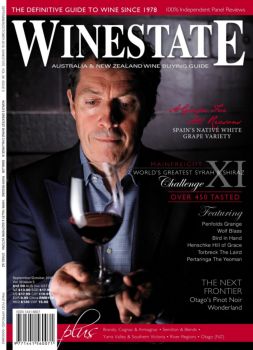
SEPTEMBER/OCTOBER 2016 WINESTATE VOL 39 ISSUE 5 THE DEFINITIVE GUIDE TO WINE SINCE 1978 100% Independent Panel ReviewsWORLD'S GREATEST SHIRAZ CHALLENGE XI SEMILLON RIVER REGIONS YARRA YALLEY & SOUTHERN VICTORIA OTAGO, NZ AUSTRALIA & NEW ZEALAND WINE BUYING GUIDE A Grape For All Reasons SPAIN’S NATIVE WHITE GRAPE VARIETY OVE R 4 5 0 TA STED Featuring Penfolds Grange Wolf Blass Bird in Hand Henschke Hill of Grace Torbreck The Laird Pertaringa The YeomanPRINT POST APPROVED 100003663 September/October 2016 THE NEXT Vol 39 Issue 5 FRONTIER $12.00 AUS (inc GST) NZ $13.00 SGD $17.95 Otago's Pinot Noir US $17.99 GBP £10.95 Wonderland EUR 9.95 China RMB100 HKD $120 CHF 15.00 plus Brandy, Cognac & Armagnac • Semillon & Blends • Yarra Valley & Southern Victoria • River Regions • Otago (NZ)
PARTNER WITH Winestate AT THE Hong Kong InternationalWine & Spirits Fair NOVEMBER 10-12 2016 PARTICIPATION COST (INCLUDES BOOTH) US$4,000ECONOMY CLASS FLIGHTS TO HONG KONG from AU$925*PP PREMIUM ECONOMY & BUSINESS CLASS FARES ALSO AVAILABLE 4 NIGHTS ACCOMMODATION from AU$599* PER PERSON TWIN SHARE CONTACT US TO BOOK YOUR PLACE Glenelg | Adelaide | Barossa Valley
Ph 1300 790 663 Australia wide enquiries welcomedGawler | Hyde Park | Modbury | Norwood | Semaphore | Stirling | Victor Harbor
Wining and Dining at Hyatt Regency PerthFine cuisine is synonymous with the more guests at Cafe or Joe’s Oriental Diner serving up a fusion of South EastHyatt brand, with a strong focus on Diner. Club at the Hyatt members are Asian flavours all prepared in the livelysourcing fresh, seasonal produce and also invited to exclusive events and open kitchen where guests can watchpreparing it in an innovative way for promotions. The restaurant is also a the chefs at work. With a choice ofguests. keen supporter of Western Australian preparation styles such as stir-fried, soupAt Hyatt Regency Perth, this approach wines, hosting Wine of the Month and based, braised, and steamed, eachis carried out, not only for the large featuring a variety of WA wines on the dish will be cooked to the preference ofnumber of events and conferences beverage menu. individual guest.held at the hotel every week, but also During the weekends, guests are able Also on the lower lobby is La Stradain room service and at the hotel’s five to enjoy a lavish High Tea served on coffee shop with access to Adelaiderestaurants and bars. Royal Albert tea sets while taking in Terrace, offering fresh pastries,Award winning restaurant, Cafe, the impressive atrium. With a glass sandwiches, cakes, tea and coffee;offers guests an interactive dining of champagne on arrival followed and PSB (Plain Street Bar), the idealexperience where they are able to by an array of Australiana themed place for a refreshing beverage or awatch the Chefs at work in the kitchen. sweet treats and traditional high tea tasty bite to eat. With fine crafted localFor a yearly fee guests are able to favourites, this is a popular event and international beers, Australianjoin Club at the Hyatt which entitles each week. wines and Champagne cocktails,them to fantastic benefits and up to The lower lobby of the hotel provides guests are able to enjoy dining in a50 percent off when dining with one or more dining options with Joe’s Oriental relaxed environment.
For Hyatt Regency Perth, excellence in food and beverage paired with superior service is a key factor in providing guests with a memorable experience.As a three time winner of the AHA (WA) Hospitality Industry each dish is to the same quality the guest would receive in aAward for Best Conference and Function Venue in Western restaurant – the food is served fresh, the ingredients are tastyAustralia, the hotel has now been placed in the Hall of Fame and innovative and the presentation is immaculate,” saysand has rightfully earned its reputation as Perth’s preferred Executive Chef, Mark Sainsbury.venue for conferences and events. With a number of chefs from all corners of the globe, HyattWith a total of 16 event spaces including three ballrooms and Regency Perth continuously creates new dishes andvarious conference and boardrooms, Hyatt boasts some of updates banquet menus with innovative changes, taking intothe best event facilities in Perth. Whether it’s a small group of consideration multi-cultural tastes, dietary requirements and10 or a large party of 1000, Hyatt has the ability to cater for themes. It is not uncommon for the team of chefs to work withany occasion. With the latest in audio visual equipment, Hyatt clients or wedding guests to personally create a tailor-madeRegency Perth also has the creativity and flair to integrate a menu for their event.theme into any event from menus and music to lighting anddecorations. The hotel’s range of event space and ability to cater for all occasions means clients can feel confident in knowingHyatt Regency Perth’s dedication to delivering excellence is their event will be a success, whether it’s a wedding, largealso evident in the food and beverage it offers. conference or small team meeting.The hotel’s philosophy Food: Thoughtfully Sourced, Carefully And for those who also happen to be staying at the hotelServed, is upheld in its day to day operations with a strong there is a fitness centre, heated outdoor pool, tennis courtcommitment to using fresh, seasonal, local produce wherever and business centre. Dining while on a business trip shouldn’tpossible and ensuring the attention and detail put into a be a problem either, with five food and beverage outlets asdinner for 500 guests is the same as that for a table of two. well as evening drinks and canapés for guests staying on the Regency Club levels.“Even with large events in the Grand Ballroom, we ensureFor event enquiries: Phone: 08 9225 1234 - Email: [email protected] - www.perth.regency.hyatt.com facebook.com/perth.regency.hyatt - 99 Adelaide Terrace Perth Western Australia 6000
NO.278 SEPTEMBER/OCTOBER 2016Editor & Publisher Peter Simic E: [email protected] Editor Lara Simic E: [email protected] Editor Michael Cooper E: [email protected] Michael BatesAdministration Vicki Bozsoki E: [email protected] Designer Naomi Fry E: [email protected] Manager Peter Jackson E: [email protected] Coordinator E: [email protected] DAI Rubicon Winestate Web Site E: [email protected] New Zealand AdministrationKay Morganty Phone: (09) 479 1253 E: [email protected] South Wales Winsor Dobbin, Elisabeth King, Clive Hartley T EWINESTATE INTERNATIONAL CABERNET TASTINGSouth Australia Skye Murtagh, Joy Walterfang, Valmai Hankel, Nigel Hopkins,Dan TrauckiVictoria Jeni Port, Hilary McNevinWestern Australia Mike ZekulichQueensland Peter Scudamore-Smith MW, Andrew Corrigan MW, Lizzie LoelNew Zealand Michael Cooper, Jane Skilton MWNational Travel Winsor DobbinEUROPE André Pretorius, Giorgio Fragiacomo, Sally Easton MWASIA Denis GastinADVERTISING SALESAustralia & InternationalPeter Jackson, Winestate PublishingPhone: (08) 8357 9277 E-mail: [email protected] O’Reilly, Public Relations - [email protected] South WalesPearman MediaPhone: (02) 9929 3966QueenslandJaye Coley Phone: (07) 3839 4100 E-mail: [email protected] ZealandDebbie Bowman – McKay & BowmanPhone: +64 9 419 0561 Email: [email protected] Philippe Marquezy - Espace QuadriPhone: + 33 170 644 700 Fax: + 33 607 780 466Web: www.espacequadri.comDISTRIBUTORSAustralia HUON HOOKE TYSON STELZER MIKE BENNIEGordon and Gotch Australia P/LInternational 95 95 95DAI Rubicon POINTS POINTS POINTSWINESTATE is published seven times a year by WINESTATE PUBLISHING PTY LTD,81 King William Road, Unley SA 5061.Copyright2016byWINESTATEPUBLISHINGPTYLTD.Thispublicationmaynot,inwholeor in part, be copied, photocopied, reproduced, translated or reduced to any electronicmedium or machine-readable form without the express permission of the publisher.Every care is taken in compiling the contents of this publication, but the publisherassumes no responsibility for the effects arising therefrom.ABN 56 088 226 411Winestate Telephone (08) 8357 9277 Facsimile (08) 8357 9212E-mail [email protected] Web Site www.winestate.com.au September/October 2016 W I N E S TAT E 7 BRA042_POC_GrandeReserve_WineState_59x270_Ad_2F7/A0.4in/2d0d151 2:34 pm
contents In fact, sometimes it has been knocked 48 OUR NUMBER 3 out altogether, proving just how elusive A winery that “does things a little bitSEPTEMBER/OCTOBER 2016 that perfect combination of vintage conditions and winemaking skill are. differently” slides into our third placeFEATURES However, in this instance, judges’ Peter spot. Every bit of tender loving care is Douglas, Koonara Wines; Chris Hatcher, provided to this Blue Eyed Boy, who’s34 THE NEXT FRONTIER Chief Winemaker Wolf Blass; and Master bright and vibrant character has just out- Central Otago has a reputation for bold, of Wine, Drew Noon unanimously shone its better known siblings, reports agreed that Grange deserved the gong. Dan Traucki. fresh, vibrantly fruity pinot noirs that Judged entirely blind, if you do win an reflect the influence of young vines in award with Winestate, you’ve definitely 50 PRICE IS RIGHT youthful soils, but as the vines mature is earned it, writes Peter Simic. This year offered the most incredible this still an accurate picture of the area? As one of the world’s top 10 wine regions 42 BEST OF A BEAUTIFUL BUNCH diversity and “something for everyone”. to visit, Michael Cooper explores why After more than 450 syrah/shiraz & From a jaw-dropping four-star $4 offering Central Otago is one of the best places scooping the pool in the under $10 outside Burgundy for cultivating this blends had been judged, the five- category, through to the money-is-no- notoriously fickle grape and how wine star field was re-tasted to reveal the object, World’s Greatest Syrah & Shiraz tourism is playing its part in drawing in Final Top Ten contenders. The blind Challenge XI winner, valued at $1,048 the crowds to appreciate it. tasting continued until only our top three (also winner in the $200+ category). In remained. If this was a horserace, you the budget categories it seems that, not36 A GRAPE FOR ALL REASONS could say the favourite won the race, surprisingly, fresh is best with the 2015 Rueda is located about 200 kilometres followed by the stayer in second-place vintage shining bright here. However, and coming in third, a surprise long-shot the more money you’re willing to fork out to the north-west of the Spanish capital, with great odds. And what a result it means that you’ll be starting at the 2014 Madrid. It’s a very unusual wine growing was with surprises galore! An amazing vintage and working your way back in region in that the area produces almost outcome for arguably Australia’s most time to get the best results. No matter entirely white wines, particularly Spain’s well-known wine taking our top spot and what your budget, rest assured we’ve native white grape variety, verdejo. And whilst some might raise their eyebrows uncovered a stellar red for you. no, that’s not a typo. Not to be confused we can assure you this wine won fair and with the more popularly known verdelho, square. Our second place-getter is an R E G U L A R S Dan Traucki explores the origins of this incredibly consistent wine from the Clare fascinating grape variety. Valley having taken out the top honours 12 Briefs before with their 2005 vintage. Finally, in 24 Cooper’s Creed with Michael Cooper70 MAINFREIGHT WORLD’S third, a surprise contender that trumped 26 European Report with Sally Easton GREATEST SYRAH & SHIRAZ the rest of the field on the day, but what 28 Wine Tutor with Clive Hartley CHALLENGE XI can you say, when you come from a 30 Wine Travel with Elisabeth King stable of wines like this one – you’re in 32 Wine History with Valmai Hankel It was a rigorous and thorough good company. We visit the winning 52 Grapevine examination in Winestate’s 11th annual wineries and look at how they developed 56 Wine Words syrah/shiraz challenge. Based on their winning edge. 60 What’s it Worth? name alone, many would assume that 62 Wine Investment & Collecting this year’s winner would always be a 44 OUR NUMBER 1 146 Aftertaste shoe-in for any major wine competition, So how good really is the 2010 Grange however this has not been the case in W I N E TAST I N G S regards to previous Winestate judgings. - and could it be the best Grange yet? Nigel Hopkins interviews Penfolds chief 92 Semillon & Blends winemaker Peter Gago, who declared 98 Yarra Valley & Southern Victoria upon its release that this particular 104 River Regions year “was a vintage when nothing went 110 Otago (Central Otago & Waitaki Valley) wrong”. 114 Michael Cooper’s Recent Releases 46 OUR NUMBER 2 Their motto is to be “always faithful” and it seems this strategy, and the subsequent attention to detail and commitment this requires, is paying off for our runner-up Annie’s Lane, reports Dan Traucki. Winestate Magazine 122 Brandy, Cognac & Armagnac, Issue Number 278 New Releases and Best Value Buys September/October 2016 under $20. Cover photograph For a complete list of what we tasted for this Peter Gago, courtesy Penfolds Image Library. issue please refer to www.winestate.com.au8 W I N E S TAT E September/October 2016
COMBI-STEAM smeg.com.au W/ DOOR KIT SPEED OVEN The professional W/ DOOR KIT multifunction oven with steam Conveniently reduces cooking times by up to 30% THERMOSEAL The seal of taste ALWAYS THE BEST POSSIBLE TASTE THE BEST THING NEXT TO A SMEG OVEN – IS ANOTHER SMEG OVEN THERMOSEAL TECHNOLOGY & CLASSIC AESTHETIC • THE ULTIMATE IN BOTH CULINARY & VISUAL TASTESMA16869
BESPOKE BRITISH ISLES England | Channel Islands | Wales | Republic of Ireland Isle of Man | Northern Ireland | ScotlandAmid the heather-cloaked moors, North Orkney Islandsrolling hills, ancient stone remnants and Atlantic Kirkwallwindswept shores, a world of culture Oceanand tradition beckons. StornowayIt’s all included All travel including flights from Australia HeOburtiedres Inverness North Sea SCOTLAND Intimate small ship cruising aboard the MS Hebridean Sky for12 nights Spacious quality suites with ocean views 5 star Iona Edinburghaccommodation including 2 nights at The Dorchester in London HeInbnriedres All Meals – plus wine, beer and soft drink with lunch and dinner NIORERLTAHNERDN Lake District All sightseeing excursions including a visit to England’s Lakes BelfastDistrict and Skara Brae in the remote Orkney Islands Our Select Douglas Snowdoniaprogram giving you a choice of complimentary sightseeing such as ISLE OF MAN ENGLANDSnowdonia National Park by steam train A Tour Host Team includingan accompanying doctor All four T’s: tipping, taxes, transfers and travel Dublininsurance* And more thoughtful extras… such as home-airport-homechauffeur driven car transfers#, our Point-to-Point luggage service and IRELANDa higher Tour Host to guest ratio… WALES London4 – 20 June 2017 (17 Days)All included from $22,270 per person, twin share from Sydney^ Included Flight Portsmouth MS Hebridean SkyPhil Asker Pty Ltd CC2385 *Subject to meeting requirements of the insurer. Coach Penzance CEhnagnl ins he l#Conditions apply. ^Prices from other cities available on request. Guernsey Island of Sark1300 015 134 | captainschoice.com.au
editorialLAST YEAR I MET AN IRISHMAN in a cellar door who turned outto be a valued subscriber. Today I met a retired Agricultural Officer fromthe Riverland at a service station coffee outlet. Also a valued subscriber,we reminisced about the great vineyards and produce of the region nowdecimated by the ill-fated government water buy back scheme. Whilst initiallyproviding funds to cash strapped growers this ultimately destroyed them whenthe “white shoe brigade” of horse (sorry, water) traders came in and hikedup the buy-back prices, which the growers could no longer afford. The deadrows of plants in the region is evidence of a very poorly thought out scheme. On a positive note the government’s free trade agreement with Asiancountries is a great initiative and every winery should take advantage of thisto take some pressure off their local market activities. Meanwhile here at Winestate we continue to judge around 10,000 wineseach year, both in Australia and New Zealand. As they say it is a tough jobbut someone has to do it. All jokes aside we recognise our responsibility infairly reporting the responsible consumption of wine at various price andquality levels using independent expert Industry judges. In this issue we feature our annual Mainfreight World’s Greatest Shiraz &Syrah Challenge with many of the big names involved, Grange, Hill of Grace, MAC, Laird, Guigal etc. The greatthing about this judging is that all wines were judged in price categories with the best brought back for anotherjudging to pick our top ten winners (regardless of price). We also awarded a winner per price category to furtheremphasise the standouts and enable a fair playing ground. As I mentioned at the subscriber tasting of thesewines, it is important for readers to note the price range of wines they currently purchase and then try some ofthe wines recommended by the judges in that range. Who knows, a new favourite might emerge? For me it makeslittle sense to waste too much time on wines that you are never going to buy (although I do admit there is alwaysthat curiousity factor). Also in this issue we include lots more recommended wines; from the Yarra & Southern Victoria, the great valueRiver Regions, and the Central Otago region of New Zealand. For our varietal judging we include the iconic Aussiewhite, Semillon (and juicy SSB’s). And for the spirited among us a great look at the grape spirit, brandy, includingimports from Cognac and Armagnac. Lots and lots to try here and enjoy.Cheers! Market your wines to the world! Peter Simic Join the Australian Wine Industry Export and Buyers Your wine, Editor/Publisher mission to Verona in 2015 our ports.Major Sponsors and Supporters Vinitaly 2015 – Verona, Italy, 22-25 March 2015 Australia Export Customer Service The world’s premier Wine Exhibition and the ideal forum for export-ready companies and for buyers sourcing international wines. 1300 134 096 Equipment and Logistics Market your wines and spirits to around 50,000 international buyers sourcing new suppliers from all over the world - buyers from Western and 1300 135 801 Eastern Europe and the UK, Asia, the US and South America. Import Customer Service The Italian Chamber of Commerce and Industry (ICCI) in Melbourne is 1300 132 813 the Australian representative office of Vinitaly and provides assistance to Australian wine industry professionals attending the show: New Zealand Outbound - 0508 222 444 - Space and stand bookings at preferential rates Inbound - 0508 333 666 - Flight bookings and confirmed accommodation in Verona - Logistics - Visitor registration ICCI Melbourne also actively promotes and facilitates contact between the Italian and Australian wine industries and provides trade services for the wine industry: market research, business listings, business matching and appointment agendas. For more information contact: No matter what. Level 1, 185 Faraday Street, www.hamburgsud-line.com Carlton VIC 3053, Australia Tel: 03 9866 5433 E: [email protected] www.italcham.com.au WINE PRESERVATION TECHNOLOGY September/October 2016 W I N E S TAT E 11
briefsA NEW GLASS FOR MUSCAT started under David Wynn at Wynn’s Winegrowers in 1969 in marketing and sales when it was usual for wine companies toAFTER 150 years of making do with any old wine glass, usually only secure a low level of return on investment, and throughtoo small and unsuited to its grand taste, North East Victoria’s deft decision making (including the introduction of the Wynn’smost celebrated wine style finally has its very own glass. wine cask) he worked his way up. By 1982 he was at MildaraThe new Rutherglen Muscat Glass (which is also excellent overseeing the first of many controversial decisions with thefor topaque) is said to accentuate the flavours, texture and decision to label the 1981 Jimmy Watson Trophy for the 1981complexity of the world famous fortified. In March, 2014, the Coonawarra cabernet under two names: the JW Trophy Winnermuscat winemakers of Rutherglen reached out to Riedel, the and the JW Classic. It earned him a roasting from Four Corners.Austrian-based wine glass company, to create an individual An interview with King opening thus: “Mr King, we think you aremuscat glass. A series of sensory workshops were held misleading the Australian wine public.”where 14 different glass shapes were tested by winemakers,sommeliers and wine writers. The results were then collated and There were successes. The purchases in the mid 1980s ofthe winner decided. By unanimous vote, the Riedel Ouverture Yellowglen from founder, Ian Home, together with KrondorfWhite Wine glass came out on top. from winemakers Grant Burge and Ian Wilson helped make his name for shrewdness and picking winners. With the creation of “Finding the perfect glass for Rutherglen muscat has been a Jamiesons Run in 1987 his reputation was cemented. Some offascinating process,” says the chair of Muscat of Rutherglen, the greatest names in the Australian wine industry ring throughColin Campbell of Campbells Wines. “It has been one where the pages from Brian Croser and Dan Murphy through to Grantaesthetics and preconceptions needed to be put to one side Burge, Wolf Blass and Stuart Anderson. When he started withand the focus be 100 per cent on what was in the glass.” Mildara in 1981 company earnings were less than $1 million and by the time he retired in 1999, they were more than $150 million. Made of non-lead crystal, the Rutherglen muscat glass canbe bought for $15 a glass from participating Rutherglen cellar VALE IAN HOMEdoors and selected retailers throughout Australia. IAN HOME, who founded Yellowglen, a small sparkling wineA KING’S RUN operation outside Ballarat back in the early 1970s which went on to become one of the biggest selling sparkling wines inHE WAS the silver fox of the Australian wine industry, a man who Australian history, has died. Home was ahead of his time whenknew his numbers and worked them hard much to the delight he decided to tap into the burgeoning market for sparkling wineof his shareholders. Ray King, the former CEO of Mildara Blass in Australia. In 1971, he was among the first to plant Champagnewho ruled when the industry was moving from small backwater grapes - chardonnay and pinot noir - for sparkling-only winesto global giant, continues to maintain a reputation for insight at a time when sparkling producers such as Seppelt were stillas revealed in his autobiography, King’s Run - A Maverick’s employing grapes such as ondenc. Convinced the bubblyTale of Football, Wine and Business (Sid Harta Publishers, market, with just eight per cent of all wine sales was untapped,2015, $34.95 paperback). As he writes in the dedication, the he planted in an ultra-cool Champagne-like environment atmemoir became “an indulgence, pure and simple,” and yet Smythesdale outside Ballarat and in 1982 poached Frenchhe manages to look above the personal bravado to reveal the winemaker, Dominique Landragin from Great Western. With ainner workings of a major wine company on the up and up. He flair for marketing, Ian Home then proceeded to launch high end premium priced sparkling wines. In 1982 he released a methode champenoise vintage and non-vintage sparkling, followed in 1983 by Australia’s first sparkling rosé and sparkling 100 per cent chardonnay. A less bubbly style brut cremant wine followed. Wine drinkers flocked to Yellowglen making it one of those great rarieties in Australian wine: an overnight sensation. It acted as a contract maker of sparkling wines too and when Mildara employed the company to make its top selling Windsor sparkling wine, Ian Home soon found himself being offered a company merger with Mildara. In 1984 he accepted. Within four years sales of Yellowglen exploded from 100,000 bottles annually to more than one million. Home was ahead of his time, creating a new market segment for ultra-quality sparkling wines in Australia. “Ian Home was something of an enigma,” writes the former CEO of Mildara, Ray King in his memoirs. “Extremely nice and honourable as well as an aggressive adventurer, he was an unusual combination.”12 W I N E S TAT E September/October 2016
briefs stabilisation tanks, an airbag press, a laboratory and bottling line were also installed. Brother May retired in 2003 and in 2008 his work was recognised with the release of 2004 Brother May Reserve Shiraz. In 2014 he was made an inaugural member of the Clare Valley Wine Hall of Fame. “Having devoted my life to the Lord, I do not expect to be honoured for my work which, for me, has always had its own rewards,” he says of his latest recognition. In his continuing role as Winemaker Emeritus, he remains the face - and soul - of Sevenhill.HARDY’S WHITE FLAGSHIP GAINING NEW GROUNDTO LOOK at 30 years of Eileen Hardy chardonnay - the Hardy’s McLAREN VALE wine brand Dowie Doole is expanding, over 20white flagship - is to peer into a fast evolving winemaking years after it was created. Dowie Doole has just purchased achapter in Australian wine. The wine reflects so much about new vineyard – the Conte Tatachilla vineyard located on Baylissthe changes taking place in the minds of winemakers. From and California Roads, McLaren Vale, which was established andthe first vintage in 1986, we see a wine being sourced from managed by the Conte family for over 55 years. The 53-hectarewhat was then considered a cool wine growing site: Padthaway. property is an undulating and picturesque landscape with“We did regard it as cooler then,” said Hardy’s Group White approximately 35 hectares planted to premium varietals includingWinemaker, Tom Newton with a smile, at the start of a recent shiraz, cabernet sauvignon, merlot and 50-year-old bush vine30-year retrospective. “Eventually, we chased fruit in the grenache. The remainder of the plantings are alternative ItalianYarra Valley, Adelaide Hills, Tumbarumba and Tassie. That’s varietals which were grafted onto existing rootstock in 2012 –how it evolved.” Indeed, the move into Tasmania for the vermentino, aglianico and lagrein.2000 vintage of Eileen Hardy chardonnay was regarded asseminal. “Tasmania brought (the taste of) silica, a sharpness “The vineyard has a diverse mixture of varieties,” said chiefand minerality,” said Group Chief Winemaker, Paul Lapsley. winemaker Chris Thomas. “There will be some new additionsThe generosity of the earlier Eileens transformed into a more to the Dowie Doole portfolio and I am particularly excited aboutfocussed, streamlined wine once Tasmania became a major the well-established grenache vines which were planted incomponent. Today, the blended wine relies for its breeding 1965. Vintage 2017 can’t come soon enough.” said Chris. Dowieon fruit from Tasmania and the Yarra Valley. The change has Doole was founded in 1995 by McLaren Vale grape growers andalso seen alcohol levels generally lowered. “If you said to me, champions of sustainable viticulture Drew Dowie and Norm Doole.‘What’s the perfect alcohol for chardonnay?’ I’d reply 13.2 per The pair were joined by Leigh Gilligan who became a partner incent. You don’t get the (alcohol) heat or the bitterness,” said 1998, as well as Thomas and new partners that have recentlyTom Newton. “To me Australian chardonnay should have lovely come on board.fruit, juicy fruit and fruit sweetness.”INDUCTED INTO THE ORDERBROTHER JOHN May, the man who helped transform theClare Valley wine industry and the fortunes of its Jesuit-runSevenhill winery, has been admitted as a member in the Order ofAustralia in recognition of his significant service to winemakingin the Queen’s Birthday Honours List. Brother May took overthe winemaking duties at Sevenhill in 1972 upon the suddendeath of Brother Hanlon, and immediately made an impactconcentrating on classic varieties such as cabernet sauvignon,cabernet franc, malbec, merlot and riesling. He also looked to“new” imports such as chardonnay and the fortified wine grape,touriga. With skills in carpentry, concreting and bricklayinghe undertook and oversaw the building of a new winery onsite. Temperature controlled stainless steel fermenters, cold September/October 2016 W I N E S TAT E 13
briefsNEW CHAMPAGNE HOUSE dominating the market by adopting a fresh andAROUND 12 months ago, a human whirlwind by the name of fun approach to bothHugues Villemain, a charming, urbane Frenchman, landed in brand and winemaking.Australia and started to contact wine industry and media folk. Arrogant Frog is nowVillemain said he was representing a new Champagne house, celebrating over aBrimoncourt, that was set to take the wine world by storm. What decade in the Australianchutzpah! In a country where big brands like Moet et Chandon, market, with over oneBollinger and Veuve Clicquot dominate, what chance was there for million bottles of winea new Champagne house, a negociant no less, with zero pedigree? sold annually. Australia is the second-largest Well, in the ensuing months Villemain has established himself as consumer of Arrogantsomething of marketing wizard; Brimoncourt has established a firm Frog wines after Holland.footprint in the Australian market and can be found on lists fromCatalina Rose Bay in Sydney, Punch Lane in Melbourne, The Lake “When new worldHouse at Daylesford, Print Hall and Rockpool Bat & Grill in Perth wines started to kick usand Willing Brothers in Hobart. So what, exactly, is Champagne out of the market I knewBrimoncourt? A noted label until the 1950s, it was re-born in there needed to be aAÿ, in the Marne, next door to Bollinger, in 2008 by the colourful change, and we were inAlexandre Cornot, a former lawyer, naval officer, entrepreneur and the right place to do it,”New York art dealer, who is himself a Champenoise. While plans Mas said. “And now weto buy vineyards are in train, Brimoncourt currently sources all its continue to evolve thefruit from growers. It is based in 18th- and 19th-century buildings brand and keep it fresh,and gardens (some a former print works), that were partially to keep the new worldconstructed by the Eiffel Company and are classified as part of the wines on their toes!” Talking about the new label design, Mas said:industrial heritage of the region. The first Brimoncourt Champagne “We wanted to create a label that illustrates the wine’s heritage,was only launched in late 2013 (and in 2015 in Australia) - and one that would tell the story of the vineyard behind the iconicalready Cornot’s audacious plan to upset the Champagne status frog. The new label emphasises the wine’s deep connection toquo appears to be working. its terroir and region, showcasing both the brand’s playful attitude and strong ties to tradition.” French wine is now reclaiming its place in the Australian market growing a considerable 9.1% in sales since March 2015.ARROGANT FROG FACELIFT FOUNDER HONOURED WITH FLAGSHIP WINEONE OF Australia’s best-selling French wine ranges, the irreverent PIONEERING Margaret River winery Vasse Felix has unveiledArrogant Frog label created by Jean-Claude Mas, has unveiled a plans for a new release of a new wine that has been 10 years in“new look” label its says “reflects the brand’s mix of old-world roots the making. Named after Vasse Felix’s founder, Dr Tom Cullity, theand winemaking know-how, and new-world attitude.” Launched wine will recognise his role in the establishment of the Margaretin 2005 by Mas, a fourth-generation winemaker from Languedoc- River Wine Region and pays tribute to his legacy. The Tom CullityRoussillon in southern France, Arrogant Frog paved a new path will sit at the top of the Vasse Felix range of wines, and is a blend offor French winemakers, challenging the new world wines that were the very best cabernet sauvignon and malbec grown exclusively on the Vasse Felix home vineyard, including from Margaret River’s oldest vines. The first-ever vintage of the Tom Cullity comes from the outstanding 2013 vintage. It will be released in 2017, the 50th anniversary of Dr. Cullity’s historic original plantings at Vasse Felix in 1967. The Tom Cullity will replace the Heytesbury as Vasse Felix’s top red wine, albeit in smaller quantities because it is now a single vineyard wine. The 2012 will be the last ever red Heytesbury, and from next year the Heytesbury name will be reserved exclusively for the Heytesbury Chardonnay. “I first raised the idea of this wine with Dr Cullity 10 years ago, and we’ve been working towards it ever since,” Vasse Felix owner, Paul Holmes à Court said. “Naturally it’s sad to replace the Heytesbury after all these years, especially as it carries an14 W I N E S TAT E September/October 2016
briefshistorical family name of mine, but the Heytesbury name will liveon with our Heytesbury Chardonnay and we’re really excitedabout recognising our founder properly with our very best redwine. “It’s also sad that Dr Cullity didn’t live to see this wine, butI know he would approve of the wine we’ve put his name to andwould be quietly flattered by the gesture.” The 2013 Tom Cullitywill be released in May 2017.NEW LOOK NOVOTEL wine list comprised of Barossa Valley’s finest drops and a skilled team of wine enthusiasts is on hand to assist with wine parings.THERE is a new look to the Novotel Barossa Valley Resort afteran extensive refurbishment and the opening of the The Cellar The Cellar Kitchen serves buffet breakfast daily followed byKitchen Restaurant and Bar. Previously Harrys Restaurant and an a la carte menu for lunch and dinner. For details see www.Bar, the restaurant’s new name and complete interior re-design, novotelbarossa.com.au.supports a ‘paddock to plate’ food philosophy, following Novotel’scollaboration with Saskia Beer. As an artisan food producer, cookand food educator, Beer has been a pivotal part of the restaurant’stransformation. Her company, Saskia Beer Farm Produce, hassuccessfully engaged local providores, growers and farmersas produce partners, enabling The Cellar Kitchen to serve upan authentic Barossa Valley experience that is seasonal andreferences the long standing food traditions of the region. Takingdesign cues from Saskia’s food philosophy, the restaurants décorincorporates market-like characteristics with a relaxed garden feel.Fitted out with a charcuterie section and fresh vegetable and herbdisplays, the produce is positioned as the hero of the restaurant. General manager Sarah Henderson said: “We are thrilled tofinally be welcoming both locals and guests to experience our newrestaurant concept. Saskia has been a great asset over this processand the team at Novotel have thoroughly enjoyed their educationalexcursions out to see the producers. This was a fantastic way forour team to truly understand where the produce they cook withcomes from and how they can share this information on to ourguests.” Working alongside Novotel’s chefs and kitchen team,Saskia has developed seasonal menus that give guests a taste ofthe true Barossa Valley. “This has been an exciting project to be apart of and I look forward to seeing The Cellar Kitchen build lastinglinks within the Barossa community,” she said. “All my dishes willbe produce driven not chef driven with ingredients as the hero.For me it’s really important to pass on our Barossa food heritage tovisitors, which in turn helps us to maintain and build that heritagefor the next generations.” The new menu features local cheesesfrom Victoria McGlurg, smallgoods selected and aged by Beer,fresh vegetables and herbs by Aldna Farms and Barossa FarmersMarket along with other small producers through the local farmersmarket. Saskia’s free-range chicken, mushroom and bacon pie andsuckling free-range Berkshire pork scaloppini are other headlineacts. The Cellar Kitchen’s sommelier team has also designed a September/October 2016 W I N E S TAT E 15
briefsCHANGING OF THE GUARD same year as Jacob’s Creek was officially launched – he accepted a job with Pernod Ricard Winemakers (then G. Gramp & Sons),TAMBURLAINE Organic Wines in the Hunter Valley has signalled makers of Jacob’s Creek. Hickin was first based in the Barossa buta changing of the guard with the appointment of Aaron Mercer as was soon moved to its Griffith winery during a period of significantits senior winemaker. Mercer recently returned to Australia from expansion. He oversaw the progressive move to sparkling wineCalifornia’s Central Coast, where he worked at Bien Nacido and production and varietal-labelled wines, and worked to produce theSolomon Hills. He previously worked stints in Canada, Gaillac in best possible wines from the region. In 1987, Hickin’s passion forFrance and in Germany. Born and bred in the Hunter, Mercer has white, botrytis (dessert) and sparkling wine saw him permanentlystudied in environmental sustainability, biological farming and relocated to the Barossa winery at Rowland Flat as the newecological management and has worked at Scarborough Wines, operations winemaker. In 1994, he was made senior white andTyrrell’s and Brokenwood. “It is with excitement I take on a new sparkling winemaker, and by 1997 was promoted to group whiteposition with Tamburlaine,” he said. “I’ve had a hand in making and sparkling winemaker. Passionate, but quietly spoken, hesome high-quality wines over the years and looking back on became chief winemaker of Pernod Ricard Winemakers’ Australianthese I see just one common thread – sustainable farming. The wines, a position he held for a decade. From 2010, he took on the‘new age’ of viticulture is here and it spearheaded by organic additional responsibility of promoting the Jacob’s Creek brandpractices. Tamburlaine is at the forefront of this movement and is internationally. His departure is being marked with the releasewell positioned to provide great-value premium wines to a growing of a special limited-edition wine: the 2010 Jacob’s Creek Limitedcustomer base who seek wines of place and also tread gently on Edition Shiraz Cabernet. The bottle label features a pencil sketchthe environment.” Tamburlaine managing director Mark Davidson of Bernard, and the release has been overseen by his successor,said: “As Australia’s largest producer of organic wine, Tamburlaine the new chief winemaker Ben Bryant.is very well established but we still have plenty of room left to grow.Aaron understands this and is up to the challenge.” “Bernard has made an enormous impact on Jacob’s Creek, ensuring the wines stayed true to style and excelled in quality over his 40 vintages,” says Bryant. “In honour of Bernard’s contribution, we have selected this special wine, blended from 63% shiraz from our best Barossa vineyards and 33% cabernet sauvignon from our finest Coonawarra vineyards, and labelled just 1200 bottles with his name.” The wine is billed as “the highest-quality wine made under the Jacob’s Creek label” and fewer than 900 of the special gift-boxed commemorative bottles will be available for sale at the Jacob’s Creek Visitors Centre in the Barossa Valley in Australia for $180 a bottle.END OF A STELLAR CAREERWINEMAKER Bernard Hickin, who spent four decades working forJacob’s Creek, retired at the end of June after a stellar career. Acity boy with no interest in wine as a youngster, Hickin ended upin charge of one of the world’s largest and most-respected winebrands. His world changed when he dropped in on a friend whowas working at a winery outside Adelaide. “Walking in, I remember the aroma of the reds fermenting, thevibrant purple colour of the red caps... it was just like being inanother world,” he recalls. He started a degree at the RoseworthyAgricultural College in the mid ‘70s, first worked a vintage at BerriEstate in South Australia’s Riverland region under two influentialwinemakers (Brian Barry and Ian McKenzie) and then, in 1976 – the16 W I N E S TAT E September/October 2016
briefsMAKE IT A MUDGEE GETAWAY which depart daily. Encompassing the towns of Mudgee, Gulgong, Kandos and Rylstone, the Mudgee Region combinesTHE COUNTRY town of Mudgee in Central Western New South country towns, historic buildings and a thriving café scene withWales is a popular weekend destination for lovers of food boutique markets and galleries to explore. Mudgee, meaningand wine. And now Mudgee is aiming to lift its profile among ‘nest in the hills’, is set amidst rolling countryside and offersgourmets with a new ‘Let’s Skip Town Together’ campaign more than 40 family-run cellar doors. For more information visitdesigned to entice city folk to leave routine – and traffic – behind www.visitmudgeeregion.com.au.for a couple of days. The Mudgee Region Tourism Board andDestination NSW have unveiled the new program to refresh food FAST TRACK EXPANSIONand drink tourism and entice back previous visitors. ADELAIDE HILLS winery Sidewood Estate is on a fast track to “We are excited about what is on the horizon for the visitor expansion with the acquisition of a 25-hectare vineyard shirazeconomy across the Mudgee Region in 2016,” said Russell on Ironstone Road at Echunga. The cool-climate location of theHolden, chair of Mudgee Region Tourism Board. Leianne new Echunga property fits with Sidewood’s current vineyardsMurphy, acting CEO of Mudgee Region Tourism said: “Mudgee at Oakbank, Verdun and Nairne. “We’ve had a somewhatRegion is a destination where people can enjoy country interesting problem in recent times in that we’ve struggled toliving without giving up the fine food and drink they expect in produce enough shiraz to satisfy demand,” says owner andmetropolitan areas. “Local produce is what makes it so special vigneron Owen Inglis. “With our national and internationaland it’s embraced by everyone. There is a genuine passion markets expanding at an ever increasing rate, the abilityfor food and drink in Mudgee region and a genuine desire to to supply more wine is of course vital. The purchase of theshare it with others.” Echunga property as well as the $3.5m expansion of our winery at Nairne will see us overcome the challenges we’ve faced in Mudgee is the third largest grape-growing region in New recent times.”South Wales and one of the oldest wine regions in the state. Athree-and-a-half hour drive from Sydney, Mudgee can also bereached by plane from Sydney Airport via a 50-minute flights, September/October 2016 W I N E S TAT E 17
briefs represent Australia in both categories at the Gourmand Awards World Event. The book is the first in a series that provides instructions on how to easily match food and wine. It features recipes along with approachable expert advice in a full-colour hard cover book. “This win is a fantastic achievement especially since this self-published book is our first,” said Fran Flynn. The couple is working on follow ups: Paired: Whites & Rosés and Paired: Reds. The initial book release costs $37.99 and can be ordered direct from www.paired- media.com. It is also available from good book stores nationwide and internationally on amazon.com.OUTRAGE AT CLOSURE WORLD CLASS REDEVELOPMENTTHERE was widespread anger in the wine industry following the ONE OF the world’s leading wine consultants has teamed up withannouncement by multinational Pernod Ricard that the historic an Argentinian oil and gas billionaire in a multi-million dollar vineyardRutherglen winery Morris Wines will be closed and sold. Pernod and winery development in the Barossa Valley. Alberto Antonini,Ricard Winemakers said in late June that the vineyard will be closed who has been named by both Decanter magazine and The Drinksand sold whilst the company will keep ownership of the brands. Business as one of the world’s top five wine consultants, is advisingSix generations of the Morris family have been making wines at Alejandro Pedro Bulgheroni on the development of Greenock Farm, athe site since vines were planted in the 1860s, and the cellars are 40ha property at the northern end of the Barossa that was purchaseda major tourist attraction. The Morris family sold the business to last year for $1.95 million. With only 12ha currently planted to BarossaPernod-Ricard in the 1970s but David Morris is still the maker of iconic grape varieties (shiraz, grenache, mataro and semillon) therethe family’s famous fortified styles. In a statement, Pernod Ricard are imminent plans to plant a further 18ha with the same varieties,said: “Regrettably, we have made the difficult decision to close while restoration work has already begun on the 150-year-old stoneour Morris Winery and Vineyard. The final date for the purposed barns and farm buildings on the site. The first vintage, under a labelchanges is yet to be confirmed but we expect it to before the end name that is still going through the international trademarking pro-of 2016, and we anticipate that the cellar door will close on the 31st cess, is expected in 2018. While it is considerably smaller than theJanuary 2017.” The company said it could not make Morris Wines a Bulgheri Family Vineyards recent US85 million vineyard and winerysustainable operation given there has been a decline in consumption development Bodega Garzón in Uruguay, the company’s Australianof fortified wines. managing director Amelia Nolan promises that, like Bodega Garzón, it will be a cutting edge development that will push boundaries inA PERFECT PAIR all directions. Bulgheri, who spent three years exploring Australian wine regions with Antonini and Nolan before settling on the Barossa,PAIRED: Champagne & Sparkling Wines, a book on wine-and- has now added Australia to a portfolio that includes multiple estatesfood matching by husband-and-wife team Fran Flynn and David in California, Argentina, Uruguay, France and Italy. Stevens-Castro, received “We like the Barossa a lot,” said Antonini. “We had many options, a ‘Best in the World but this was a place of inspiration. The Barossa has great terroir and Award’ at the prestigious has built a great reputation, but what I taste now is not what we think Gourmand World Cook the Barossa is capable of delivering. We will focus on the origin of Book Awards in Yantai, the grapes, the unique place, not the variety. Varieties are generic, China. The Australian but places like the Barossa are unique.” book, recently published by Paired Media, also won two ‘Best in Australia’ Gourmand awards earlier this year in the categories of Food/Wine Matching and French Wine, which qualified the book to18 W I N E S TAT E September/October 2016
Like his name implies, Darwin isin a state of constant evolution – always moving and growing in new and exciting directions. From the Paspaley PearlingCompany to the Menzies School of Health Research, Darwin is brimming with successfulbusiness ventures born from an inherent entrepreneurial spirit that affects all who meet him.So if you want to spark visionary thinking and rapid action,come and let Darwin inspire you. Think unconventionally meetdarwin.com.auNorthern Territory, AustraliaSeptember/October 2016 W I N E S TAT E 19
briefsTHE HUNTER’S FAVOURITE SON MARGAN’S VERMOUTH VENTURETHE move from winemaker at Tyrrell’s to running his own vineyard MARGAN FAMILY WINES in the Hunter Valley has released whatand winery back in 1996 was the making of one of the Hunter Valley’s it believes is the world’s first vintage off-dry vermouth made fromfavourite sons, Andrew Margan. If he hadn’t made the jump how semillon grapes. Margan Vermouth is a collaboration betweenwould we know that the Italian red grape, barbera was so well suited winemaking father Andrew Margan and barman son Ollie Margan.to the Hunter soils or that Spanish grapes such as tempranillo and The duo decided that the perfect vermouth could be made fromgraciano are equally as promising in what they can deliver? In 20 the semillon grape blended with aromatic home-grown herbs andyears, Andrew Margan at Margan Wines has accomplished much, spices – and the perfect Negroni was a step closer. The duo believesbeen through boom and recession and all the while highlighted the the answer to an interesting Negroni is a drier-style vermouth and aindividuality of his wine producing sub-region of Broke. “The Pacific less-aromatic gin. “It has been made from a base of semillon grownOcean is just 85 kilometres away,” he says, cresting a small hill in on our own vineyards and added to spirit that was distilled from thethe middle of his vines. “The ocean influences our weather. We get a same base wine,” says Andrew Margan. “Of the 22 herbs and spicessignificant diurnal differentiation between day and night. Grapes here used, to provide the aromatics, the majority of fresh ingredients werecan be fast ripening but during the cold nights they keep their acid.” sourced from our gardens.”The humid weather provides him with a botrytis semillon every yearand with a sub-regional difference for Hunter stalwarts, semillon and The new drink was released simultaneously with Margan Familyshiraz. Margan semillon possesses middle palate weight and body, Wines celebrating its 20th birthday. Andrew Margan is the son of theproviding a marked contrast to the classic leaner Hunter style. “My late Australian food and wine pioneer Frank Margan, and decided tosemillon ages but it can age a bit faster,” he says. His aged release forge a new path with his son. “It’s been a really enjoyable processsemillons, which started in 2003 the year he moved to screwcaps, putting this together and we are really happy with the result,” saysare testament to it. An aged release shiraz provides traditional Hunter Ollie. “Vermouth is starting to regain significant momentum in thesavouryness and medium body with a highlight of red and blue fruits. international bar scene and there is no reason, given our access to“Our wines aren’t better or worse than anybody else, but they are unique botanicals and flavours, that Australia shouldn’t be leadingdifferent,” says the winemaker/viticulturist. That they are. the charge. What we have come up with stands alone in the category, which is a really exciting prospect.” Margan Vermouth is made from the ground up using over 20 aromatic elements including orange peel, star anise and bergamot, the majority of which are sourced from the Margan Restaurant kitchen garden. The Margan Vermouth is available from the Margan Cellar Door for $50 online at www. margan.com.au.20 W I N E S TAT E September/October 2016
briefsCELEBRATING A MILESTONE birthday: the 2014 PSV Pinot Noir, 2013 Concongella 1868 Vines, a blend of pinot meunier, shiraz and dolcetto, and the 2014 Sparky’sWHILE other wineries were making a fuss about their 20th and Block Shiraz. All are sealed under cork and wax, will cost $150 a30th birthdays, Best’s Great Western celebrated a real milestone in bottle and are probably sold out by the time you read this. They2016: 150 years of wine production. Over those 150 years, Best’s are available only at the Best’s cellar door or online.has been owned by just two families, including the Thomsons, forthe last 96 years. Best’s held a tasting of some older vintages atJimmy Watson’s in Melbourne to celebrate recently – and alsolaunched a book on the winery’s history. The Best’s story goesback to April 18, 1866, when local butcher Henry Best was givenpermission to clear the land near Concongella Creek in westernVictoria. The site boasts some of the oldest vines in Australiabecause Best planted just about very variety he was able tolay his hands on at the time. There are still 38 grape varieties inwhat’s known as the Nursery Block – including what are believedto be the oldest pinot noir vines in the world and a few that areunknown anywhere else. The Thomson family has run Best’s since 1920, when Best soldup, and now produces around 20,000 cases a year. “We just don’t have the population mass around us to sell ourwines to, which means we just have to work that much harder,”says Viv Thomson. “We are trying to entice more visitors to theGrampians and Great Western – and the word is slowly gettingout about the quality that people can find here; but we have tospend more time taking our wines out of the region and gettingthem tasted in the major capital cities.” Viv, who has worked 55vintages, and his wife Chris, still live in an old homestead adjacentto the winery, cellar door, and vines – and many of older buildingson site also date back 150 years. “We like to think that the region isa well-kept secret,” Viv Thomson says. “We’d love that to changebut it is one of the realities of farming in a country area.” Current winemaker Justin Purser, vastly experienced in France,unveiled three new wines made in tiny quantities to mark the 150th September/October 2016 W I N E S TAT E 21
nzbriefswhat’s happening on the NZ wine sceneSAUVIGNON COUNTRY $200 TREATSPUBLISHED recently, NZ Winegrowers Vineyard Register Report THE Church Road range of Hawke’s Bay wines from Pernod Ricard2015-2018 confirms what you probably already know. The NZ offers excellent, often outstanding quality. At the summit ofmajority of the NZ wine industry can be summed up in five words the four-tiered range is a trio of rare, prestigious wines under the- sauvignon blanc, pinot noir, Marlborough. As a land of mostly Tom brand, released recently at up to $NZ200 ($A187) per bottle.cool-climate wine regions - from Wairarapa south - it’s no surprise Dedicated to the memory of Tom McDonald, a key pioneer ofthat NZ is planted principally (78 per cent) in white-wine varieties. winegrowing in Hawke’s Bay, who died in 1987, this elite range isAnd there is no prize for guessing the major white-wine grape - strikingly packaged and sold mostly at the cellar door, in duty-freesauvignon blanc (74 per cent of white-wine plantings), followed shops and in restaurants. So how do you make a $NZ200 wine?distantly by chardonnay (11 per cent) and pinot gris (9 per cent). “We start in the vineyard,” says chief winemaker Chris Scott,With reds (which cover just 22 per cent of the bearing vineyard “targeting blocks we know produce our best wines. The vinesarea), there’s a similar dominance by a single grape variety. Pinot get extra work, with more shoot thinning, leaf plucking and bunchnoir accounts for 70 per cent of red-wine plantings, far ahead of removal, to promote full ripening of the grapes. And because themerlot (16 per cent) and syrah (6 per cent). But what’s hot, in terms wines are more powerful, denser, the barrels they are matured inof less established grape varieties? Albarino and gruner veltliner have a high percentage of new French oak.” Comparing Tom winesare both expanding in terms of their area of producing vines. with the next level down - labelled Grand Reserve and at leastRiesling, cabernet sauvignon, cabernet franc and malbec are $100 cheaper - Scott says they are similar in terms of complexity.stagnant, and semillon, gewurztraminer and viognier are declining. “But the primary focus of everything we do at Church Road isNZ has 10 wine regions, stretched from Northland to Otago, but 66 ‘mouthfeel’ - achieving fullness, roundness and plushness. Tomper cent of the vines are clustered in Marlborough. Hawke’s Bay should be seamless, complete.”is far smaller but sizeable, with 13 per cent of the vines, followedby Otago (5 per cent). Over the next couple of years more vines Among NZ’s highest-priced wines to date, Church Road Tomwill come into production in Marlborough (especially) and Hawke’s Cabernet Sauvignon Merlot 2013 and Church Road Tom SyrahBay, but the survey shows little expansion elsewhere. So dominant 2013 both cost $NZ200, making Church Road Tom Chardonnayis Marlborough, it is NZ’s most heavily planted region for varieties 2013 a “snip” at $NZ150 ($A140).that it is not even commonly associated with - chardonnay (justahead of Hawke’s Bay), gewurztraminer (well ahead of Gisborne) MOVING ONand - surprise - pinot noir (well ahead of Central Otago). TWO well known wineries recently changed hands. Lake Chalice,AN ABUNDANT HARVEST which produced its first Marlborough vintage in 1992 (just 60 cases), and has grown to a medium-sized producer, has beenTHE shelves will soon be packed with infant Marlborough purchased by the region’s largest family-owned wine company,sauvignon blanc. Vintage 2016 has yielded a bumper crop - much Saint Clair. Carrick, in Central Otago, was a partnership betweenbigger than 2015. In Marlborough, “warm rain events in January the owners of three Bannockburn vineyards, including managerduring the berry expansion period saw sudden berry swell,” Steve Green. The first vintage flowed in 2000. The new ownerreported Craggy Range, “resulting in the largest berry weights is West Auckland-based Ying Zhong, who last year purchasedon record for Marlborough sauvignon blanc at harvest time”. At Kennedy Point vineyard on Waiheke Island.Allan Scott, the harvest was double the size of 2015. The goodnews is that a warm, sunny March, followed by a very sunny, dryand warm April, helped to ripen the region’s heavy bunches. TeWhare Ra predicted Marlborough’s top 2016 wines “will be equalto some of the best we’ve ever had”. In Hawke’s Bay, a cool, wetspring was followed by a hot, dry summer. “It was like changingjerseys at half time,” says Barry Riwai, winemaker at Alpha Domus.In March, Alpha Domus dropped “a lot (of bunches) on the ground- a third to a half”. Sacred Hill picked “great” chardonnay, butintense humidity in late March adversely affected thinner-skinnedred varieties, especially merlot. Central Otago’s growers enthusedabout a notably dry season, which yielded small, flavour-packedberries. Grasshopper Rock, at Alexandra, reported quality “up withthe very best vintages”.22 W I N E S TAT E September/October 2016
BEST TOUR OPERATOR BEST TOUR OPERATOR BEST RIVER CRUISE INTERNATIONAL DOMESTIC OPERATOR 2015 2015 2015See Europe like you never imaginedEurope Wine Ambassador Cruises Magnificent Europe – 23 July 2017Join APT and enjoy a truly unforgettable luxury journey. SCOTT MCWILLIAMUnpack only once and relax as APT’s all-inclusive river 15 days from $7,695*cruises take you through Europe’s most stunning scenery pp twin sharein style. Romantic Rhône & Seine – 17 Aug. 2017In 2017 APT is proud to partner with winemakers fromAustralia’s First Families of Wine, presenting you with BRUCE TYRRELLthe country’s leading multi-generational winemakersas your hosts for an unforgettable European river 15 days from $9,695*cruising experience. pp twin share Wonders of Bordeaux & Rhône – 19 Sept. 2017Steeped in rich wine making heritage, your Wine CHERRY STOWMANAmbassador will guide you through local wineries and 18 days from $12,995*vineyards to reveal age-old processes that are still revered pp twin sharetoday. You’ll also enjoy special tastings, presentations anda wine pairing dinner, among other charming highlights. Magnificent Europe – 11 Nov. 2017So join APT in 2017 for a relaxing and unique PETER BARRYholiday experience. 15 days from $6,495* pp twin shareASK ABOUT OUR AIRFARE SUPERDEALSVisit aptouring.com.au/WineSeries or call 1300 216 380 or see your local travel agent*Conditions apply. Prices are per person (pp), AUD, twin share and include port charges. Prices are correct as at 14 July 2016, but may fluctuate due to changes in availability, surcharges, fees, taxes or exchange rates. Prices are inclusive of Early Payment Discount. Prices based on: EUMC15W: 23 July 2017 (Cat. E), EUBCRPP18W:19 September 2017 (Cat. E), EURSC15W: 17 August 2017 (Cat. E) and EUMCR15W: 11 November 2017 (Cat. E). A limited number of all SuperDeal offers are available on select itineraries, suites and departures. All offers are subject to availability, until sold out. SuperDeal offers have specific booking, deposit and paymentconditions: EARLY PAYMENT DISCOUNT: Save up to $300 pp on holidays of 15 days or more. A first non-refundable deposit of $1,000 pp must be paid within 7 days of the booking. A second deposit of $2,000 pp must be paid by 31 October 2016. Full payment is due 10 months prior to tour departure. NO EARLY PAYMENTDISCOUNT: 1st non-refundable deposit of $1,000 pp must be paid within 7 days of the booking. 2nd deposit of $2,000 pp must be paid by 31 October 2016. Full payment due 100 days prior to tour departure. Australian Pacific Touring Pty Ltd. ABN 44 004 684 619. ATAS accreditation #A10825. APT4615
c o o p e r ’s c r e e d WORDS MICHAEL COOPER CHANGING TIMESNEW Zealand is a young wine country, number one white varietal wine, which supply GroCo, Gisborne’s wine co-operative.but its best combinations of classic grape became prominent in the 2030s”. Andrew Vette, GroCo’s marketing director,varieties and regions are already clear. is adamant sauvignon blanc has a future inSauvignon blanc and pinot noir flourish in Cooper’s Creek’s 2011 bottling was the the region, reflecting its ability to “producethe cool-climate regions from Wairarapa first true example of albarino from NZ or at a price point other areas struggle to meet,south, leaving the warmer, northern regions Australia. Called albarino in Spain and due to our strong yields, very low inputs, noto focus on Bordeaux-style reds, syrah and alvarinho in Portugal, this internationally irrigation and early harvest reducing the riskchardonnay. fashionable variety produces aromatic of rain affecting quality.” wines with citrusy, peachy, mouth- But times are changing. Not only are wateringly crisp flavour. With its loose The idea of sauvignon blanc from Gisborneemerging varieties - especially albarino clusters, thick skins and good resistance takes many wine lovers by surprise; so does- starting to make an impact. Sauvignon to rain, albarino could thrive in NZ’s wetter pinot noir from Hawke’s Bay. But Hawke’sblanc is expanding in Gisborne - which for regions - and elsewhere, too. Kirsten Bay’s output of pinot noir in 2015 was doubledecades promoted itself as “the chardonnay Searle, of Matawhero in Gisborne, believes that of Waipara, in North Canterbury; thecapital of New Zealand” - and pinot noir albarino’s vibrancy suits sauvignon blanc same amount as Nelson’s; almost as largeis spreading in Hawke’s Bay, traditionally lovers, while also attracting those looking as Wairarapa’s. Its pinot noirs have recentlyacclaimed for its merlot and cabernet for something new. scooped top accolades in Australia, Asia,sauvignon-based blended reds. North America and Europe. The idea of sauvignon Geoff Thorpe, of Riversun nursery in Hawke’s Bay’s legacy of sparkling wineGisborne - NZ’s key supplier of certified blanc from Gisborne production, based partly on pinot noirvines - is not convinced that winegrowers planted on the heavy, fertile soils of theare hungry for new grape varieties. When he takes many wine lovers Heretaunga Plains, hasn’t helped to buildadvertised three years ago, inviting growers respect for its pinot noir-based reds. Butand wine producers to contact him if they by surprise; so does over the past 20 years plantings havewere interested in seeing any new varieties shifted to cooler, elevated, inland districts.imported, he didn’t get a single phone call. pinot noir from “We believe that some sub-regional pockets have the right characteristics to allow us to But climate change will change that. Dr Hawke’s Bay. produce world class pinot noir,” says GrantGlen Creasy, senior lecturer in viticulture Edmonds, chief winemaker at Sileni Estates,at Lincoln University, believes that as wine Doug Bell, a leading Gisborne which produces about half of Hawke’s Bay’sregions become warmer, growers will no grapegrower, insisted for over 30 years pinot noir.longer be able to keep using the same that he would never plant sauvignon blanc.varieties. But Bell and his wife, Delwyn, owners of a At Sileni’s elevated sites on the Crownthorpe 30-ha vineyard at Hexton, recently ripped and Mangatahi terraces, cool air funnels “Areas that are too cool to grow quality out 9ha of mature viognier, arneis and down from the Ruahine Ranges, creatingwine will be able to in future,” he says. chardonnay, to replant in sauvignon blanc. far larger diurnal shifts in temperature than“We may find in 50 to 80 years that most of “Gisborne is well positioned to produce on the plains. The rapid drop in temperatureMarlborough sauvignon blanc is being made good quality sauvignon blanc at realistic in the evenings and cooler nights lengthenin Ward (south of the Awatere Valley) and not prices,” says Bell. “We are not in competition the season, giving more time for pinot noirthe Wairau Valley”. Creasy also picks the with Marlborough because they will always grapes to build flavour, while retaining acidity.eastern Wairarapa and Canterbury as ripe hold the premium position in the marketfor expansion. for that variety. But we do have a real Sileni reports that the growing degree days opportunity in Gisborne to be a second tier (a measure used to estimate the maturing Dr Richard Smart, the prominent Australian of NZ sauvignon blanc.” of crops during the growing season) atviticulturist, a few years ago forecast the Mangatahi (1259) are almost identical tostate of NZ winegrowing in 2053. From a The Bells planted sauvignon blanc to Dijon, in Burgundy (1242). The averagevantage point 40 years in the future, he rainfall during the three months of harvest isdeclared that “New Zealand was quick also extremely similar. Watch this space...to lead a world trend to albarino, now the24 W I N E S TAT E September/October 2016
The Best of Australia at Vinitaly 2017 Verona, Italy 9-12 April 2017 Winestate magazine will in 2017 again host ten Australian wineries at the51° Edizione Vinitaly Wine Exhibition. The World’s biggest International Wine Exhibition Lilian Carter in Tiansai vineyard Bookings or enquiries contact: Peter Jackson 08 8357 9277 or [email protected]/October 2016 W I N E S TAT E 25
europeanreport WORDS SALLY EASTON MWTHE BALANCING ACT CONTINUES BETWEEN GLOBAL EXPANSION AND CONSUMPTIONVITICULTURE can be a fickle thing. Australia the global bottom line, reported by the litres per head. With 1.3 billion people,had a heyday during the 1990s until grape OIV (International Office of Vine and Wine) China’s per capita consumption is justprices collapsed in the mid noughties, after recently, is that world wine production 1.2 litres. A comparison with mature andsome 40,000 hectares (ha) had been planted increased slightly to more than 274mhl in declining markets, such as France (42.5in the few years before the millennium. China 2015. The other side of the coin, world wine litres/head), Italy (33.3 litres/head), Spainhas taken up the expansionist mantle, consumption, has remained pretty static (21.3) illustrates the opportunity still to beplanting 34,000 hectares of vineyards in overall – at about 240mhl - since the global had in these nations. Australia drinks 24.52015. The country’s vineyard area has more financial crisis of 2008 … already eight litres of wine per head.than tripled since the turn of the millennium. years ago. That 30 mhl-odd difference eachThis gives it 830,000 ha, and the moniker of year typically gets used for industrial spirits, Going from global to local, the fragmentationthe country with the second largest vineyard vinegars etc. of Burgundian vineyard plots historically putacreage, after France, but according to negociants in a strong position: they boughtProfessor Huiquin Ma, of the University of This situation illustrates wine or fruit from tiny plots and blendedBeijing, only about 20% of this total acreage wines into saleable volumes of individualis for wine grapes. China is a big grower of another changing aspect appellations. But Burgundy (and every othertable grapes. Nonetheless, 20% of 830,000 appellation in the European Union) is legallyis 166,000ha – really not far off Australia’s of the global industry defined and delimited. Appellation plantings149,000 ha. And Australia’s vineyards now are quite often ‘full’.are almost exactly the same size as it was - most vineyards (forin 2000, having peaked at 177,000 ha in Negociants struggle to expand their2009. China may yet have something to all uses - table grapes, businesses within the region, though therelearn from Australia, especially given global has been some consolidation. Additionally,consumption isn’t really growing. raisins and wine) are no during the latter half of the 20th century there has been a growing trend to domaine- This situation illustrates another changing longer in Europe. bottled wines – rather than selling fruit/wineaspect of the global industry - most vineyards to negociants, more and more Burgundy(for all uses - table grapes, raisins and wine) The national picture of consumption may growers have been bottling and sellingare no longer in Europe, or more specifically offer some hope for the traditional countries their own production. A direct consequencethe European Union. The EU-28 (pre-UK of France, Italy and Spain, which continue to of this is that less wine, and less topreferendum on EU membership) vineyards decline only slightly or are stabilising – the quality wine, has been made availablecome in at 3,362,000 ha, whilst non-EU trend may be bottoming out. It is the USA to negociants. And it’s estimated thatvineyards reached 3,510,000 ha. This trend and China that are showing signs of small somewhere around half of Burgundy wineis likely to continue as the vinous historical growth. In 2015, the world’s biggest wine- is now domaine-bottled. Of course thisheartland of France, Italy and Spain adjust consuming nation, the USA consumed 31 includes domaine bottling of estates ownedtheir vineyard size to a long term declining mhl (compared with Australia’s 5.4mhl), and by negociants, such as Domaine Louisdomestic consumption pattern, combined China consumed about 16 mhl. That’s still Latour and Domaine Faiveley.with increasing vineyard areas outside 20% of global consumption between theEurope, which is pretty much happening two of them. All of which makes China the As a consequence, in order to grow,only in China, and a tiny bit in New Zealand. fifth biggest wine consuming nation (behind negociants have, in the last generation, France, Italy and Germany). Australia just been buying vineyards outside of the Côte In terms of wine production, China is on makes the top ten. d’Or. Burgundy, for all its small 29,000the verge of overtaking both South Africa hectares’ extent, is hugely varied, andand Australia. Currently, China and South Looking at the per capita figures helps mainly expansion has been to either end ofAfrica are on a rough par at around 11mhl show the potential opportunity for growth in the region – north to cool continental Chablis(million hectolitres), ranked 9th and 8th both these lead nations, and may go some and south to Mediterranean-influencedbiggest producers respectively, just behind way to explaining China’s continued rapid Beaujolais, though some have ventured into7th-ranked Australia in 2015, with 12mhl. plantings: with nearly 3.4 million people, the Languedoc too. USA wine consumption comes in at 10.25 The position in China notwithstanding, Chablis offers little competition with rich, nutty, lemon-leesy Côte d’Or chardonnay26 W I N E S TAT E September/October 2016
because of the notably different style –steely, stony, linear, sometimes erring to lean,often without new oak - arguably the style of‘skinny, lean’ chardonnay that cooler climateAussie producers have been creating for thepast decade. Property in this 5,500ha region doesn’tcome on the market that often, and Faiveleyand Louis Latour are two negociants whohave managed to buy properties since theturn of the millennium: Domaine BillaudSimon and Simmonet-Febvre respectively.Little surprise opportunities are rare whenthe region’s wines are sought-after, withsome suggesting Chablis has a similarbrand strength as Champagne – i.e. peoplebuy Chablis (or Champagne) rather thanparticular producers. Indeed, whilst theterm “Chablis” may have disappeared fromthe ‘generic white wine’ lexicons of Aussieand New Zealand production thanks toagreements with the EU, some producers inthe USA continue to use the word on home-grown wines for sale in their home market. There has been more activity in theBeaujolais crus appellations, includingFleurie, Morgon and Moulin à Vent. Thesealso offer little competition with the mainstayCôte d’Or wines of traditional negociants,given that they’re made from gamay, notpinot noir. And the region has been lessfashionable than Chablis, therefore arguablyeasier, and cheaper, to gain access. Thougheven Beaujolais is experiencing revitalisedinterest, possibly the result of a two-prongedeffort of increasing effort towards quality ingeneral, including the realisation that someof those densely-planted (up to 10 to 13,000vines per hectare) old (up to three figures)gamay bush vines make great quality wine,plus the inward investment that comes to theregion when a Côte d’Or negociant buys in.Chicken or egg? The latest trend away fromhuge tannins and high alcohol also helpsBeaujolais. Gamay has not so much of either.Bojo renaissance, anyone? September/October 2016 W I N E S TAT E 27
winetutor WORDS CLIVE HARTLEYASSYRTIKO – FROM CALDERA TO THE CLARETHE island of Santorini is located in successfully grown in such an unforgiving new vine to grown – normally a few metresthe Aegean Cyclades Islands between environment. Both nature and the ingenuity away. The new vine feeds off the motherCrete and the mainland of Greece. It’s a of ‘man’ have combined to create an vine until it has grown its own root systempopular holiday destination renowned, internationally renowned wine. and when this has happened (normallywith its unique feature of being a water- around three to five years) the cane is dugfilled caldera, which are the remnants of a Nature solves the water problem. During up and cut and the new vine is set free fromvolcano that famously erupted around 1630 the summer months a damp mist/sea fog its mother. The baskets get renewed everyBC. This eruption created the famous walls covers the island in the early morning and 20 years but some of the roots of the vinesof the Caldera (Caudron) that we see today this dew coats the vine and penetrates can be up to 300 years old.that rise to a height of 330m. The eruption the soil to a depth of around 50cm. Theburied the island in 30-40 metres of volcanic volcanic soil acts like a sponge and holds It’s not known how long Assyrtiko hasash destroying all life. It caused a tsunami this moisture for weeks. The vine takes been grown on the island of Santorini but itand the whole planet had a veil of very fine moisture from the soil which helps it to could have been on the island before theash. It took 3 centuries for the island to be survive through the dry rainless months. eruption. It’s resistant to most diseases andresettled. Today it is a busy island renowned As a consequence, the roots are not like has high tartaric acid and a pH similar tofor its whitewashed cubical houses and a normal vine and they are spread around Mosel riesling, below 3. At 12-13% alcoholfabulous sunsets. the surface to access this moisture, rather it displays floral, green apple aromas with than go deep. a seashell-like minerality and above that This is the setting for one of the most the wines have more ripe pear and apricotunique wines of the world – the Assyrtiko. Both nature and the flavours. Due to the islands prosperity andWhat makes this white grape unique are lack of land they are the most expensivethe challenges it faces on the island. ingenuity of ‘man’ have grapes in Greece.Firstly, there are no rivers or lakes on thetiny island and the vine has to survive off combined to create Santorini white wines can either be 100%rainwater. That wouldn’t be so bad but there Assyrtiko or blend with Athiri and Aidani, twois no rainfall for six months of the year, and an internationally other Greek white varieties. The majority ofbetween October and February, the annual wines are dry with high acid and a wet-stonerainfall is below 400mm and sometimes as renowned wine. minerally, fleshy palate. Assyrtiko takes oaklow as 130mm. Secondly, there is a strong well and a more richer style can use thenortherly wind called Meltemia that blows To protect the vine and grapes from the traditional label term Nykteri (Nichteri) forfrom May until September which further Meltemia the locals have developed a wines aged for at least 3 months in oak withdries out the vine and can do damage at unique Amoliti pruning system which trains a minimum alcohol of 13.5%.flowering. The soils are another challenge the vine into a basket known as a Koulouraand consist of pumice, black lava and or Ampelia shape. Basically, the vine canes The island also produces an excellentash, locally called Aspa, which have no are knitted together, forming a wreath sweet wine called Vinsanto (note it is onenutrients. Finally, it’s hot; temperatures in within which bunches can grow. It is a very word and comes from vin-wine & santo-summer months are generally around 25 low training method, there are no wires or Santorini as opposed to the holy wineto 29 degrees centigrade. posts. Phylloxera cannot live in the soil on of Tuscany Vin Santo) which involves the island so the vines are on their own sun drying the grapes for 6-14 days to It is a wonder that the locals grow grapes root system which means replanting new dehydrate them and increase the sugarat all. However, making wine on the ones can be done by the ancient method of ratio. The grapes are then fermented andisland has always happened and can layering. This is where a cane is bent down aged for a minimum of 2 years. Figs, fruitbe traced back to ancient pre-eruption and buried up to a point where they want the cake, raisins all leap out of the glass of thistimes. Grapes are a hardy crop and one complex wine.of the few agricultural pursuits that can be So with Assyrtiko ability to adapt to extreme climates it is not surprising to learn28 W I N E S TAT E September/October 2016
we now have the first Australian examples. 5 Star Winery - James Halliday Wine Companion 2015It has taken Clare Valley winemakers Peter James Halliday Wine Companion - Top Ten Dark Horse Winery 2015and Sue Barry over six years to realise theirdream of bringing Assyrtiko to Australia. Winery / Cellar DoorThey first tasted the white wine of Santorini Jeanneret Road, Sevenhill, South Australia, Australia, 5453whilst on holiday in 2006 and immediatelysaw the potential of the grape for their home T: (+61) 8 8843 4308 F: (+61) 8 8843 4251in Clare. With the help of Athens based E: [email protected] Lazarakis MW they wereintroduced to renowned Greek winemaker PO Box 61 Sevenhill, South Australia, 5453Yiannis Paraskevopoulos. Yiannis hadcontacts on Santorini and they travelled www.jeanneretwines.comto Greece and took cutting from YiannisArgyros’s vineyards. Finally, the cuttingsarrived in Australia and then they had towait through the two years’ mandatoryquarantine before finally planting thenursery grown cuttings in 2012. The firstparcel was picked from young vines in 2014and this October sees the release of their3rd and most commercial vintage. Clare valley doesn’t share the sameclimate challenges as Santorini. The Clareis a lot cooler and has higher rainfall, butPeter believes that Assyrtiko is an insurancepolicy for a possible decline in rainfall anda raise in temperature from the effects ofglobal warming. His company Jim Barryhave planted their vines on a 480m highsouth facing slope vineyard and haveeven used the Amoliti pruning system forsome vines. On assessing the early results Peterbelieves he has “reproduced some similarcharacteristics to the Assyrtiko of Santorini,producing a richer wine with a mineral/saltyaftertaste”. I recently had the opportunity of tastinga tank sample and his Australian Assyrtikohas a new world pristineness to it and afar cry from the Caldera wines with theirhigher alcohol and minerality, but it still isan enjoyable drop. September/October 2016 W I N E S TAT E 29
winetravel WORDS ELISABETH KINGBORDEAUX’ STAR ON THE RISEFEW nations rival the French when it comes of wine. That doesn’t mean a hard sell of merchant’s galley. Where there’s wine,to nurturing a grand vision. As the new Cite local vintages. The meet and greet space there’s food and the Cite du Vin boastsdu Vin in Bordeaux looms into view, the on the ground floor is the Latitude20 wine several restaurants and cafes. One offersringing tribute of Francois Hollande during bar, lined with 14,000 bottles of wine from 50 wines by the glass and it might take athe opening ceremony in June springs to 80 countries. The usual suspects are well- while to order at the top end eatery withlife. Dubbed the “Guggenheim of Wine”, represented, of course, but visitors can its wine list of 500 wines.the gleaming spiral of a building inspired also discover hard-to-get bottlings suchby the swirl of wine in a glass really is, as as Ethiopian chardonnay. Bordeaux’ star is so much on the rise thatthe French President truthfully exclaimed a new branch of France’s high-speed TGV- “An emblem of excellence, a symbol of Owners of the city’s train will make its first run in early 2017,coming together... a success for France”. cutting the journey time from Paris by 90 majestic 18th century minutes. Eurostar already links London Bordeaux has undergone major urban with Bordeaux with a change at Lille orrenewal over the past few years. A buildings were told to Paris for a sub-seven hour train ride. Therenaissance best viewed from the preferred mode of transport for many ofBelvedere on the eighth floor of the Cite du scrub up the facades the British surfers who catch the wavesVin, which offers a 360-degree panorama on the Atlantic surf coast.of the iconic wine city. Built at the cost of and cruise ships can$124 million, the project was designed There’s plenty to see in France’s fifthby star architects Anouk Legendre and now disgorge their largest city, poetically known as the PortNicolas Desmazieres as a museum-cum- de la Lune (port of the moon). Victor Hugotheme park. As fascinating for neophytes passengers close to the loved the city and gave it a tourist taglineas it is for wine connoisseurs, especially that has never been superceded: “Takewhen both parties are sipping the free heart of town. Versailles, add Antwerp, and you haveglass of wine at the end of a tour. Bordeaux”. Evocative venues to plan how The international nature of wine cultivation to spend your time are both located amid The man behind the rebirth is Mayor Alain continues on the cavernous second floor. the clutch of wine bars in the old city. AuxJuppe, who is planning a run for president. Giant screens show chopper rides through Quatre Coins de Vin is a quirky bar whereTo boost his political ambitions, he has vineyards from South Africa and Chile. patrons are given magnetic cards to self-overseen the pedestrianisation of the old There’s a chillax zone where you can select Bordeaux wines by the glass. Youcity centre, introduced a tram network and listen to wine-inspired poetry. Queues are pay when you leave. The Ecole du Vin dereinvigorated the historic custom houses routine at the “chair of despair”, where Bordeaux is a wine school in monickeron the Garonne River. Owners of the city’s you can listen to celebrities describing only and is a top choice for a quiet drink.majestic 18th century buildings were told to their worst hangovers. A programme ofscrub up the facades and cruise ships can wine workshops caters to all levels of The biggest culinary excitement of thenow disgorge their passengers close to the knowledge from children to wine writers past two years was the opening of Laheart of town. A whirlwind of activity that has to bypass the spectre of one-upmanship. Grande Maison de Bernard Magrez. A twoled to a UNESCO World Heritage listing. star Michelin restaurant and five-star hotel, The permanent World’s Fair atmosphere grand is too mean a description. Magrez, As Johnny-come-lately countries have sprawls over 20 themed areas. A highlight the owner of four Grands Crus Classeschallenged French wine supremacy, the even for the jaded is the Disney-style boat including La Tour Carnet, has teamed withCite du Vin is not only intended to attract ride that retraces the journey of a wine super-chef Pierre Gagnaire to offer themore tourists but also to rubber-stamp ultimate in haute Bordelaise cuisine andBordeaux’s standing as the world capital a dream cellar of 168 grand crus.30 W I N E S TAT E September/October 2016
Another hot eating ticket is Garopapilles,which translates as “get ready tastebuds”,where chef Tanguy Laviale serves upinventive dishes such as squid ink gnocchiand pan-roasted scallops with shiitakemushrooms and parsley. For half the price,Restaurant Miles showcases the talents offour young chefs from Israel, Japan. NewCaledonia and Vietnam. Consider: vealtartare with sesame seed oil-marinatedegg yolk and swordfish with Madras curryjelly and coconut and coriander gremolata. Using local produce has always been adrawcard of French regional restaurants,but the historic tendency has reached newheights. The Saint Pierre area buzzes withrestaurants, but there’s often a queue atBelle Campagne, where it’s hard to faultmains such as free range guinea fowl withfoie gras. Chef Rudy Ballin has also uppedthe locavore cred at Cote Rue, where therelaxed atmosphere contrasts with theartistry of dishes such as quail fillet withfresh turmeric. French chefs are trackingthe affordability trend as strongly as theirAustralian counterparts, and value is thelure at Bourchon Bordelais, where themarket-driven menu contains gems likescorpion fish with fennel, black olives andparsley jus. For the wine pilgrim, a wide variety ofhalf-day excursions fulfills your fantasies oftours to St Emilion and Margaux. Or, why notmake things easy on yourself by headingto the Cours de l’Intendance, Bordeaux’sritziest shopping street, and settling in forthe afternoon at L’Intendant des GrandsVins de Bordeaux, one of the most storiedplaces to buy the finest offerings fromBordeaux’s biggest names. September/October 2016 W I N E S TAT E 31
winehistory WORDS VALMAI HANKELANDRE SIMON VISITS HAWKE’S BAY IN NEW ZEALANDIT WAS essential that French wine and the 1963, 1962, 1960 and 1958 vintages. He wine-growers, with a sprinkling of lawyersfood writer, Andre Simon, should visit thought that they ‘all possessed a distinctlyMcWilliams while he was in Hawke’s Pinot character and a higher appeal than and doctors. Simon commented on theBay. The company was at the time New any other New Zealand wine known toZealand’s leading winery and remained me’. At lunch that day at Tom McDonald’s abundance of food – corn-on-the-cob,a major producer for the next 30 years. It home (he was the President of the Hawke’shad been importing wines from Australia Bay Wine Growers’ Association) Simon steaks, kebabs, pork chipolatas, salads,since 1944 and had planted its first vines and Thorpy had a particularly memorablein New Zealand, at Hawkes Bay in 1947. meal, where they were waited on by cheeses and fruit. For once, all the winesOn Saturday 15 February 1964 Simon McDonald’s wife and daughter. McDonald’sand his guide and friend, Frank Thorpy, 13-month-old grand-daughter ‘merely were from New Zealand: a 1963 McWilliamsvisited the company’s Napier Winery, looked on’ as Simon noted. Lunch beganwhere they tasted both commercial and with crayfish cocktail washed down with a Cresta Dore made from Muller-Thurgauexperimental wines. Winemaker at thetime was the highly qualified Hungarian, Simon was horrified grapes and a best seller for McWilliams;Denis Kasza. (Described by some as aluminary, Kasza’s contribution to the New to discover that it was a 1963 Waiherere dry white made fromZealand wine industry has been largelyoverlooked. A Hungarian refugee, he was almost impossible to get Chasselas grapes from Gisborne, northa Montpellier-trained oenologist who wasappointed Government Viticulturalist at Te anything to eat. of Hawke’s Bay; a 1960 Corban ClaretKauwhata from 1951 to 1957. In his timethere he made some discoveries which 1959 Niersteiner Domtal. Next was beef, curiously made from pinot meunier andwere to improve greatly the quality of New accompanied by what Simon describedZealand wines, in particular, that domestic as ‘three remarkable wines’. A 1949 pinot noir from the company’s Hendersonwinemakers were harvesting grapes too McDonald Cabernet he considered toearly: the grapes were not naturally low be ‘truly a fine wine by any standard’. vineyards near Auckland; and a 1962in sugar and high in acid, and did not Then came a ‘quite good’ 1955 Seppeltsnecessarily require the large amounts of Moyston Claret, followed by the pièce de Bakano, the name registered by McWilliamssugar and water they were receiving. On résistance, a 1949 Chateau Margaux fromleaving Te Kauwhata he was appointed Tom McDonald’s cellar. The two 1949 wines for their commercial blend of claret, usuallygeneral manager and winemaker at especially pleased Simon: the MargauxMcWilliams.) In 1962 McWilliams merged was ‘a very good bottle’ with ‘a sweeter a blend of cabernet sauvignon, pinot noir,with the much smaller but very highly finish and a more welcoming bouquet,regarded McDonald’s Wines, and Kasza greater breed, but it did not shame the and some hybrid grapes to bring downremained winemaker. New Zealand cousin of the same vintage’. Remy Martin Brandy and coffee rounded the wine’s price. Finally came the two Simon and Thorpy tasted a number of off a notable meal.wines made by Kasza at the Napier Winery. wines which most impressed Simon – aThey included the popular Cresta Dore As usual, there was another impressivefrom the 1963, 1962, and 1958 vintages, meal that evening. An open-air barbecue 1962 McWilliams Private Bin Cabernetmade from Muller-Thurgau grapes grown hosted by the Hawke’s Bay Wine andin rich silt soil. Simon was more interested Food Society took place in McWilliams’ Sauvignon and a 1951 McDonald Cabernetin the wines made for the firm’s ‘Private Te Awanga vineyard and attracted overBins’ which were not for sale. These came 100 people, most of them farmers or Sauvignon, matured for three years in smallentirely from pinot chardonnay grapes from oak casks, ‘a very nice wine’. The following day, 16 February, was a Sunday, and Simon was horrified to discover that it was almost impossible to get anything to eat. He, Thorpy and winemaker Alex Corban left Napier to drive the 212 miles (some 340 km) south to Wellington. Feeling the need for sustenance, they stopped on the way for a couple of cold beers, but ‘never a crust of bread or a bite of cheese’ were they offered: ‘the back door of the tap room is open to the thirsty who just ask for beer, not for the hungry’, grumbled Simon. The men stayed at The Lodge, a luxury hotel with one of New Zealand’s finest restaurants, The Mermaid. Contentment was renewed when the three men had an ‘excellent dinner’ in Simon’s spacious sitting room. Unfortunately, Simon’s account reveals nothing of the food nor wine served. 32 W I N E S TAT E September/October 2016
THE LAND. THE WINE. OUR STORY. At Hemera Estate our passion is for producing award winning wines that speak of our land here in the Barossa Valley. We pride ourselves on wines such as our 2010 JDR Shiraz, winner of the Best Barossa Shiraz Trophy at the 2015 International Wine Challenge in London. Try us for yourself. www.hemeraestate.com.au
Huge variability in the soils, from 150 years old to 350 million years old, all in the space of 10 kilometres, lays the foundation for terroir- focused reds, as in Burgundy.THE NEXT FRONTIERMICHAEL COOPER The local soils have proved excellent for High priority goals, based on the survey, pinot noir and Central Otago is lauded as are to develop a one-stop website for wineCENTRAL Otago’s reputation for bold, one of the best places outside Burgundy tourists and also to find ways to make itfresh, vibrantly fruity pinot noirs reflects the for cultivating this notoriously fickle grape”. easier for overseas enthusiasts to buyinfluence of young vines generally planted Central Otago wine while visiting the regionon flat sites with youthful soils, according to Wine tourism is “the next frontier”, and to ship it home.winemaker Steve Davies, of Doctors Flat, according to viticulturist James Dicey, ofan elevated site at Bannockburn. “My view Ceres and Mt Difficulty. He is also president Sauvignon blanc dominates NZ’s totalis that this is no longer an accurate picture.” of Central Otago Winegrowers. “Until now vineyard area, but accounts for just 2 per we’ve been focused as an industry on the cent of plantings in Central Otago and As the region’s vines mature and the trade - wine writers, buyers, retailers - a North Otago (the Waitaki Valley). Here,potential of sites far above the valley small group of people of influence,” he said. pinot noir rules, accounting for over 77floor are explored, the styles of pinot “The next stage is working more directly per cent of plantings. Pinot gris followsnoir emerging from Central Otago are with the consumers who buy our wine.” distantly with 12 per cent, then riesling withbecoming a lot more varied, which makes 4 per cent and chardonnay with 3 per cent.for endless fascination. But these are slow A survey of 178 wine tourists, mostlychanges, compared to the wine tourists from overseas, conducted at 17 cellar Central Otago’s majestic inland basinsnow flooding into the region. doors, found that few visitors found out and valleys look and feel like classic about Central Otago wine by using phone wine country, but the style of its reds is Lonely Planet last year ranked Central apps or even by accessing information on changing. Winemaker Antony Worch,Otago among the world’s top 10 wine the internet. “The survey reinforced for us from Alsace, has been working in Centralregions to visit. “Its wild landscapes make how important word-of-mouth advertising Otago since 2005 and is currentlyup the world’s southernmost wine region... is,” Dicey said. winemaker/manager at the contract34 W I N E S TAT E September/October 2016
winemaking facility, Alexandra Vintners. Aubert de Villaine, co-owner of Domaine de clay, lime, iron and other elements. The pinot “When we came to the region,” says la Romanee-Conti, visited Central Otago in 2014. “We label with brand first and vineyard noirs from these older soils “seemed to haveWorch, “everyone was trying to construct second,” says Dicey. However, De Villainetheir pinots, extract more and make them suggested, “it should be about the vineyard a common thread of finer tannin, good textureas big as possible. But if you go to the first and the brand second”.supermarket and get a $12 shiraz from and substance”.South Australia, you’ll get the tannins and Soil age is increasingly understood as apurple tongue for much greater value”. vital influence on wine style. The majority As the region’s vineyards mature, they are of Central Otago’s vines are planted in the Times have changed. “People are more Cromwell Basin, which over a series of ice yielding noticeably different wines. Winemakerconfident in what they have and they are ages has filled with glacial debris. At theable to pull back a little bit and let the fruit region’s Pinot Celebration in 2015, a major Grant Taylor, of Valli, notes that the leafy,express itself.” tasting grouped the wines by soil age, rather than districts. “green” influence in pinot noirs from the cool, Dicey argues Central Otago is on “the samejourney as Burgundy”. “Huge variability” in Wines from the river flats, with young soils, elevated Gibbston sub-region has becomethe soils, from 150 years old to 350 million about 15,000-20,000 years old, showedyears old, “all in the space of 10 kilometres”, “more primary fruit, better clarity of fruit and far less obvious.lays the foundation for terroir-focused reds, the tannins were more sinewy,” says Davies.as in Burgundy. “We are moving away from Those on high terraces, with soils around If you enjoy Central Otago pinot noir, buttalking about fruit aromas in Central Otago 450,000 years old, were further down theand towards what the mouthfeel is, how it erosion path, breaking down to release more only buy the cheapest bottlings, expect toprogresses across the palate...” pay more in the near future. Since the end of the GFC, the basic price per tonne of grapes has soared from $2000 to $3250 per tonne. This “prices out most of the really low-end,” says Dicey. Top: Prophet’s Rock Wines, Central Otago, Rocky Point Vineyard Steep. Prophet’s Rock grows pinot noir (principally) and pinot gris on its stunning, elevated site at Bendigo, in the Cromwell Basin. Opposite page: Prophet’s Rock Wines, Central Otago, Vineyard in Snow. September/October 2016 W I N E S TAT E 35
36 W I N E S TAT E September/October 2016
A Grape For All Reasons SPAIN’S NATIVE WHITE GRAPE VARIETYDAN TRAUCKIIMAGINE standing in the middle of a The Verdejo very few white varieties that have the abilityvineyard (that of Javier Sanz Viticultor) grape lends to lure drinkers away from the omnipresentsurrounded by short, stumpy, bush vines sauvignon blanc and chardonnay. Overthat were planted 208 years ago! Roughly itself to the years there have been a few attempts,about the same time that John MacArthur producing such as verdelho and viognier, but as yet,was establishing Australia’s first viable they have not done so.vineyard at Camden, before the Hunter severalValley was established and long before distinctly In recent times I have been championingthe Barossa or any other wine growing different styles Austria’s grüner veltliner as an exciting,region in Australia began. Then, just a of wines. up-and-coming white wine variety, withshort while later, you are standing ten a great global future in front of it. Well inmetres underground in a cellar that was Opposite page: Wine varieties from Javier Sanz Rueda, I have discovered another excitingoriginally an underground winery, which winery; Vineyards from the Rueda region. white variety that I believe has the potentialwas dug out in 1656 – that’s 14 years to lift wine drinkers out of the monotony ofbefore Captain Cook discovered Australia. drinking their “same old, same old” whiteI recently did both of these, in the Rueda wine and also to introduce new people towine region of Spain. While both seem the enjoyment of quality white wine.like an extraordinarily long time ago to us,they are short-term in the context of Spain, This variety is Spain’s verdejo – not towhere they have been making wine for be confused with verdelho, a completelyaround 3,500 years. separate variety grown in other parts of the country. Verdejo, the origins of which Rueda is located about 200 kilometres are unknown, has been in Rueda sinceto the north-west of the Spanish capital, 1,000 A.D. where over 90 per cent of theMadrid. It consists of 13,000 hectares of region’s wines are made from this nativevines and is a very unusual wine growing white variety. This makes Rueda one ofregion in that the area produces almost only a handful of wine growing regions inentirely white wines (and a tiny bit of rosé). the world that rely almost entirely on oneThis is due to its elevation, of 700 to 800 grape variety.metres above sea level, which makesthe climate too cool for growing “vinos Viticulturally Rueda consists of atintos” (reds). considerable number of patches of 100+ year-old bush vines, particularly around the Speaking of reds, whilst there is a city of Segovia, in addition to the significantmyriad of red grape varieties which have areas of newer vines which are trellised forthe potential to lure Aussie wine drinkers machine harvesting. Their trellising is quiteaway from their staple triumvirate of shiraz, a bit lower than what we are accustomedcabernet sauvignon and merlot, there are to in Australia, because as one vigneron explained: “due to their altitude and the September/October 2016 W I N E S TAT E 37
latitude, the growing season here is shorter has access to 50 to 100 year-old vines of wines. The first of which is the crisper,and therefore the quicker they can get from some of their local growers, allowing steelier, fruit-driven wine, where the winesthe nutrients out of the ground and into them to make a range of different style are made in stainless steel tanks, bottledthe canopy, the sooner we can ripen the verdejo wines. soon after fermentation has finished, andgrapes”. Some of the larger Bodegas such then on the market in less than 12 monthsas Cuatro Rayas, also have a third type of On the subject of underground cellars, from vintage. In Spanish red wine parlancevine management system, in that they have most of the villages have a maze of these could be called the Joven wines.re-trained some of their very old vines onto tunnels under them dating back to the They are delicious aperitif and summerlow trellises so as to be able to machine days when families made their own wines wines, which slake a thirst and refresh; anharvest the grapes. underground by using gravity feed. In ideal type of wine for our weather. Great recent times, as small family operations examples of this style include: Avelino Much of the vineyard acreage in the are bought out, some of the larger wineries Vegas Circe Verdejo 2015, Bodegas Protoregion is owned by small family growers have been joining up these small tunnels Verdejo 2015, Eresma V&R Verdejo 2015,who work with the wine companies. More so as to form a maze of maturing cellars. Javier Sanz Verdejo 2015, Jose Parienterecently they started heeding technology The most awesome of these labyrinths is Verdejo 2015, Oro de Castilla Verdejoand the winemaker’s advice rather than that of bodegas Grupo Yllera, which has 2015, Palacio De Bornos Verdejo 2015,doing exactly the same as previous set up “El Hilo de Ariadna” (The Thread of Quatro Rayas Organic Verdejo 2015.generations had done. Well, some at least Ariadna – from Greek mythology) touristhave. I was told that there were still a few attraction under its winery, consisting of The second style is more complex andwho start their harvesting based on the over a kilometre of interconnected wine a more food friendly style of wine. Thesecalendar rather than grape maturity, but caves with a superb and very elegant wines are fermented in stainless steelthey are gradually being replaced by the 100 seat restaurant, all 20 metres below tanks but the wine is left on lees aftermore tech savvy younger generation. the surface. fermentation. Also, a proportion of the make is matured in oak barrels to gain even There are a number of organic and The verdejo grape lends itself to more complexity, particularly with wineriesbiodynamic wineries in the region, however producing several distinctly different styles that battonage (stir) the wine. The resultas they explained at the innovative is that this style, which could be calledBodegas Menade (which also brews beer) Above top: Vineyards in the Spanish Rueda region. Crianza, is less crisp and austere than thewhile I was tasting its delicious wines, the Above: Javier Sanz Verdejo wine in the vineyard. Joven style, and has subtler more complexE.U. organic certification is rather lax in Opposite page from top to bottom: Grape harvesting aromas, is bigger bodied and richer inthat it allows practices that true organic at Cuatro Rayas vineyard in the Rueda region; flavour. These wines are typically left onproducers would never countenance. Verdejo vineyards grow low to the ground; Road signs lees for around 3-6 months, then bottledTherefore, while they adhere to the “best in the Rueda region of Spain; Cuatro Rayas selection and left in bottle for several months beforepractices” of organic production, many of of wines; A selection of delicious Spanish tapas that they are released. Delicious examplesthe organic and biodynamic producers are complements the verdejo wines. include: Castelo De Medina Vendimianot “officially” certified. Seleccionada Verdejo 2014, Diez Siglos Verdejo 2015, Hijos de Alberto (organic) The wineries themselves range from Verdejo 2015, Javier Sanz Malcorta 2015some that have been around for centuries – an ancient clone of Verdejo, Menadesuch as Hijos de Alberto Gutierrez, which 2015 V3 (Vinas Viejas Verdejo - organic),dug its first underground winery in 1656, Palacio De Bornos La Caprichiosa – verythrough to state of the art wineries like slowly fermented.that of the innovative Bodegas Castelode Medina (est.1995) and the newest, The third style of wine could be calledBodegas Shaya which commenced the Reserva (in Spanish red wine terms)operations in 2008. Bodegas Shaya also38 W I N E S TAT E September/October 2016
Spain’s Verdejo – not to beconfused with Verdelho, a completely separatevariety grown in other parts of the country. September/October 2016 W I N E S TAT E 39
as it is much less commonly available as it is made in small volumes, and cellared for much longer, by some of the Bodegas. This is the “fermentado en barril” or barrel fermented wine. This is the pinnacle of what verdejo can achieve. It is a sublime, rich, creamy, mouthfilling, unctuous wine that is truly lip-smackingly good. This style of wine is quite comfortable being matched with any meat dish that hasn’t been swamped by a very rich sauce. However, equally, it is fantastic on its own. Great examples include: Caserio de Duenas Ferrmentado en Barrica 2014, Diez Siglos Fermentado en Barrica 2012, Eresma 2014, Jose Pariente Cuvee Especial 2013 - fermented in concrete “eggs”, Oro de Castilla Finca Los Hornos 2014 – single vineyard, Proto Barrel Fermented 2014. The fourth style is “Method Tradicional” bottle fermented sparkling wine, made exactly the same way as Cava (Spanish for sparkling wine), except that it is made from verdejo. Not many wineries do this because of the amount of effort required, however those that do, produce a damn good sparkling wine such as: Jose Parientes Verdejo Cuvee Especial, Palacio De Bornos Brut and Yllera Privee Brut- a blend of chardonnay and verdejo. The newest and most exciting style of verdejo wine that is just starting to emerge is that of “Frizzante”, a semi-sweet, lightly sparkling verdejo that finishes nearly dry. In Spain, it is flying off the shelf this Spring/ Summer as the younger generation discover it. It is usually presented in eye catching packaging. It is a smash hit with newer wine drinkers and is also helping to convert new40 W I N E S TAT E September/October 2016
people into being wine drinkers. an amontillado sherry style of nose, a good climate is a bit warmer, they are not quite Good examples of this include the crown sweet palate that was not cloying and a as steely or mineral, rather they are a bit pleasant dry-ish, spirity finish. softer, rounder, more in the aperitif stylesealed YLLERA Cinco.5 Frizzante, a than the wines of Rueda, which are suiteddelicious fizzy verdejo with 5.5 per cent So as you can see in Rueda verdejo to match all but the richest of meat dishes.alcohol which is slightly sweet but finishes can produce the full range of wines, fromreasonably dry. An ideal introductory wine a sparkling wine, through to aperitif style I see Rueda as a prime example of theand very popular with the “millennials”, or wines, serious food wines and also a dessert “Renaissance of Old World” winemaking,the slightly stronger (9 per cent) Cuatro wine. How versatile is that? where they have kept the best of theRayas Dulce Bianco 2014. past, such as their ancient vineyards and To create a point of difference in some incorporated the latest technology. Some The final style of verdejo is so old that wines, verdejo is ably supported by a splash bodegas have even started using “roscas”nobody seems to know how long ago it of sauvignon blanc and to a much lesser (screwcaps), to create sensational whitestarted. This is the “Dorado” which is made extent, viura, in some wines. Like here, wines that are truly worth seeking out.in a somewhat similar style to sherry, but they can add up to 15 per cent of other Some Rueda wines are now available indifferently. The wine is fermented as normal varieties without having to declare it on the Australia, and I am sure that over time, awhite wine, then it has its alcohol level label. There are even a couple of “radical” lot more of them will become available.raised up to 16 per cent by the addition growers out of the 69 wineries in the region,of grape spirit alcohol and then the wine who are experimenting with other varieties So I suggest that when you get a chance,is poured into 16 litre glass demijohns, as to add in small volumes, to their verdejo, so try a verdejo- a grape for all reasons andit has been done for centuries. These are as to make theirs perceptibly different from you won’t be disappointed! not filled completely as they are left with a the others. However, that is still a while awayconsiderable airspace to aid in the oxidative and top secret. Opposite page from top to bottom: Cuatro Rayas bushprocess. The main difference with sherry is vines, Rueda; Harvesting done by hand at Cuatrothat there is no solera system used in the Verdejo is an amazingly consistent high Rayas; Glass demijohn bottles stored to create sherrymaking of Dorado. In earlier times it was quality white variety, it varies in style style sweet wine; Cuatro Rayas old family photomade from the sherry variety, Palomino Fino, according to the winemaker, but each showing traditional harvesting; Verdejo grapes frombut that variety has almost disappeared in and every wine still has the same inherent Rueda region.Rueda, they now use verdejo instead. primary characteristics of the variety. Above & below: Javier Sanz wine varieties in the Unlike, so many other white varieties, such vineyard; a selection of wonderful verdejos. The filled demijohns are stored out in open as chardonnay, which can vary so muchcourtyards with only sturdy shade cloth in flavour that the consumer never knowsover them as protection against hailstones what they will be getting until they open thewhich have been known to smash the glass bottle and taste it.demijohns. They are left there for around24 months, or longer to slowly oxidise and Most recently, a handful of adventurouscreate a sherry style sweet wine which wineries in Australia have startedfinishes quite dry. The only attention they producing verdejo. This small bandget during their “penance” is that they are includes Trentham Estate which was theoccasionally checked to see if they have first to release an Aussie verdejo, Dell’uvapopped their corks, which are then bunged and Peter Lehmann in the Barossa. Theback in. The Alberto Gutierrez “Dorado” has Aussie verdejo has the same characters as those from Rueda but because our September/October 2016 W I N E S TAT E 41
BEST OF A Beautiful BunchPETER SIMIC Shiraz makes up about 20% of and New Zealand’s Craggy Range. Also Australia’s 232,000 tonnes wine grape to contradict those who believe onlyEACH year Winestate pulls together an crop, far more than that produced Barossa or McLaren Vale “blockbusters”exciting judging of shiraz and syrah anywhere else in the world. So it is would win in this competition we wouldwines which we call The World’s Greatest appropriate that this judging is held here. like to point out that other annual winnersShiraz & Syrah Challenge. This is not It is no surprise therefore that most of the have come from the Clare Valley (Annie’sthrough an over inflated sense of ego wines judged in this four day judging Lane Copper Trail) and the Adelaide Hillsbut because it is not only the biggest came from this homeland. We also like (Bird in Hand Nest Egg).judging of this variety at any one time, to include other shiraz or syrah winesbut also because it involves some of from overseas, particularly France, so How it works:the big name heavy hitters that normally we scoured the liquor shops to see what Four different panels of three judgesdon’t enter wine shows. We source these we could find. In all, an additional twoiconic yardstick wines and go out and dozen or so imports were added across evaluated these wines blind over fourbuy them and include them in this blind all prices. To show our fair judging days. Each wine was presented totasting. Sometimes they get five stars, criteria, previous winners were from the the judges as rows of unidentifiedsometimes three and sometimes they Guigal and Clape stables of the Rhone glasses within various price ranges.get knocked out. We let the cards fall Each wine was scored independentlywhere they may.THE JUDGES (left to right): Wes Gilson, Marie Clay, Campbell Greer, Angus Wardlaw, Adam Eggins, Richard Mattner, Peter Douglas, Peter Simic,Chris Hatcher, Drew Noon, Andrew Locke, Rebecca Kennedy and Greg Tilbrook.42 W I N E S TAT E September/October 2016
by each judge, the scores collated raise some eyebrows, I can assure you evaluation and the many judges involvedand a consensus given which then that there was no way the judges knewtranslated into a star rating. Following what they were tasting. We purchased in this fabulous judging. Also to ourthis all wines which achieved a five star the wine independently (the 2011 wasrating, regardless of price, were then not available anywhere) and the result sponsors, particularly naming right’sbrought back for another blind judging was well deserved for this superbto determine a ‘Top Ten’ listing. This also wine. Second placegetter was the 2014 sponsor Mainfreight, who give us theincluded an overall winner, second and Annie’s Lane Coppertrail Shiraz (fulfillingthird placegetter. its legacy as a previous overall winner). ability to source some of the world’s Third was the surprise Mollydooker BlueThe Winners: Eyed Boy 2014, this time scoring better most exclusive wines. For our loyal In a hard fought final our Trophy than its higher priced siblings, Velvet Glove and Carnival of Love. subscribers who claimed their free ticketPanel of Drew Noon MW, Chris Hatcherand Peter Douglas, were unanimous Our thanks to all the wineries who to the public tasting event of these winesin choosing the Grange 2010 as the entered their wines for a vigorousoverall winner. Whilst this result might (held in Adelaide in late May), you can now see if your favourites correspond with the judges’ awarded wines. A full report on all the recommended wines is included in this issue. Whatever your pocket there is a wine or two for you here. Enjoy! September/October 2016 W I N E S TAT E 43
1STPLA CEGIVING IT TO GRANGECould this be the best Grange yet?NIGEL HOPKINSSO HOW good really is the 2010 Grange - and but gee, we really had to work at it. management, oak selection, the winemakingcould it be the best Grange yet? “In 2010 we didn’t have to work as hard. We regimen and timing of racking and, just as important, the right time to bottle. Released in 2014 in the shadow of the had a bounty of spoils, which is why I said it100 point Parker-winning 2008 Grange, and was a vintage when nothing went wrong. As “The Grange character is a by-product ofbetween the less acclaimed 2009 and 2011 in 1990, we had a wonderful intake of grapes; barrel fermentation, 100 per cent new oak,vintages, Parker gave it a mere 99 points, the weather was moderate, nothing extreme. fruit material that soaks up the oak – if you seethough many other reviewers gave it the It’s only when you look back after the vintage any oak poking out it’s a fault. It must be atextra point. that you realise how good it’s been.” one with the wine. There are massive tannins in Grange, but they’re the right tannins, not The judges of Winestate’s annual World’s Fruit was sourced from the Barossa (85 per aggressive or astringent.Best Shiraz challenge have had no such cent), Clare (five per cent), Adelaide Hills,doubts and if Parker’s Wine Advocate were McLaren Vale and Magill Estate, 96 per cent “We give the juice no extended time onto have another look, they might reconsider. of it shiraz, the balance cabernet sauvignon. skins, just 5-6 days in primary ferment – it’s the antithesis of the European and Californian “The 2010 Grange is the better wine, In his tasting notes, Gago reported: model. No post-ferment maceration. I’m notcompared to the 2008,” says Penfolds chief “Summer rainfall came early…followed by preaching that this is what you have to do, butwinemaker Peter Gago. “And I think it’s getting dry, warm weather alleviating any disease it’s part of the Penfolds style.”better, but then all Grange does.” concerns. Mild conditions followed during harvest; with yields in some vineyards below One of the more noticeable differences from The critics, he adds, don’t necessarily average due to the dry season overall. The a consumer’s point of view is the immediatealways get it right with Grange: “The ’55 fruit from these regions showcases excellent drinkability of Grange.Grange made the front page of Wine colour, concentrated flavour developmentSpectator as one of the 12 best wines of the and integrated tannins – hallmarks of a “We say the 2010 is best drunk from 2018,20th century,” he says. “But the ’52 and ’53 standout 2010 vintage.” but that’s grossly misleading,” Gago says.are actually better wines.” “People think they’ve got to wait until then, but The result, says Gago, is a wine, “that’s not that’s just optimal. It’s a beautiful drink now. It’s clear, though, regardless of whatever pretending to be something that it isn’t. There’s Grange really should have a warning label:points and accolades it’s won and will a lovely poise, a lovely sheen, self-assurance ‘This is a really dangerous wine. Its drinkabilitycontinue to win, that the 2010 vintage about it – it’s a beautifully balanced wine. is off the Richter scale.’ You can drink it fromproduced an extraordinary Grange. Nothing pokes out. It doesn’t grab you from day one, on release, before it goes into that behind; it doesn’t slap you across the face Grange ‘hole’.” “When I said on its release that this was a with power and aggression. It’s just, here I am.vintage when nothing went wrong, well that If you miss that magic moment, of course,was a bit of a throwaway line,” Gago says. “We’ve never changed the style of Grange – then you have to wait.“If I contrast it with 2008, that was a vintage it’s still Max Schubert’s template. We honour itwhen everything went wrong. We had 15 or but we think it’s better now. We’ve refined the One of the advantages for Gago and hisso heatwave days, 12 of them over 38C. We way it comes together. Now it’s all about tannin team is that Grange is a multi-region wine:made a 100-point wine simply by selectivity, “Even in the worst years we’ve got a spread44 W I N E S TAT E September/October 2016
from Wrattonbully and Robe to McLaren hasn’t stopped. We then have to assemble the 1ST PLACEVale, the Barossa and Clare. In some years blend to really optimise the perfume, to makewe include a bit from Magill. We have many sure it’s structurally intact. By that stage we’ve PENFOLDS GRANGEcolours to paint with to create that template also worked out if some cabernet should be SOUTH AUSTRALIAstyle, and then it’s all about the tweaking and included (of the 60 Grange vintages so faroptimising, getting some of the high notes. only six have been totally shiraz.” SHIRAZ 2010 “Grange is not pretending to be Australia’s Gago says this “brutal” process removesbiggest wine, not the oakiest, not the most two very important biases: the financial biasalcoholic. It’s always been about balance, and the emotional bias: “It would be a loteven in the earliest wines from the 1950s. cheaper if we made it from only PenfoldsThe ’52, ’53 and ’55 are amongst the most vineyards,” given that Grange growersbalanced wines ever made in Australia.” can reap more than $10,000 tonne,” and it removes any bias towards favourite blocks, The 2010 Grange, as with all Grange, had the icon blocks, the old school tie effect. Thisto undergo an extraordinary classification is not storytelling – this is how we do it.”process that includes the assessment of100 or more A1 Grade shiraz wines. By Perhaps inevitably this access to so manycomparison, the Penfolds Bin 389 is A3 Grade parcels of grapes, as opposed to a singleand the RWT is A2 Grade. vineyard wine, has led to suspicions Penfolds limits Grange production to make it rarer so as The sorting process starts with the ferments to increase the price. The company doesn’tin Penfolds’ 10 tonne static fermenters both reveal specific figures for Grange production,at Nuriootpa and Magill – Gago says 12 per but Gago says it averages 7-9,000 cases.cent of the 2010 Grange was made at Magill.Morning and afternoon tastings take place “We can’t just turn on the tap and makeduring ferment. more,” he says. “If we could make more at that quality we would, of course we would. “One of the most critical points is during But we’re just not that clever. We cannotfermentation when we decide whether to compromise our flagship wine. Why wouldmove the wine to barrels (American oak for you ever risk that?Grange, French oak for RWT) or let it fermentout and go into something else.” “And while Grange still has the world’s worst wine label, we’re not going to change that Then, with lots of barrels everywhere, either.” classification brings them together with blind,organoleptic tastings. From left to right: Grange maturing in the Barrel Room at Penfolds Magill Estate Winery; Peter Gago in the Grange “It’s a pretty brutal process, but the culling Tasting Room Magill & exterior Penfolds Magill Estate. September/October 2016 W I N E S TAT E 45
2NDPLA CE2014 COPPER TRAIL SHIRAZDAN TRAUCKITHE HOME of Annie’s Lane is the heritage consistently produce premium quality and Challenge IV and the Tahbilk based Greatlisted Quelltaler Estate, which dates back to this commitment created by Carl Sobels Shiraz Challenge as well.1863. In the early days of wine making, the and Herman Buring (the original ownerslocal community in the Clare Valley would and winemakers at Quelltaler) continues to This wine is named the “Copper Trail” afterpitch in and help each other during the be the focus for Annie’s Lane and their Clare the fact that the main vineyard that the fruitbusy times of the season. It was during one Valley grape growers today. is sourced from is situated on part of thesuch time, in the middle of winter, that the trail’s route through the Clare Valley – justname Annie’s Lane came into being. Annie The Annie’s Lane flagship wine is its south of Watervale. The trail was the routeWayman was on her way back to her cottage Copper Trail Shiraz. Each year the very that prospectors and miners used to travel,in Polish Hill River, after delivering lunches to best Clare shiraz grapes available to the mainly on foot, to get to the nearby townshipthe workers who were pruning vines, when company are specially selected from of Burra after copper was discovered thereher horse drawn cart struck difficulty in vineyards in Sevenhill and Watervale as well in the 1840s.negotiating the muddy track. This is how the as other areas of the Clare Valley, so as totrack became known as Annie’s Lane and epitomise the flavours and characters of The current winemaker, Melbournetoday it borders one of the winery’s major the region. The majority of the grapes and raised, with Clare Valley family history, Alexvineyards in the Clare Valley. backbone of the wine come from Sevenhill MacKenzie originally studied viticulture and to a lesser extent Watervale, with before becoming a winemaker, based on The name Quelltaler originates from the balance being sourced from different the reasoning that “you can’t make good‘Quellthaler’ which is German for Spring vineyards across the valley varying vintage wine if you don’t know what happensVale. Quelltaler Estate was one of the by vintage depending on the conditions. out in the vineyard”, which is part of theleaders in converting Australian wine philosophy that “great wines are made in thedrinkers from fortified wines to drinking table The Copper Trail Shiraz was first made by vineyard”. Along the way he did a vintagewines in the 1960s and 1970s, with, among David O’Leary in 1995, and was originally at M.Chapoutier in L’Hermitage, France, theother wines, their Quelltaler Hock, used by called Contours. Along the way it has renowned Rhone wine producer, where Alexdrinkers to make the immensely popular had a name change and has collected came to appreciate a different perspectiveHock Lime & Lemon drink. Quelltaler’s a swag of awards, starting with the 1996 on shiraz. On top of this, he also workedmotto, engraved in its crest, is semper fidelis vintage being named Best Red Wine of vintages in Piedmont and Chianti in Italy as(always faithful) reflecting Quelltaler’s aim to the Show at the Adelaide Wine Show. The well as the Pfalz in Germany. 2005 vintage won The Winestate Shiraz Alex says that the attention to detail is one46 W I N E S TAT E September/October 2016
2ND PLACEof the key features of this wine. Starting with it is very aromatic with lovely aromas of ANNIE’S LANEthe selection of grapes from old and very raspberries and plums, with hints of violets COPPER TRAIL CLARE VALLEYold, low-yielding vines, producing no more and black pepper.than two and a half tonnes to the hectare. SHIRAZ 2014Then going through to the separate parcel The palate is big and rich with wellfermentation in 10 tonne open fermenters integrated tannins and finishes with aand leaving the wine on skins for up to 12 lingering slightly savoury character. Thisdays. Close monitoring right through-out wine has great structure which Alex believesthe process and the careful selection of comes from the fact that the grapes areoak barrels and their toasting, through to grown at a higher altitude than most shirazthe blend selection from the barrels after at in Clare, giving them more natural tanninsleast 18 months of oak maturation. He says and a better balance between the acid andthat, “This wine is made by intuition and feel the fruit weight.rather than to a formula”. Despite 2014 being a very dry year in As the Copper Trail Shiraz is the pinnacle which the month of January was muchwine, it is not made routinely every year. It hotter than normal, and thanks to the carefulis in fact only made in those years where he grape selection and TLC (tender lovingbelieves that the selected grapes are good care) lavished upon the wine, the result isenough to produce a classic Clare style a wine with more poise and elegance thanshiraz wine. Thus recently, the Copper Trail most Australian shiraz have and shall ageShiraz was not made in 2007 or 2011. Alex gracefully.advises that the 2016 wine which is in barrelat the moment, is looking very promising to The end result of all the combinedbe another excellent wine. efforts, from the vineyard to the cellar, is a sensational wine that has deservedly The 2014 Annie’s Lane Copper Trail Shiraz come second in the 2016 Winestate World’sis deep and dark in colour, almost black, Greatest Shiraz Challenge. with alluring purple hues. On the bouquet From left to right: Signs to Annie’s Lane winery, Alex MacKenzie, Chief Winemaker and vineyards in the Clare Valley. September/October 2016 W I N E S TAT E 47
3RDPLA CEDAN TRAUCKISINCE they first branched out into making given special treatment once it enters the to generate the flavours that they are lookingtheir own wines, Sarah and Sparky Marquis winery. The parcel by parcel fermentation to achieve for the wine.have always done things a bit differently to starts off at around 25˚C and then as theother boutique winemakers. Starting with alcohol level rises, it is cooled down in order Mollydooker Wines regularly conductthe winery name, instead of using the family to extract the maximum colour and flavour extensive oak trials so as to maximise thename, or a place name like most wineries from the grapes. As with the fruit weight flavour of their wines, whilst at the same timedo, they called it “Mollydooker” which comes scale, they have developed an in-house ensuring that they are approachable uponfrom Australian slang for a left-handed person formula for this process as well. To ensure release and do not have to spend a long(“Southpaw,” in the US) because they are that everything is ticking along as it should, time in the customer’s cellar before becomingboth left-handers. the process involves each and every ferment smooth and elegant. being tested four times a day and tasted at Being different from the mainstream, they least twice a day. It is the mind blowing attention to detail allbecame early adopters of sealing their wines the way through the process that ensuresunder screwcaps, when in 2002 they started The Mollydooker team believe that greater each and every wine is the very best wine thatdoing extensive trials. This was done, as oak absorption and integration is achieved by they can produce from their grapes.screwcaps were seen as the very best way the wine before the fermentation is complete.available to preserve the high quality of their Thus the wine is pumped into new American In the winery this meticulous attention towines, a primary focus of theirs. It wasn’t very oak barrels as the sugar level in the ferment detail includes each wine being tasted andlong at all before all their wines were sealed drops to around 5 Baume, with the final part tested on a regular basis so as to ensureunder screwcaps. of the fermentation occurring in these oak that the flavours and balance in the wine barrels. Again, each is tested and tasted are right. This is done up until the wines are The quality focus starts, as it should, out regularly until fermentation has finished. prepared for bottling. Before bottling a veryin the vineyard, where apart from getting Once this has been achieved, the wine is light “polish filtration” is done, only so as toplenty of TLC (tender loving care) whilst transferred to another brand new oak barrel, create a little sheen to the wine as opposedgrowing, when ripe, the grapes are assessed in which it matures. Specific flavour profiles to the heavier filtration to remove impuritieson a special “fruit weight” scale, which was with bitter grain tightness and “toasting” which is the practise in many other wineries.devised by the team at Mollydooker, as well levels are selected for the maturation barrels Then after filtration, the wines are “rested” foras on their maturity levels. so that they imbue the wine with the exact twenty four hours before the final pre-bottling characters that the winemakers want so as check, so as to ensure that the previous days’ When the grapes are fully ripened each filtration didn’t detract from the wine in anyparcel is handled with “kid gloves” and is way, and only then is the wine bottled. Once48 W I N E S TAT E September/October 2016
3RD PLACEbottled the wines are stored for a period of that this wine will keep and develop for a long MOLLYDOOKERtime, in order for the wine to settle down after time, but not big or strong enough to swamp BLUE EYED BOYthe bottling, before being sold, once again the wines’ flavours as happens in so many McLAREN VALE SHIRAZ 2014regularly tasting the wine to ensure that it is other young shiraz wines.in the best condition. This gorgeous wine, which came third Fifty-three percent of the 2014 Blue Eyed out of more than 450 wines in this year’sBoy wine is matured in new American oak Winestate World’s Greatest Syrah & Shirazwhilst the other 47 percent is matured in one- Challenge XI, is in good company. Followingyear-old oak. When one is going to taste the on from the 2013 vintage which was one ofwine, one is entreated to do the “Mollydooker the finalists in the 2015 Winestate Wine of theshake” first, where by you pour half a glass Year (Shiraz category), along with the 2013of the wine out of the bottle, seal the bottle Mollydooker Velvet Glove, giving Mollydookerand then give it a really good vigorous shake two out of the five finalists. As well as this,before pouring more wine out. The shake the Mollydooker 2012 “Carnival of Love”,helps significantly to open up the aromas was the Winestate Wine of the Year winnerand flavours on the palate. for 2014. That is a pretty impressive track record over the last three years for the crew The 2014 Blue Eyed Boy has magnificent at Mollydooker Wines.depth of colour with deep purple and somealmost black hues. After the shaking, the It is wines like these, along with those ofaromas of blackberries and coffee are bright other premium producers in the “Vale” thatand vibrant, bursting out of the glass. In are helping to propel McLaren Vale to be seenkeeping with their aim of every wine being and recognised globally as a world-classready to drink when released, the Blue Eyed premium wine producing area, whereas onlyBoy fills every nook and cranny of your mouth around 25 to 30 years ago, very few peoplewith masses of vibrant, classy flavours of outside South Australia had even heard ofberries and chocolate with a hint of vanillin this exciting, dynamic wine region. oak. The wine’s tannins are fine-grained andjust powerful enough to let the palate know From left to right: Blue Eyed Boy label photo, Sarah & Sparky Marquis in the vineyard. September/October 2016 W I N E S TAT E 49
categor y winnersSHIRAZ/SYRAH & BLENDSTHE STATSthat countNUMBER TASTED: 451NUMBER AWARDED: 280% awarded: 62.1NUMBER OF FIVE STARS(Gold Award): 13% awarded: 2.8NUMBER OF FOUR& HALF STARS(High Silver Award): 53% awarded: 11.75NUMBER OF FOUR STARS(Silver Award): 83% awarded: 18.4NUMBER OF THREE Under $10 $10-$15 $15-$20 $20-$25& HALF STARS(High Bronze Award): 61 James Busby Big & Bold Taylors Promised Land Thorn-Clarke Wines Saltram 1859 Barossa% awarded: 13.5 Australia Shiraz 2015 South Australia Sandpiper Barossa Shiraz 2014 HHHH $4 Shiraz 2015NUMBER OF THREE STARS HHHH1/2 $13 Shiraz 2015 HHHH1/2 $22.99(Bronze Award): 70 HHHH1/2 $19% awarded: 15.5 $40-$50 $50-$60 $60-$70 $70-$80 $80-$90Mollydooker Blue Eyed Sanguine Estate D’Orsa Sidewood Estate Annie’s Lane Wolf Blass Estates of Boy McLaren Vale Heathcote Shiraz 2014 Mappinga Adelaide Hills Copper Trail the Barossa Dorrien Shiraz 2014 Clare Valley Shiraz 2014 Barossa Valley Shiraz HHHHH $49 HHHHH $59.95 Shiraz 2013 HHHHH $79.99 2014 HHHHH $89 HHHHH $6050 W I N E S TAT E September/October 2016
Search
Read the Text Version
- 1
- 2
- 3
- 4
- 5
- 6
- 7
- 8
- 9
- 10
- 11
- 12
- 13
- 14
- 15
- 16
- 17
- 18
- 19
- 20
- 21
- 22
- 23
- 24
- 25
- 26
- 27
- 28
- 29
- 30
- 31
- 32
- 33
- 34
- 35
- 36
- 37
- 38
- 39
- 40
- 41
- 42
- 43
- 44
- 45
- 46
- 47
- 48
- 49
- 50
- 51
- 52
- 53
- 54
- 55
- 56
- 57
- 58
- 59
- 60
- 61
- 62
- 63
- 64
- 65
- 66
- 67
- 68
- 69
- 70
- 71
- 72
- 73
- 74
- 75
- 76
- 77
- 78
- 79
- 80
- 81
- 82
- 83
- 84
- 85
- 86
- 87
- 88
- 89
- 90
- 91
- 92
- 93
- 94
- 95
- 96
- 97
- 98
- 99
- 100
- 101
- 102
- 103
- 104
- 105
- 106
- 107
- 108
- 109
- 110
- 111
- 112
- 113
- 114
- 115
- 116
- 117
- 118
- 119
- 120
- 121
- 122
- 123
- 124
- 125
- 126
- 127
- 128
- 129
- 130
- 131
- 132
- 133
- 134
- 135
- 136
- 137
- 138
- 139
- 140
- 141
- 142
- 143
- 144
- 145
- 146
- 147
- 148