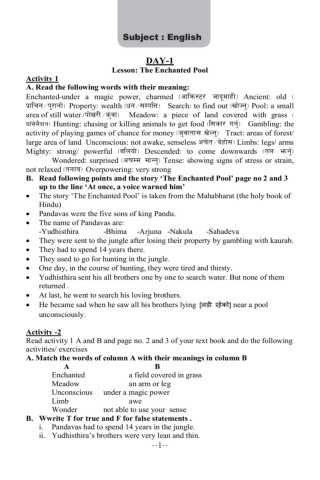
Subject : English DAY-1 Lesson: The Enchanted Pool Activity 1 A. Read the following words with their meaning: Enchanted-under a magic power, charmed -cflqm:6/ hfb\"dfxL_ Ancient: old - k|flrg÷k/' fgf]_ Property: wealth -wg÷;DklQ_ Search: to find out -vfH] g_' Pool: a small area of still water.-kf]v/L÷s'jf_ Meadow: a piece of land covered with grass - 3fF;d] }bfg_ Hunting: chasing or killing animals to get food -l;sf/ ug'_{ Gambling: the activity of playing games of chance for money -hj' ftf; v]Ng'_ Tract: areas of forest/ large area of land Unconscious: not awake, senseless cr]t÷a]xf;] _ Limbs: legs/ arms Mighty: strong/ powerful -alnof]_ Descended: to come downwards -tn emg_'{ Wondered: surprised -crDd dfGg'_ Tense: showing signs of stress or strain, not relaxed -tgfa_ Overpowering: very strong B. Read following points and the story ‘The Enchanted Pool’ page no 2 and 3 up to the line ‘At once, a voice warned him’ • The story ‘The Enchanted Pool’ is taken from the Mahabharat (the holy book of Hindu) • Pandavas were the five sons of king Pandu. • The name of Pandavas are: -Yudhisthira -Bhima -Arjuna -Nakula -Sahadeva • They were sent to the jungle after losing their property by gambling with kaurab. • They had to spend 14 years there. • They used to go for hunting in the jungle. • One day, in the course of hunting, they were tired and thirsty. • Yudhisthira sent his all brothers one by one to search water. But none of them returned . • At last, he went to search his loving brothers. • He became sad when he saw all his brothers lying [लडी रहेको] near a pool unconsciously. Activity -2 Read activity 1 A and B and page no. 2 and 3 of your text book and do the following activities/ exercises A. Match the words of column A with their meanings in column B AB Enchanted a field covered in grass Meadow an arm or leg Unconscious under a magic power Limb awe Wonder not able to use your sense B. Wwrite T for true and F for false statements . i. Pandavas had to spend 14 years in the jungle. ii. Yudhisthira’s brothers were very lean and thin. --1--
Class-5 iii. He became happy when his brothers didn’t return. iv. They used to go for hunting. v. Pandu was the father of Pandavas. Day-2 Lesson: The Enchanted Pool Activity-1 A. Read these word meaning. -Quench: satisfy, especially thirst -ltvf{ d]6g\\ _' -Rapidly: quickly -Yakshya: mythical character -Possibility: chance -;Defjgf_ -Rescue: release -arfpg'_ -Courage: boldness -cf6F ÷;fx;_ -Wisdom: knowledge -a'bl\\ b_ -Association: union -;Dks{_ - Vessel: pot -efF8f]_ -Keep on: continue -Dharma: good deeds -Fade: weak - sdhf/] _ Read these points. The brothers of Yudhisthira died because they tried to drink water without answering the questions of Yakshya. Yudhisthira was wise man. So,he decides to give the answers of Yakshya’s questions which are listed below: 1. What rescues -arfpg'_ men in danger? –courage -;fx;_ 2. By the study of which science does man becomes wise? – man becomes wise by association with the great in wisdom that he gets wisdom. 3. What is swifter -t]h÷l56f_] than the wind? -The mind 4. What is more faded -sdhf]/_ than a dried straw -k/fn_? -A sorrow- stricken heart 5. What befriends a traveller? -Learning 6. Who is the friend of one who stays at home? – The wife 7. Who accompanies -;fy lbg_' a man in death? -Dharma, it alone accompanies the soul -cfTdf_ in its lonely journey -ofqf_ after death. 8. Which is the biggest vessel? – The earth. It contains all within itself. 9. What is happiness? – happiness is the result of good conduct (behaviour) -/fdf| _] 10. When does a man become loved by all? -when a man gives up pride -uj{÷3d08_ he will be loved by all 11. What is the loss which gives joy and not sorrow? – Anger, if we give up - TofUg÷' 5f]8g\\ '_ anger, we will no longer be subject to sorrow. 12. How can a man become rich? -when a man gives up unnecessary desire - rfxgf_, he will become rich. 13. What makes one a real ‘Brahmana'? Is it birth, good conduct or learning? -birth and learning do not make one ‘Brahmana' but it is good conduct. However -t/_ learned person may be, he will not be a ‘Brahmana' without giving up bad habits. 14. What is the greatest wonder in the world? – Everyday men see creatures (animals) depart -56' \\g÷' hfg_' to Yama's kingdom; and yet those who remain want to live forever. This is the greatest wonder. --2--
English Activity-2 Read activity 1 A and B carefully and copy activity 1 B. Day-3 Lesson: The Enchanted Pool Activity-1 Read the story \"The Enchanted Pool\" once again up to page no. 5. Activity-2 A. Select the most suitable alternative to complete each of the following statements. a. The Mahabharatis ............ i. a Latin epic ii. a Sanskrit epic iii. an English epic iv .a Maithili epic b. The.........is swifter than the wind. i. Mind ii. Sun iii. Moon iv.Fire c. ..........had the strength of sixteen thousand elephants. i. Yudhisthira ii. Bhima iii. Arjunaiv iv. Nakula d. Nakula was the son of ....... i. Draupadi ii. Kunti iii.Madruiv iv. Gandhari e. The Mahabharat narrates a story of the great war between........ i. Ram and Ravan ii. Krishna and Kansha iii. Ram and Shyam iv. Pandavas and Kauravas B. Make sentences of your own by using the following words. Vessel, powerful, creature, courage, possibility Day-4 Lesson: The Enchanted Pool Activity: 1 A. Read these new words meaning. Revive : come back to life Sorrow : stricken: overcome with Ruin : destroy grief Shield : safety ,protection Faint : to become unconscious Disappear : vanish or be out of sight - Sacred : holy Exile : forced stay away from one’s x/fpg_' own place Embrace : hug -cuF fnf] xfNg'_ Depart : passaway, die Might : strength Bereaved : express sorrow Mourn : express sorrow, show grief Pleased : happy Restrain : control, hold back Impartiality : the quality of being fairness -lgikIftf_ Read the following points. • Yakshya became happy with the answers given by Yudhisthira. So, he wanted to give life one of his brothers. • Yakshya said to yudhisthira, “Who do you want to come back to life?” --3--
Class-5 • Yudhisthira said,’Nakula' • Nakula was his stepmother's(Madri) son. Yakshya was happy byhearingthis answer. He gave life to all his brothers • It was Yama, the Lord of Death, who had takenthe form of Yakshya so that he might see Yudhisthira and test him. • Following are the main themes of the story: Wisdom is stronger than strength (power) Gambling never brings good result in our life. Activity -2 A. Read the whole story \"The Enchanted Pool\" carefully. B. Fill in the blanks below with a suitable word selecting from the list. Guested, proud, dharma, preferred, contained a. The pool...... clear water. b. Yudhisthira.......Nakula to his other brothers. c. WhenYakshyawarned Yudhisthira, the latter ....... what had happened to his brothers. d. A man who is ....... of himself ensures him position and wealth are not loved by anybody. e. Doing justice to others in Nepali language is also called............. . C. Find the words which have similar meaning. (Read only page no. 5 &6) Answered, vanished, hugged, power, destroyed Day-5 Lesson: The Enchanted Pool Activity: 1 Read the whole story \"The Enchanted Pool\" carefully. Activity: 2 A. Answer the following questions. a. What did the brothers of Yudhisthir go in search of? b. What did Yudhisthira do when he saw his brothers lying still and silent? c. What would have happened to Yudhisthira if he dad tried to drink from pool without answering Yakshya’s questions? d. Name the Pandavas. e. How diidYakshya reward Yudhisthira? Day-6 Lesson: The Enchanted Pool Activity: 1 Read the whole story \"The Enchanted Pool\" carefully again. --4--
English Activity: 2 Answer the following questions. a. Why had Yama taken the form of Yaksha? b. Whose life did Yudhishthira ask for? Why? c. Whose son was Nakula? d. When were the four brothers of Yudhisthir revived? e. What lesson did you learn from this story? Day-7 Lesson: The Enchanted Pool Activity: 1 Read page no. 2 and 3 carefully again. Activity: 2 Answer the following questions. a. Describe the condition of Yudhisthira when his brothers didn’t return. b. Give a description of the forest in which Yudhisthira went for looking his brothers. Day- 8 Lesson: Parts of speech Activity: 1 Read the following points. All the word in English language do not have same meaning and function in sentences. So, they are placed in different groups. The classification of words into different types is known as parts of speech. For example: Suman plays cricket. • Suman: It is the name of a person. So, it is a noun. It functions as subject because it is a doer. • plays: It functions as verb because it shows action. • cricket: It is the name of a game so it is a noun. It functions as object because it gives the answer of ‘what’ question. There are eight parts of speech in English language. Parts of speech: 1. Noun: Rajan, Pokhara, bag…. 2. Adjective: tall, fat, big….. 3. Pronoun: he, she, it……. 4. Verb: go, sing, play…… 5. Adverb: slowly, tomorrow, there…. 6. Preposition: at, in, on…… 7. Conjunction: and, but, because….. 8. Interjection: alas, wow, hurray…… Activity-2 A. Read activity 1 carefully. B. Make a chart of parts of speeches with five examples of each as shown in activity 1. --5--
Class-5 Day- 9 Lesson: Parts of speech Activity: 1 Read the following points. Noun: A noun is the name of a person, animals, place or thing. Name of person: Sujan, Sunita, Ajaya…… Name of animals: cow, goat, dog ,etc. Name of place: Pokhara, Kathmandu, Biratnagar, etc. Name of thing: pen, book, bag, etc… • Sunita is holding her bag. Noun can be used as subject and object in a sentence. Activity-2 Read the above points and page no. 2 of your text book and do these exercises. 1. Underline the nouns in the sentences. i. The bird is in the cage. iv. Aman is a doctor. ii. There is a book on the table. v. Rita goes to Kathmandu. iii. Avi is drinking milk. 2. Write 5/5 examples of the following. 1. Name of the person: 2. Name of animal: 3. Name of place: 4. Name of thing: Day -10 Lesson: Parts of speech Activity: 1 Read the following points. • Adjective: An adjective is a describing word. It tells us about what kind of, how many, how much, what colour, etc persons, animals, places or things are. • Some examples of adjective are:- big, tall, beautiful, red, old, five, etc. • Use of adjective in sentences. -Sunita is a beautiful girl. -Beautiful describes Sunita. It gives the answer of “What kind of girl Sunita is.” - I have a red car - Red describes the colour of car. Activity-2 Circle the adjectives in the sentences: 1. Bipin is a clever boy. 4. The red bag is empty. 2. Nancy is carrying a beautiful bag. 5. She is very intelligent girl. 3. There are twenty students in class five. Day- 11 Lesson: Parts of speech Activity: 1 Read the following points along with page no. 3 and 4. Pronoun: a word used in place of a noun is called a pronoun. Foor example: he, she, it, they, etc… --6--
English - Sita is a beautiful girl. Sheis 10 years old. • In above sentence the word ‘she’ is used in place of ‘Sita’. So, she is a pronoun. Verb: A verb is a part of speech that tells us about something about a person, animal, place or thing. For example: is, telling, go, play, etc. - Anu cooks food. - The word cooks tells, What does Anu do? So, the verb shows action. - verb tells what persons, animals or things. Activity: 2 Circle the pronouns and underline the verbs in the sentences. 1. Raju wrote a poem. 4. He told him to shut up. 2. The baby is crying. 5. I am playing cricket with my friends. 3. They are watching the television. Day- 12 Lesson: Parts of speech Activity: 1 Read the following points and page no. 4 and 5 carefully. Adverb: An adverb is a word which modifies a verb, an adjective or another adverb. For example: quickly, carefully, slowly, etc. - He ran quickly. The word ‘quickly’ modifies [प�रमाजनर् गनु]र् the verb ‘ran’ It tells, how does he run? Here, ‘quickly’ gives the answer of how question. Preposition:A preposition is word that shows the relation between a noun or pronoun and some other words in a sentence. For example: on, in, at, near, between, etc. - the book is on the table. - the word ‘on’ shows the relation between the nouns ‘book’ and ‘table’. Activity-2 Write 10/10 examples of adverb and preposition. Day- 13 Lesson: Parts of speech Activity: 1 Read the following points and page no. 5 and 6 of book. Conjunction: A conjunction is a word which is used to join words, group of words or sentences. For example: and, but, or, although, because etc. - He sells apples and bananas. -The word ‘and’ joins two words ‘apples’ and ‘bananas’. Interjection: An interjection is a word which expresses some sudden feelings and emotions. For example: Ouch! Alas!, Oh! etc. It always comes with exclamation mark (!). - Hurrah! We won the match. The word ‘Hurrah!’ expresses the feeling of happiness. --7--
Class-5 Activity: 2 A. Read the above activities and page no. 5 and 6 of your textbook. B. Write 5/5 sentences by using conjunction and interjection. Day- 14 Lesson: Parts of speech Activity: 1 Read these sentences and write the words in the proper columns. 1. The bag is in the box. 5. Anu is an honest girl. 2. Wow! It looks wonderful. 6. She gives me pen and copy. 3. Nancy goes to school by bus. 7. I worked hurried to get here on time. 4. He walks slowly. Nouns Pronouns Adjectives Verbs Adverbs Prepositions Conjunctions Interjections Day- 15 Lesson: So You Think You Can Divide Activity: 1 A. Read the following new words with their meaning. Remote: दगु ्रम Disappoint: �नराश हुनु Gloomy : unhappy Suggest: to recommend [प्रस्ताव गनु]्र Eager: keen [उत्साह�/इच्छु क] B. Read the following points and the story. (page no.18 and 19) up to the line:\" but do exactly as their father had suggested\". The main characters [पत्रहरु] in the story. Father – He was an old man. Three son of an old man: -Resham [जेठो छोरा] -Nitesh [म�हलो छोरा] -Lalit [कान्छो छोरा] Seventeen camels of an old man. A holy man [ऋ�ष] and his camel. The old man told his sons not to quarrel over his camel. He suggested them to divide camels according to his wish after his death. Activity: 2 Read page no 18 and 19 of your text book and find the opposite words. a. Happy b. youngest c. city d. apart --8--
English Day- 16 Lesson: So You Think You Can Divide Activity: 1 A. Read the following words meaning. - Funeral: a ceremony of dead person -Stunned: to surprise [past form of stun] [अिन्तम ससं ्कार] -Agree: सहमत हुनु - Obvious: clear -Argument: discussion [छ्लफल/�ववाद] - Quarrel: argue - Scowled: show displeasure B. Read the following points and the story [page no.19 and 20 upto line, you must be crazy!] They started to divide camels among them after their father’s death. It was difficult to divide camels according to their father’s wish because they had only 17 camels. At last, they quarrelled with each other. Activity-2 A. Read the above activity and the story \"So You Think You Can Divide\" page no 18, 19 and 20. B. Write ‘T’ for true and ‘F’ for false statement. i. The old man had 20 camels. iv. Lalit was the youngest son. ii. He lived in a town. v. The brother began quarrelling iii. He had three sons. before the father’s funeral. C. Refer to the lines taken from the story and answer the questions. The younger boys were a little disappointed but they did not complain. a. Who were the younger boys? b. What was it that made them disappointed? Day- 17 Lesson: So You Think You Can Divide Activity: 1 A. Read the following word meaning. - Bequeath: to leave personal property to somebody after death means of a will. - Interrupt: to say or do something that makes somebody stop what they are saying or doing. - Inheritance: उ��र�धकार - Fist: मुट्ठ� B. Read the following points and page no. 20. A holy man camewith a camel while they were quarrelling. He stopped them to quarrel. Resham told him about their problem. The holy man ready to solve their problems by giving them his own camel. --9--
Class-5 Activity: 2 A. Read the story from page no. 18 to 20. B. Find the words which have similar meaning to the following . a. Sacred b. nearer c. well d. desire Day- 18 Lesson: So You Think You Can Divide Activity: 1 A. Read the following word meaning. - Amazement: a feeling of great surprise - Struck: past form of strike. - Strike: to hit somebody or something with force B. Read the following points and page no. 21 of your text book. With the holy man’s camel Resham got nine camels. Nitesh got six camels. now they had a total of Lalit got two camels. eighteen camels. The main theme/lessons we learn from this story is listed below: - Every problem can be solved in peaceful manners. Activity: 2 A. Read the story \"So You Think You Can Divide\" B. Put the following sentences into proper order. i. The holy man gave his own camel to the three brothers. ii. The brothers were able to solve the problem. iii. The man looked like a holy man. iv. The argument went on and on. v. The brothers now had a total of eighteen camels. vi. The holy man wanted to help them. vii. The old man lived in a remote village. Day- 19 Lesson: So You Think You Can Divide Activity: 1 Read the story \"So You Think You Can Divide\" carefully. Activity: 2 Answer the following questions: a) What was the name of the youngest son? b) How many camels did the father want to give to Nitesh? c) Who would get the largest share? What was the share? d) What was Lalit’s idea? Was it a good one? e) What was the eldest brother’s reaction to the idea of the youngest brother? Day- 20 --10--
English Lesson: So You Think You Can Divide Activity: 1 Read the whole story\" So You Think You Can Divide\" again. Activity: 2 3. Did the brothers accept the holy man’s Answer the following questions. offer? 1. What happened when the argument 4. Were all brothers happy in the end? was at its height? 5. What is the moral of the story? 2. How did the holy man help the brothers? Day- 21 Lesson: So You Think You Can Divide Activity: 1 Read the story \"So You Think You Can Divide\" again. Activity: 2 Rewrite the whole story in one paragraph in our own words. Day- 22 Lesson: Noun: Its Kinds Activity: 1 Read page no. 11 of your text book and these points: Noun: A noun is the name of a person, place or thing. For example: Aman, cow, bag, Pokhara, etc. There are five kinds of noun: Common noun: boy, girl, city, etc. Proper noun: Krish, Riya, Koshi, etc. Collective noun: class, family, army, etc. Material noun: gold, water, salt, etc. Abstract noun: honesty, music, truth, etc. Activity :2. Write the kinds of noun with 5 examples of each. Day- 23 Lesson: Noun: Its Kinds Activity: 1 Read the following points and activity 12. Common noun: A noun is called a common noun when it gives a common names to person, places, animals or things of the same kind. For examples: book, cat, bus, etc. Proper noun: A noun is called proper noun when it names as a particular [एउटा मात्र] person, place or thing etc. f or example:Rajan, Kathmandu, Koshi, etc. --11--
A proper noun always begins with capital letter. Class-5 Koshi is a river. Kathmandu gun Activity: 2 Put these words under correct headings. Girl cow Ravi Holi newspaper school train magazine Monday nurse Proper noun Common noun Day -24 Lesson: Noun: Its Kinds Activity: 1 Read page no. 12 in your textbook carefully. Activity: 2 Circle the proper nouns and underline the common nouns in the sentences. 1. Nepal is our country. 4. They are playing with stones. 2. Kunti is an intelligent girl. 5. Mr.Khadka is my brother. 3. I met Amita with her friends. 6. Sunita bought some books today. Day- 25 Lesson: Noun: Its Kinds Activity: 1 Read the following points and page no. 13 of your textbook. Collective noun: A collective noun is the name of a number of persons, animals or things taken together and spoken as a whole. For Example: crowd, class, flock, etc. Material noun: A material noun is the name of substance or material of which things are made. For Example: wood, silver, plastic, etc. Activity: 2 Circle the collective nouns and underline the material nouns in these sentences. 1. Our team easily won the match. 6. There are twenty students in our class. 2. Gold is an expensive metal. 7. Tin is used to give a coating to iron. 3. The bucket is made of plastic. 8. Brass is yellow in colour. 4. The army fought bravely. 9. This committee has ten members. 5. The old man asked for a bundle of 10.The audience enjoyed the show. sticks. Day- 26 Lesson: Noun: Its Kinds Activity: 1 Read the following points and page no. 14 of your textbook. --12--
English Abstract noun: An abstract noun is the name of some quality, idea or feeling that we can only think of and see but cannot touch. For Example: honest, truth, courage, etc. Activity :2 Find abstract nouns in these sentences. 1. Honesty is the best policy.- Honesty, Policy 2. Her kindness was rewarded. 3. I am happy for his success. 4. Sunita has great courage. 5. The innocence of the child attracted all. 6. Pleasure and pain go together. 7. He could not speak because of fear. Day- 27 Lesson: Noun: Its Kinds Activity: 1 Read these points and page no.15, 16 of your textbook Countable nouns: Countable nouns refers to those nouns that we can count. For example: pen, boy, book, hen, etc. Countable nouns have two forms: singular and plural. They can b used with numbers and quantifying expressions such as many, several and few. -She has a book. -She has many books. Uncountable nouns: Uncountable nouns refer to those nouns that we cannot count. For Example: ice, water, sugar, etc. Uncountable nouns have only one form singular. For eg. -Milk is good for health. Activity-2 A. Read page no. 15 and 16. B. Write 10/10 examples of countable and uncountable noun. Day- 28 Lesson: Noun: Its Kinds Activity: 1 Read these points and page no. 16 of your textbook. Quantifiers come with different nouns. 1. A, an, are, this, that + singular countable nouns. He has a red pen.- singular countable noun 2. These, those, several, many + plural countable noun. -I have many books. – plural countable noun. 3. Much, a little + uncountable nouns - There is much sugar in my tea. – uncountable noun --13--
Class-5 4. Many, a few + countable nouns plural -He reads a few poems aloud.- plural countable noun Activity :2 Correct the following expressions. A . He has bought much books. –He has got many books. b. Thee were much chairs in the hall. c. This books are useful for me. d. I have drunk a few juice. e. This is a bamboo chairs. Day- 29 Lesson: Noun: Its Kinds Activity: 1 Read these points and page no. 18 and 19. Singular and plural: Nouns have two numbers singular and plural. Singular nouns refer to only one person animal, place or thing. For example: boy, cat, bag , etc. - A table has four legs.- only one table Plural nouns refer to more than one person, animal, place or thing. For Example: boys, cats, dogs etc. - The dogsare barking.-many dogs. Generally, we add –s, -es, -ies, -ves to singular nouns to change them into plural. Boy-boys city-cities class-classes calf-calves Activity: 2 A. Read and write all the rules to change singular noun into plural from. ( page no. 18 and 19.) B. Write the pluralform of the following nouns. Horse- mouse- bus- knife- box- child- woman- Lady- fly- tooth- Day- 30 Lesson: Noun: Its Kinds Activity :1 Read these points and page no 20 and 21. Apostrophe: Apostrophe (‘),is a sign which is used to show ownership and belongings. -This is Anu’s bag. - It shows that’bag’ belongs to Anu. We use apostrophe (‘) to nouns on the basis of the following rules. -singular nouns + (‘) = boy’s bag -most plural nouns+ (‘) = boy’s bags -plural noun without (‘s)= children’s parks --14--
English Activity: 2 Look at the example and make similar expressions with apostrophe. a. Hari has got a son. He is fourteen. –Hari’s son is fourteen. b. Ravi has got a sister. She is very pretty. c. Julee has got a son. He is thirteen. d. My mother has got a brother. He is a doctor. e. Neena has got a daughter. Her daughter is very tall. Day: 31 and 32 Test yourself Group A (Objective Question) 1. Fill up the blanks by choosing the correct answers from the alternative. (10×1=10) a. The moon goes round ……… earth. (a, an, the) b. He came here ………. 10 o’clock. (in, at, on) c. She …….. a pen. (have ,has, is) d. Honesty is the best policy. The underlined word is an example of …………… noun. (collective, proper, abstract) e . Aman always goes to school. In this sentence the word ‘goes’ is an example of …………. . (noun, verb, prepositions) f . She likes bread …….. honey. (but, and, therefore) g. There was a small but near the ……… . (see, sea) h. There were eighty people in the ………. . (ship, sheep) i. There are many …….. in your cupboard. (mouse, mice) j. Goats ……….. grazing in the field. (is ,am, are) Group ‘B’ (Subjective Questions) Read the passage below and do the activities that follow. Long ago, in ancient times, the pandavas were sent to the jungle after losing their property by gambling. They had to spend fourteen years there .When they were in the jungle, they would go hunting. One day in the course of hunting, they felt tired and thirsty. So, Yudhisthira sent his brothers to search for water. His brothers got ready to go. One brother went, did not return. So, Yudhithira sent all of his four brothers; Bhima, Arjuna, Nakula and Sahadeva one after the another. But none of them returned. This made Yudhistira worry and finally decided to search for his losing brothers himself. Yudhisthira went in the direction his brothers had gone and kept on walking through tracts full of wild bear, spotted deer and big forest birds. After sometime, he came upon a beautiful green meadow. There was a pool of clear water. He saw his brothers lying there. They all were unconscious. Seeing this he became tense .He touched the faces of Bhima, Arjuna, Nakula and Sahadeva. They were lying still and silent. --15--
Class-5 A. Fill in the blanks. [2×1=2] a. ThePandavas were sent to …………….. . b. Yudhisthira sent his brothers to search for …………….. . B. Answer the following questions. [3×2=6] a. What did the brothers of Yudhisthira search ? b. Why did Yudhisthira worry about his brothers ? c. Who were lying still and silent beside a pool of clear water ? 2. Read the passage below and do the activities that follow. The honeybee is one of the man’s best insect friends. It has been valued for centuries as the source of honey. However, the honeybee’s greatest value is the role it plays in distributing pollen among plants. In olden days farmers in the USA took pollination for granted when they discovered that honeybee colonies placed near their fields doubled and trebled the crop yield. They gained a new respect for the busy bee. Now in the USA beehives are moved from crop to crop as needed, and farmers are glad to pay the service. When a bee finds a particularly rich source of nectar and wants to tell his fellow workers the good news, he goes into a special twist dance. The movement tells the other bees how far to reach the nectar-loaded blooms and in what direction. The number of turns indicates the distance and direction is given in relation to the sun. A. Find the similar words from the passage of the following words. [4×1=4] -Found -Achieved -Required -Wealthy B. Answer the following questions. [4×1=4] 1. Who is man’s best insect friend ? 2. What did the USA farmers discover about honeybee ? 3. Why does a bee go into a special twist dance ? 4. How is the distance indicated ? 3. Punctuate the following sentence. [2×0.5=1] amit buys books copies and pens. 4. Construct the meaningful sentences of your own by using the following words. [3×1=3] a. Festival b. Worship c. Strong 5. Write a short paragraph about ‘Cow’ . [5] Day-33 Lesson-A Letter to God Activity-1 Read the following word meaning. Crest : top of a hill Crop : अन्नबाल� Ruin : destroy Supper : food taken before going to bed Severe : extreme [प्रचण्ड/कडा] Situated : located Read the following points and page no.32 if the text book . Main characters of the story 1. Lencho - A hard working farmer 2. Wife --16--
English 3. Two sons 5. Postmaster 4. Postman 6.God • Lencho’s crop was destroyed by snowfall. • Next year, the situation was not good. There was no rainfall on time. Activity-2. A Match the words in list ‘A’ with their meaning in list ‘B’. List ‘A’ List ‘B’ entire peak crest really truly group bunch clear evident total B. Write ‘T’ for true and ‘F’ for false statements. a. Lencho was not a farmer. c. Lencho’s cropland was damaged by b. He had two sons. flood. Day-34 Lesson- A Letter to God Activity: 1 A. Read these word meaning. Predicted : said that something would plague : a kind of disease happen in the future corn : मकै hailstones : frozen ball of ice B. Read these points and page no.33. • Lencho’s cornfield was destroyed by hailstones and wind. • Not a leaf remained on the trees. • He became very said. Activity-2 Read page no. 32 and 33. A. Fill in the blanks with suitable words selected from the list given below. middle totally severe hailstones a. The corn was ……………. destroyed. b. When the storm stopped, Lencho stood in the ………… of the field. c. Once Lencho faced ruin due to ……………. snowfall. d. The whole valley was covered with …………… . Day-35 Lesson- A Letter to God Activity-1 A. Read these word meaning. --17--
Class-5 Immediately : quickly Pesos : the unit of money in latin American countries Faith: trust, belief Envelope: paper wrapper used to enclose letter B. Read the following points and page no.34 of your text book. • Lencho was helpless. • He wrote a letter to God. • He told a hundred pesos (money) to God in the letter. • The postman and postmaster laughed by reading that letter. • They decided to send money to Lencho by the side of God. Activity:2 e. thin Find the opposite word from the page no.34. a. forget b. outside c. happy d. closed Day-36 Lesson- A Letter to God Activity:1 Read these new word meaning. Crooks: dishonest people/thieves Intimately: closely Charity: generosity Contentment: satisfaction Employees: workers Resemble: look like Regarded: looked attentively Reject: refuse Satisfied: content B. Read these points and page no. 35 of your text book. • Lencho got only seventy pesos.So, he was surprised. • He thought that God had sent me hundred pesos but employees of post office had taken other money. • Again, he wrote letter to the God. Activity-2 Fill in the blanks from page no. 35. a. Lencho dropped letter into the …. . c. Postmaster collected money from his .. b. He got only …. Pesos. . d. He put the money in an … . Day-37 Lesson- A Letter to God Activity: 1 A. Read the story \"A Letter to God \" carefully. Activity: 2 following Select the most suitable alternative to complete each of the statements. --18--
English a. ……………… helped Lencho. i. God iii. His children ii. His wife iv. The Postmaster b. Lencho was a ……………… . i. farmer iii. labourer ii. worker iv. teacher c. Lencho thought only of ……………. . i. his wife iii. his hope ii. the help of God iv. his girlfriend d. Lencho’s cornfield was destroyed by …………… . i. flood iii. fire ii. hailstones iv. landslide Day-38 Lesson- A Letter to God Activity:1 Read the whole story \"A Letter to God \"carefully. Activity:2 Answer the following questions. a. Where was the house situated ? d. How did Lencho feel when it began to b. For how long did the hail fall ? rain ? c. What happened during meal time ? e. Who was Lencho ? Day-39 Lesson- A Letter to God Activity: 1 Read the whole story\" A Letter to God \"carefully. Activity: 2 Answer the following questions. a. What damage did the hailstone do ? b. What did Lencho write in the letter to God ? c. Why did the postmaster laugh at Lencho’sletter ? d. When did Lencho receive the letter ? e. Lencho had only ‘one hope’ . What was it ? Day-40 Lesson- A Letter to God Activity: 1 Read the whole story again. Activity: 2 Answer the following questions. a. How did the hailstones affect lencho’sfields ? b. Why did lencho write a letter to God ? c. Who received the letter and how did he help Lencho ? d. How did the post-office employees help Lencho ? --19--
Class-5 Activity-1 Day-41 Read the following points. a, an and the are called articles. Lesson: Articles Articles Indefinite definite (‘a’ and ‘an’) (the) ‘A’ and ‘An’ are called the indefinite article because they are used to speak of any persons or things in general. For example a. An ox was grazing in the field. In this example, an ox means any ‘ox’ , there is no specification about ‘ox’. ‘The’ is called definite article because it is used to point out some particular persons or things in general. It specifies persons or things in particular. For example a. The milk in this glass is pure. In this example the use of ‘The’ with milk makes it definite. Activity:2 Read the above activity and write it in your note copy. Day-42 Lesson: Articles Activity: 1 Read the following points. ‘A’ is used before the singular countable noun beginning with a ‘consonant sound’. a man a boy ‘An’ is used before the singular countable noun beginning with a ‘vowel sound’. an axe an umbrella Activity:2 Read page no.29 of your text book and write it in your copy. Day-43 Lesson: Articles Activity:1 Read page no.29 of your text book carefully. Activity:2 e. …. ape and ….. monkey. Add A or An. f. .. honest man and … dishonest boy. a. …… pen and ….. copy. g. …… hour and ….. minute ago --2h0.--……. Student in …… uniform. b. ….. bat and …… ball. c. …… elephant and ….. whale. d. …… egg and ….. slice of bread.
English j. …. interesting book and …. colourful pencil. i. … Nepali boxer and …. Indian cricketer. Day-44 Lesson: Articles Activity-1 Read the following points. We use ‘the’ with the following nouns. • Before the names of holy books. The Bible The Vedas • Before the names of rivers,seas,oceans and mountain range. The KoshiThe Pacific The Himalayas • Before the names of musical instruments. The madalThe guitar Activity-2 Read and write the page no.30 of your text book from definite article ‘the’ up to universal objects of page no.31. Day-45 Lesson: Articles Activity: 1 Read page no.31 of your text book. Activity: 2 Copy page no.31 of your text book only the part of ‘No Article’ . Day-46 Lesson: Articles Activity:1 Read the whole lesson \"Article\". Activity:2 Use articles where necessary. a. We usually have …… dinner at seven g. They speak …. Nepali fluently. o’clock. h. David is ….. strongest boy. b. ……. Linda loves listening to radio. i. Aman is …….. student. c. They went to London by …… plane. j. The koshi is …… biggest river of d. He plays …….. tennis very well. Nepal. e. Can you play ….guitar ? k. She bought …… umbrella. f. She has bought …. expensive gold ring. --21--
Class-5 Day-47 Lesson: Articles Activity:1 Read the whole lesson. Activity:2 g. Prem is ….. tallest boy in the class. Use articles where necessary. a. Have …. nice day! b. I am …… engineer. h. Babita is …… one-eyed girl. c. ……. Cats are afraid of …. dogs. i. We usually have …. Breakfast d. They work in …… office. together. e. ……..Water is necessary for survival. j. Kathmandu is …… capital of Nepal. f. …….. sun is in the sky. Day-48 Lesson: The First Man on the Moon Activity:1 A. Read the following word meaning. roared- made a very loud deep sound crawl- to move forward on your hands trail- a long line or series of marks left and knees by vehicles tunnel- a passage or way astronauts- people whose job involves spacecraft- a vehicle that travels in space travelling and working in a spacecraft instruments- tools companions- friends orbit - a curved path around a planet B. Read the following points and page no.50 and 51 of your text book up to line “to complete their work on the moon.” • Neil Armstrong, Michael Collins and Edwin Aldrin were three astronauts. • They were the first men who went to the moon in the world. • They went to the moon on 20th July 1969 by rocket(Apollo 11). • Neil Armstrong and Edwin Aldrin entered to the moon by a small spaceship(Eagle). Activity-2 Write ‘T’ for true and ‘F’ false statements. a. The name of the small space is Eagle. b. Neil Armstrong, Michael Collins and Edwin Aldrin were teachers. c. They went to moon on 20th June 1969 d. The rocket went to space from Japan. e. The first part of their journey was boring. Day-49 Lesson: The First Man on the Moon Activity-1 A. Read the following word meaning. -crater: a large hole - moonscape: a view of the surface of the moon --22--
English -Scatter: to separate and go in different directions -steer (past form-steered): to control the direction in which the vehicle is moving B. Read the following points and page no.51 of your text book. • Neil Armstrong and Edwin Aldrin saw a crater scattered with huge rocks in the moon. • They took rest for several hours inside the Eagle. • Armstrong opened the door of the Eagle at 10:40 pm. This moment was seen by thousands of people around the world on their televisions. • They wore spacesuit and helmet. • The weather on the moon is sometimes very hot and sometimes very cold. Activity - 2 Match the words in list ‘A’ with their meaning in list ‘B’. List ‘A’ List ‘B’ 1. roar friend 2. exciting to throw or drop things in different directions 3. companion to make a very loud deep sound 4. scatter causing great interest 5. flash shine very bright for a short time Day-50 Lesson: The First Man on the Moon Activity- 1 A. Read the following word meaning. - giant: very big -awkwardly: making you feel embarrassed–stuck: unable to move–-breeze: light wind-unfurl: to open or to make something open–stiffened: to make yourself straight and still -gravity: force of the earth that attracts objects in space. B. Read the following points and page no.52 upto line “They collected samples of moon rock and soil.” • Armstrong and Aldrin spent two and a half hours on the moon. • They stuck (put) the American flag into the moon soil. • There is less gravity on the surface of moon. So, they walked slowly there. • They collected samples of moon rock and soil to research. Activity- 2 Read page no.50,51 and 52 of your text book.. A. Complete the following sentences. a. Mission control consisted of …… c. From Houston,America ………… . b. The Eagle travelled ………………. . d. At 4:17 pm …………… . B. Using the following words make sentences of your own. a. record b. immediately c. gravity d. giant --23--
Class-5 Day-51 Lesson: The First Man on the Moon Activity- 1 A. Read the following word meaning. - Splash: to fall noisily onto a surface, especially liquid - Lonely: to be single and feel unhappy - Moonscape: a view of the surface of the moon - Wonderful: very good B. Read the following points, and page no. 52 and 53 of your text book. • At 1:15 am, on 21st July, the two men climbed back into the Eagle. • Moon looked beautiful with its soft grey dust,grey rocks and wide open craters. • Earth looked like a blue lamp from the space. • On 24 July, Apollo 11 splashed down safely into the pacific ocean. Activity-2 Read the whole text \"The First Man on the Moon\". A. Put the following statements in the proper order. i. After many hours, the space-ship entered the orbit of the earth. ii. The most exciting journey of their lives was over. iii. Armstrong and Aldrin left behind on the moon their backpacks and things. iv. Armstrong’s leg floated down slowly. v. Thousands of people around the world watched this wonderful moment on their televisions. vi. Armstrong and Aldrin stuck the American flag into the moon soil together. Day-52 Lesson: The First Man on the Moon Activity-1 Read the whole text \"The First Man on the Moon\". Activity-2 Find words in the text which have the similar meaning to the following. a. Head of a republican state b. At oncec. Sealed pressurized suit for an astronaut in outer space. d. Protective head covering worn by police motorcyclists. e. Fell into water by making drops of it fly everywhere. Day-53 Lesson: The First Man on the Moon Activity-1 Read the whole text\" The First Man on the Moon\" carefully. Activity-2 Answer the following questions. a. When did the Apollo 11 rocket roar into space ? --24--
English b. Who were the astronauts going on the longest and fastest journey ever to the moon ? c. What did Armstrong and Aldrin do as they were in the orbit of the moon ? d. What amazing thing happened when the two astronauts entered a small space ship ? e. When did the Eagle land on the moon ? Day-54 Lesson: The First Man on the Moon Activity-1 Read the whole text \"The First Man on the Moon\" carefully. Activity-2 Answer the following questions. 1. Describe the appearance of Armstrong when he opened the door of the Eagle ? 2. Describe how Armstrong came out of the Eagle and landed on the moon. 3. What did he say slowly and in a deep voice ? 4. How did they speak to the president of the US ? 5. Did they come back safely to the earth ?How ? Day-55 Lesson: Self-assessment Activity: 1 A. Read the following points and page no. 38 and 39. Sentence: - A sentence is a group of words that gives complete sense. For example: The goat has horns. Words in a sentence must be placed in proper order to give complete sense. A sentence always begins with a capital letter and ends with full stop (.) or a question mark (?) or exclamation mark (!) There are four types of sentences. Types of sentences 1. Assertive sentence 3. Imperative sentence 2. Interrogative sentence 4. Exclamatory sentence Assertive Sentence: A sentence that says or states something is called an assertive sentence. For example: Riya brushes her teeth every morning. Activity-2 A. Read above activity again. B. Rearrange these words to make assertive sentences. a. nurse / Bimala / is / a b. became / my uncle / man / a rich c. mountains / are not good / the roads / in the d. Sunita and Binita / the house / the owners / of / are e. of the country / an / honest / man / the leader / should have been --25--
Class-5 Day-56 Lesson: Self-assessment Activity-1 A. Read the following points and page no. 40 Interrogative sentences: A sentence that asks a question is called an interrogative sentence. It ends with a question mark (?). For example: Are you a student? Activity-2 A. Rearrange these words to make interrogative sentences. a. is / she / beautiful / a / girl /? d. eating / is / a food / who / spoon / b. a / his / is / father / teacher /? with /? c. she / beautifully / dance / does /? e. treat / patients / a doctor / does /? Day-57 Lesson: Revision: Sentence Activity-1 A. Read the following points and page number 41 of your text book. Imperative sentences: A sentence that expresses a request, command or advice is called an imperative sentence. For example: Come here. Activity-2 Rearrange these words to make imperative sentences a. the / ball / throw d. in / beaker / pour / solution / the / a b. nail / your/ trim e. slight / burner / the / bushes c. candle / the / light / please Day-58 Lesson: Revision: Sentence Activity-1 A. Read the following points and page number 42 of your text book. Exclamatory sentence: a sentence that express a strong feeling is called and exclamatory sentence. It ends with an exclamation mark (!). For example: what a lovely dress! Subject and Predicate: These are the parts of sentence. Subject – A noun or a pronoun comes as the subject in a sentence Predicate – It includes verb and object For example They built a house Subject (pronoun) (verb) (object) [predicate] Activity-2 A. Separate the subject and predicate in these sentences. --26--
English 4. We won the match. 5.David writes neatly.6.Riya is good at 1.The baby is crying. 2.The hen lays eggs. drawing. 3.An elephant is a big animal. Predicate is crying Subject The baby ……………… ………………… ……………… ………………… Day-59 Test yourself 1. Fill in the blanks by picking the right answer from the alternatives. 20×1=20 a. I have useful thing. (a, an, the, nothing) b. There is piano at my home. (a, an, the, nothing) c. He is S.P. (a, an, the, nothing) d. They are very honest students. (a, an, the, nothing) e. David is strongest boy. (a, an, the, nothing) f. They speak Nepali fluently. (a, an, the, nothing) g. Cow gives us milk. The underlined noun is an example of noun. (common, collective, proper) h. They are playing football. The underlined word is an example of . (verb, pronoun, adjective) i. The plural of ‘man’ is. (mans, men, mens) j. A came and sat on the flower. (be, bee, b) k. She waited me for an .(hour, our, nothing) l. you reading book now? (Do, What, Are) m. doing now? (What you, what are you) n. What a clever boy ! (he is, she is, is he) o. Come here. This sentence is an example of sentence. (interrogative, imperative, exclamatory) p. The plural of ‘tooth’ is .(tooths, teeth, teeths) q. The boys in a hostel. (live, lives, lived) r. They happy yesterday. (was, were, is) s. He has got long . (hair, hare, here) t. He didn’t a story. (write, wrote, written,) Group ‘B’ (Subjective Questions) 2. Read the following text and and do the activities that follow. Long ago, there was only one house situated in a whole valley which was situated on the crest of a low hill. Lencho was a hard-working farmer of that village. Once he faced rain due to severe snowfall. It caused total damage to his crops. So, he felt hopeless. As a result, he thought he would write a letter to god asking him to send money. --27--
Class-5 The next year too, the situation was not good. The farmer needed rainfall for his crops. One morning he spent the whole time looking at the sky towards the North- East. “Now we’re really going to get some water, woman”, he told is wife. The woman, who was preparing super, replied: “Yes, if god is willing.” His older sons were working in the field, while the smaller ones were playing near the house. The woman called to them all: “come for dinner……….” A. Find the similar words. [4×1=4] a. Required b. Having no hope c. Condition d. The meal eaten at night B. Answer the following questions. [4×1=4] a. Where was only one house situated? b. Who was a hard-working farmer? c. Why would the farmer write a letter to the god? d. Who were working in the field? 3. Read the following text and do the activities that follow. Once there lived an old man in a village. He had three sons and seventeen camels. The father was very old and one day he called his sons and suggested them not to quarrel over his camels after his death. For this he divided the camels in this way. He called his first son Resham and told him to take half of the camels, the third of the camels were given to Nitesh, the second child. And the ninth of the camel were given to Lalit, the youngest child. Although the boys were disappointed, they agreed to their father and promised not to quarrel. Soon the old man died and the boys got down to their business of sharing out the camels. Resham said, “father wanted me to have half of the camels but half of seventeen is eight and half; how can I take half a camel? The best idea would to be take nine for me, and you two divide the rest”. The other two did not agree with him so they could not share the camels. Finally, a holy man came and gave them a camel. Then, they shared the camel according to the order of their father Resham took nine, Nitesh took six and lalit took two. But they were surprised because one camel was still left and it was the holy man’s camel. A. Put the following sentences into correct order. [4×1=4] i. The holy man gave his own camel to the boys. ii. The old man lived in a village iii. The boys quarreled for camels iv. The old man died B. Answer the following questions. [4×1=4] i. What was the name of the youngest son? ii. How did the holy man help the boys? iii. Who got the largest share? iv. What did the old man suggest? 1. Read the following text and ana do the activities that follow. It was the summer season. The day was very hot, when a crow became thirsty. He flew hither and thither in search of wate-r-.2B8u--t he could not find water anywhere.
English After sometime, the crow came across a pitcher that was lying under a tree. She peeped into it, and found that there was water, but at a very low level, and it was not possible for him to suck it with his beak. He was disheartened. But he did not leave the place because the presence of water in the pitcher made him eager to drink it. The crow’s eyes suddenly fell on a heap of pebbles which were lying under a nearby tree. A wonderful idea came to his mind that by dropping the pebbles into the pitcher, the level of the water could be brought to a higher level. So, he began to drop the pebbles one by one into the pitcher, and finally the level of the water was raised by the process, and he drank it. A. State “T” for true and “F” for false statements. [4×1=4] a. The crow saw a pond. b. Wonderful idea came to his mind. c. He did not leave the place because of water in the pitcher. d. He saw the water everywhere. B. Answer the following questions. [4×1=4] a. Which season was it? b. What type of day was it? c. Why did crow fly hither and thither? d. How did crow succeeded to drink water? 2. Read the following text and do the activities that follow: It was the first night of 2016, all my family members were asleep. But I was awake listening to radio program. Prakriti, I had sent an answer to the question asked in the program and it was about to declare the winners. The prize was ticket to the central zoo for three winners. My heart was both hopeful and hopeless at the same time. When program host Milan Timilsina announced my name along with other two winners, I became ecstatic. I share this happiness with my family members the next morning. After completing my exam, my sister Samjhana and I headed to the FM radio station to collect my prize on January 7. After providing basic information like name, phone number, address and so on at the station, I was given a piece of paper. Showing that piece of paper, we could enter inside the zoo. So, rushed to the central zoo from there. It was my first visit to FM radio station and I was very happy. A. Match the following words with their opposite words. [4×1=4] a. Last i. sent b. Loser ii. Hopeful c. Hopeless iii. First d. Received iv. Winner B. Answer the following questions. [4×1=4] a. Which was the program the writer listening to? b. Where did writer go after showing a piece of paper? c. Why was the writer awake up to late at night? d. Who was the program host? 5. Punctuate the following sentence. [4×0.5=2] Ramesh looked pleased “thank you father, “he said”. 6. Write a readable story with the h-e-l2p9o-f-the following hints. [5]
Class-5 One day a crow………... thirsty……...flew. …………. water……. but……..unable….. shortly after………. pitcher ………... unfortunately……... too low……... to reach …………. tried to ………... upset………… but ……... A new idea ……. Brings pieces of stones……...drops ……… the level of water rises ……... quenches……… Moral: wisdom is stronger than strength. 7. Change the following sentences as instructed in the brackets. [6×1=6] a. The girls are singing. [into interrogative] b. They were happy. [into negative] c. He works hard. [into negative] d. They know me. [into interrogative] e. My friends aren’t helping me. [ into affirmative] f. Gita didn’t write a poem. [into affirmative] 8. Write a meaningful sentence of your own by using the following words/phrases. [4×1=4] a. Keep on b. Limbs c. In order tod. Rain 9. Write an essay on \"My School \"in about 120 words. [6] *THE END* --30--
ljifo M g]kfnL lbg M Ps kf7 M ufpF3/ -sljtf_ cWoog v08 tnsf sljtf kª\\lQmx¿ /fd/| L k9 / To;eGbf tn lbOPsf s'/fx¿df Wofg b]pm M ;fg} eP tfklg ufpF xfdf| ] kf/f}F pHofnf] cem x'G5 /fd|f] of] ufpF aGbf slt yf]s aG5 of] aGg 5f8\\bf dg w/] ?G5 . dfly ‘ufp3F /’ sljtfsf rf/ kª\\lQm lbOPsf] 5 . sljtfsfrf/ kªl\\ QmnfO{ Znfs] elgG5 . dflysf] sljtfz+ df klxnf] / bf;] |f] kª\\lQmdf /x]sf ‘xfdf| ’] / ‘/fd|f’] zAbx¿ pRrf/0f ubf{ p:t} p:t} ;l' gG5g\\ . To:t} t];f| ] / rf}yf] kªl\\ Qmsf ‘aG5’ / ‘?G5’ zAb p:t} ;'lgG5g\\ . pRrf/0fdf p:t} ;l' gg] / p:t} no cfpg] zAbnfO{ cg'k|f; elgG5 . uLt / sljtfdf cg'kf| ;sf] lgs} dxŒj x'G5 . o;n] sljtf jf uLt dL7f] agfp5F . ‘xfd|f’] / ‘/fdf| ’] ‘aG5’ / ‘?G5’ cEof; v08 dflysf] sljtf+z / To;kl5 lbOPsf] cgR' 5]b ltdLn] cjZo} kl9;Sof} . ca tnsf kZ| gsf] pQ/ bp] m M s_ dfly sltj6f kª\\lQm lbOPsf] 5 < 3_ ‘ufp3F /’ sljtf s;n] nv] ]sf] xf] < v_ Ps Znfs] df slt kªl\\ Qm x'G5g\\ < ª_ cg'k|f; ePdf sljtf / uLt s:tf] ;'lgG5 < u_ cg'k|f; egs] f] s] xf] < lbg M bO' { kf7 M ufp3F / -sljtf_ cWoog v08 ‘ufpF3/’ sljtf /fd|f/L k9 . cEof; v08 klxnf] lbgsf] cWoog v08df lbOPsf] h:t} u/L tnsf kª\\lQmdf ePsf cg'k|f; ldn]sf zAbx¿sf] hf8] f agfpm M lbg M tLg kf7 M ufp3F / -sljtf_ cWoog v08 ‘ufp3F /’ no xfn]/ afrg u/ .cleejsnfO{ ;'Gg nufpm . gldn]sf] 7fpFdf ldnfpg nufpm . lbg M rf/ kf7 M ufp3F / -sljtf_ cWoog v08 ‘ufp3F /’ sljtf k9\\of} . To;sf] no;uF ldNg] sg' } ljifodf rf/ kª\\lQm sljtf n]v . --31--
lbg M kfrF Class-5 kf7 M ufpF3/ -sljtf_ cWoog v08 tnsf sljtf kªl\\ Qmx¿ k9 . dfG5] p7/] } clg b]z p7\\5 a:tL ;ad} f ;v' zflGt h6' 5\\ 5f8o\\ f}F eg] l/; ;a} ldn]/ of] b]z xfF:g]5 km'nk] mn]/ . cEof; v08 dflysf] sljtf+z cjZo} k9\\of} xfn] f . ca tnsf s]xL kZ| gsf] pQ/ b]pm x} t M s_ b]z s;/L aG5 < 3_ ;a} ldn]/ sg' s'/f 5f8g\\ k' 5{< v_ ;'vzflGt s;/L h6' 5\\ < ª_ ‘a:tL’ / ‘bz] ’ zAbsf] cy{ nv] . u_ ‘ufp3F /’ sljtfsf nv] ssf] gfd nv] < lbg M 5 kf7 M zAbe08f/ cWoog v08 tn s]xL p:t} cy{ cfpg] zAbx¿ lbOPsf 5g\\, ltgnfO{ k9 / cy{ a'em . ;fy} pbfx/0fdf p:t} cy{ lbg] sx] L zAbsf] hf8] L ldnfOPsf] 5, To;nfO{ x]/ . cg'xf/, a9L, /fi6«, yf/] }, dflg;, v§' f, sk8f, dfG5], ldq, afaf, sd, kfp, dx' f/, lktf, n'uf, b]z, w/] }, ;fyL, pbfx/0f M cg'xf/ – dx' f/ a9L – w/] } /fi6« – bz] cEof; v08 dflysf] pbfx/0fdf em}F p:t} cy{ lbg] zAbx¿ 5fg]/ hf]8L ldnfpm . -p:t} cy{ lbg] zAbnfO{ kofo{ jfrL zAb elgG5 ._ lbg M ;ft kf7 M zAbe08f/ cWoog v08 tnsf] pbfx/0fdf lbOP h:t} u/L syfz+ k9 . aflx/, sfnf,] ?g', leq, k\"j,{ pbfpg,' 5p] , 6'Kkf], cFWof/f,] cfsfz, lgbfpg,' lbg, c:tfpg', ;t] f,] lapeF mg,' wtL,{ pHofnf], /ft, xf:g,' klZrd ?g' – xf:F g' aflx/ – leq sfnf] – ;t] f] cEof; v08 != pbfx/0fdf h:t} pN6f] cy{ lbg] afFsL zAbx¿nfO{ hf]8f ldnfP/ n]v . @= ‘g]kfntnsf zAbx¿sf ljk/LtfyL{ zAb ‘ldqtf’ kf7sf] bf];f| ] cgR' 5b] af6 vf]h/] n]v . clg xh/' cfdfn] la:tf/} ;Demfpg vf]Hge' of], æhfGg' eg]sf] lstfj k9]/ dfq hflgg] xf]Og . /fd|/L hfGg' eg]sf] b]Vg', ;G' g', ef]Ug' / cge' j ug{' xf] . w]/–} w]/} dflg;x¿n] w/] } lsl;daf6 bM' v kfP . --32--
Nepali slt hgf kl' /P/ d/] . slt dflyaf6 xfdkmfNbf d/,] slt 3/sf leQf] n8/] d/,] 3fOt] t slt eP slt ¤ clg w]/}sf] 6fps} km'6s] f ¤ oL ;a s'/f b]v]kl5 cem ef]u]kl5 s]s] ug{ x'Fbf/] x]g5 / ss] ] ug{k' bf]{ /x5] eg]/ w]/} s'/f yfxf kfP lg . lstfa klg To:tf] s/' f ;a} b]v]kl5 t nl] vG5 lg, xg} / < s'g} s'/f yfx} gkfO{sg s;n] nV] g ;Snf / <Æ s_ tnsf zAbx¿sf] 7Ls pN6f] cy{ lbg] zAb dflysf] cgR' 5]baf6 5fg/] n]v M a;] /L, ghfGg', gk9]/, g;'Gg,' yf/] }, ;'v, d/g] g\\, tn, gkm6' ]sf, kfPgg\\, g;Snf -sg' } klg zAbsf] pN6f] cy{ lbg] zAbnfO{ ljk/LtfyL{ zAb elgG5 . ljk/LtfyL{ zAbsf] dfWodaf6 klg sg' } zAbsf] cy{ klxrfg ug{ ;lhnf] k5{ ._ lbg M cf7 kf7 M a9fP/ nV] g] cWoog v08 tnsf] sljtf kªl\\ QmnfO{ a9fP/ n]lvPsf] pbfx/0f x/] . dfG5] p7/] } clg bz] p75\\ a:tL ;a}df ;v' zflGt h'6\\5 . dflysf] sljtf kªl\\ Qm ufpF3/ sljtfsf] xf] . of] sljtf s[i0fk|;fb k/fh'nLn] n]Vge' Psf] xf] . dflysf] kªl\\ Qmdf dfG5] ;a} p7/] b]z ljsf;sf nflu sfd ug{] s/' f atfOPsf] 5 . dfG5] sx] L gu/Lsg a;]df ljsf;sf sfd xbF' g} g\\ . ljsf;sf sfd gePkl5 bz] hxfsF f] ToxLF xG' 5 . bz] k5fl8 k5{ . ljsf; lgdf0{ fsf sfd ePkl5 hgtfn] ;v' / ;'ljwf kfpF5g\\ . ;a} hgtfn] ;v' kfPkl5 x/s] a:tLdf zflGt 5fp5F . To;}n] xfdL ;a} ldn/] sfd ug'{k5{ . b]znfO{ dfly p7fpgsf nflu xfdL p7]/ sfd ug'k{ 5{ . ;a} ldn]/ sfd u/d] f bz] ljsf; xG' 5 / xfdL ;an} ] ;v' zflGt kfpF5fF} . cEof; v08 dflysf] pbfx/0f x/] / tnsf kªl\\ QmnfO{ a9fP/ n]v M of] ufpF aGbf slt yf]s aG5 of] aGg 5f8\\bf dg w]/ ?G5 . lbg M gf} kf7 M zAbe08f/ cEof; v08 sf]i7sdf lbOPsf zAbaf6 pxL cy{ lbg] zAb 5fgL hf8] f ldnfpm M s_ afaf – -aa' f, bfh,' lbbL_ ª_ uf]8f – -6fpsf,] xft, v§' f_ v_ au}Frf – -af/L, vt] , km'naf/L_ r_ 3/ – -;x/, ux[ , b/af/_ u_ /ft – -/ftL, lbg, laxfg_ 5_ k9fO – -cWoog, n]vfO, afn] fO_ 3_ ljb]z – -b]z, k/b]z, kb| z] _ lbg M b; kf7 M zAbe08f/ cWoog v08 Jofs/0fsf] k':tsaf6 ljk/LtfyL{ zAbx¿af/] cWoog u/ / a'em . --33--
cEof; v08 Class-5 tn lbOPsf zAbsf] pN6f] cy{ lbg] zAb sfi] 7saf6 5fg / hf8] f ldnfP/ n]v . s_ aflx/ – -dfly, ptf, leq_ ª_ :jb]z – -b]z, dn' s' , ljb]z_ v_ vfg' – -ksfpg', gvfg,' pdfNg_' r_ xf:F g' – -v]Ng,' afN] g', ?g_' u_ 3fd – -kfgL, cfsfz, hg\" _ 5_ hg\" – -rGb|df, jfo,' tf/f_ 3_ 6'Kkf] – -kmb] , sf08, kft_ h_ k};f – -plkofF, ?lkof,F laofF_ lbg M P3f/ kf7 M z'4 n]vg cWoog v08 tnsf] cgR' 5b] /fd|/L k9 . cgh' n] la:tf/} es'G8f] cufl8 a9fof] . ;hnn] /fS] g vfH] of] . cg'hn] v6' \\6f otf / ptf ub}{ ;hnnfO{ 5Sofof] . cg'h ;/f;/ clu a9o\\ f] . ;hnn] cgh' nfO{ k5o\\ fof] t/ e]6\\g ;s]g . cgh' n] es'G8f] nfTtfn] l7Sb} cufl8 nUof] . es'G8f] kf]nlt/ nu/] uf]n xfGg] bfp x]¥of] . ufn] /IfsnfO{ bªu\\ kfb}{ cg'hn] 8o\\ fDd es'G8f]nfO{ nfTtLn] ahfof] . uf]n u/]kl5 dv' ld7o\\ fpbF } ;fyL ePlt/ bf}l8of] . cg'h km'6an v]Ng lgs} l;kfn' 5 . cEof; v08 cgR' 5]bdf ePsf cfwf cIf/ / v§' f sf6s] f cIf/nfO{ tn pbfx/0fdf lbOPh:t} tflnsf agfP/ nv] . cfwf cIf/ k|of]u ePsf zAb v'§§ sf6]sf cIf/ ePsf zAb esG' 8f] v6' \\6f ====== ====== ====== ====== ====== ====== ====== ====== ====== ====== ====== ====== lbg M afx| kf7 M zAb lgdf0{ f cWoog v08 tn wft'af6 zAb agfpg] pbfx/0f lbOPsf] 5, /fd|/L x/] . a;\\ ± Psf] ≠ a;]sf] cfp ± Psf] ≠ cfPsf] vn] \\ ± Psf] ≠ v]ns] f] x]/\\ ± Psf] ≠ x]/s] f] ;t' \\ ± Psf] ≠ ;t' ]sf] kv{ ± Psf] ≠ kv]s{ f] cEof; v08 tn lbPsf wfta' f6 dflysf] pbfx/0fdf h:t} ‘Psf]’ hf8] /] zAb agfpm . lx8F \\, nv] \\, vf, p7\\, kms,{ ag\\, km'6\\, afn] \\, kf]n\\, e'6\\, en' \\ --34--
Nepali lbg M t]x| kf7 M zAb lgdf0{ f cWoog v08 tnsf] pbfx/0f x/] / tn lbOPsf zAbnfO{ tflnsfdf ldnfP/ nv] . ;f; kmg] {] ;f; gkmg] ]{ ufO{ 9ª' \\uf e8] f sf7 3f]8f kmnfd ====== ====== ======= ====== ======= ======= ====== ======= ====== ======= ======= ====== ======= ====== srf}/f, s';L,{ xfQL, rKkn, aQL, af3, la/fnf], sfkL, d;' f, snd, df]afOn, dfG5,] eft, e;}F L, sldnf, O6F f, vf]nf, k/fn, uf8L, r/f lbg M rfw} kf7 M gfd cWoog v08 tnsf] pbfx/0fdf bv] fPemF} tnsf gfdx¿nfO{ ldNg] u/L tflnsfdf nv] . dflg;sf gfd hgfj/sf gfd j:t'sf gfd 7fpFsf gfd /fh' ss' /' afnj' f kf]v/f l/df v/fof] ¿v bdf}nL ====== ====== ====== ====== ======= ======= ======= ====== ======= ======= ======= ======= ====== ====== ====== ======= ====== ====== ====== ======= ======= ======= ======= ====== ======= ======= ======= ====== cGh,' AjfF;f], nfdfrf}/, ;g' , ;ljtf, cfaF v' /} g] L, /d]z, :ofn, x6] f8F} f, cfsl[ t, df6f], /v] f, du[ , /f]lxt, ;/fªsf6] , lu§L, la/fnf], sf7, si[ 0f, u8F} f, /fwf, sf7df8f,F} l;+x, lk|of lbg M kGw| kf7 M cEof;leqsf] kf7 -ki[ 7 M *_ cWoog v08 kf7sf] bf];|f] cgR' 5b] /fd|f cIf/ agfP/ sfkLdf ;f/ . --35--
lbg M ;fx] | Class-5 kf7 M j0fl{ jGof; cWoog v08 tnsf] cg'R5b] /fd/| L k9 / ToxfFaf6 rGbl| aGb' - F _ / /k] m - { _ nfu]sf zAb 5fg]/ nv] . ufOn{ ] 3fF; vfG5 . gld7f] 3fF; lbg] xf] eg] ufO{n] dG' 6f] kmsf{p5F . ld7f] 3fF; lbFbf /dfpF5 . ufO{ /dfof] eg] w/] } bw\" lbG5 . ufOn{ ] afR5f]nfO{ x'sf{p5F . afR5f] a?' sa'?s plkm| G5 / otfplt bu5' { . afF afF ub{} afR5f] s/fpF5 clg ufO{ a's;'{ L dfb}{ afR5f] ePsf] 7fpFdf cfOk'U5 . afR5fn] fO{ s;}n] rnfof] eg] ufOn{ ] l;ªn] lxsfp{ F5 . ufO{n] afR5fnfO{ dfof u5{ . rGb|laGb' nfus] f zAb /]km nfu]sf zAb 3fF; kmsfp{ F5\\ lbbF f xs' fp{ 5F lbg M ;q kf7 M n]vg cEof; v08 tn lbOPsf ab'F fsf cfwf/df ‘d/] f] kl/jf/’ zLif{sdf Pp6f n]v tof/ kf/ . kl/jf/df slt hgf xg' 'x'G5 < kl/jf/df sf] sf] xg' 'x'G5 < kl/jf/df sf] sf] n] ss] ] ugx'{ 'G5 < Psn] csfn{ fO{ s;/L ;xof]u ug{x' G' 5 < ltdLn] sg' sg' sfddf ;xofu] u5f{} < lbg M c7f/ kf7 M kR' 5/sf] s/' f cEof; v08 kv]6f xg' ] kf| 0fL p8\\g ;S5g\\ . kv6] f gx'g] kf| 0fL p8\\g ;Sbg} g\\ . ltdLn] kv6] f ePsf / gePsf ba' y} l/ k|f0fL bv] s] f 5f} xf]nf . kv6] f xg' ] / kv]6f gxg' ] u/L b'O{ ;dx\" df af8F /] To:tf kf| 0fLsf] gfd nv] . lbg M pGgfO;{ kf7 M k'R5/sf] s'/f cWoog v08 ‘kR' 5/sf] s'/f’ kf7 Wofgkj\" {s k9 . cEof; v08 != kR' 5/ x'g] sg' } kGw| kf| 0fLsf] gfd nv] . @= kf| 0fLn] kR' 5/sf] ;xofu] n] s'g sg' sfd u5{g\\ < aFb' f agfP/ n]v . lbg M aL; kf7 M k'R5/sf] s'/f --36--
Nepali cEof; v08 tnsf] pbfx/0f x]/ / pbfx/0fdf h:t} sfd ;uF ldNg] sfd ug]{ cª\\usf] gfd nv] . sfd cª\\u lx8F \\g] uf8] f ;f; kmg] {] gfs af]Ng] ===== :jfb lng] ===== cf8;] nufpg] ===== ef/L afS] g] ===== cfF;' emg]{ ===== sDKo'6/sf] lsaf]8d{ f nV] g] ===== lbg M PSsfO;{ kf7 M k'R5/sf] s/' f cWoog v08 ‘kR' 5/sf] s/' f’ kf7 /fd/| L cWoog u/ . cEof; v08 ufOj{ :ts' f] k'R5/ geP ltgLx¿n] lemFuf / d';g' fx¿ s;/L wkfpnfg\\ < sNkgf u/L kfFr jfSodf nv] . lbg M afO{; kf7 M cg's/0ffTds zAb cEof; v08 != tnsf cgs' /0ffTds zAb / lso| fsf] hf8] f ldnfpm . cgs' /0ffTds zAb ls|of km6fkm6 s'bg\\ ' v/' { a:g' yrSs yS' g' 6\\jfNn lx8F \\g' rdSs x]g{' x\\jf:; rlDsg' x'/{ ;dfTg' kmtSs ldNsfpg' lv:; uGxfpg' rkSs s'lxg' --37--
lbg M t]O{; Class-5 kf7 M Jofs/0f -gfd / ;j{gfd_ cEof; v08 != tnsf zAbx¿ gfd jf ;jg{ fd s] x'g\\ < pbfx/0fdf h:t} 5fg]/ nv] . gfd ;jg{ fd lj/f6 Tof] cd]l/sf pm d:] ;L d u08sL xfdL ===== ====== ===== ====== ====== ====== ====== ====== ====== ====== ====== ====== ====== ====== ===== ====== cho, ltdL, s/] f, s], la:s'6, pgL, tkfO,{F e}F;L, pxfF, t/fO{, Toxf,F gk] fn, tF, tL, sDKo'6/, logLx¿¿ rn' f], slxn], hxfF, rSs,' crf/, h,] l;dG] 6, h:tf,] a/km, nK;L lbg M rfa} L; kf7 M cltl/Qm 1fg cWoog v08 tn lbOPsf hgfj/n] sg' sfd u5g{ ,\\ x/] . e;}F L bw\" lbG5 uf?] vt] hf]T5 la/fnf] d';f df5{ sv' /' f kfl] vPsf] vfg]s/' f vfG5 ss' '/ 3/sf] /Iff u5{ df}/L dx lbG5 cEof; v08 dflysf h:t} cGo rf/ hgfj/ / ltgn] ug{] sfd÷;xofu] sf af/d] f nv] . lbg M kRrL; kf7 M cltl/Qm cEof; cWoog v08 xfdLn] xfdf| cª\\ux¿n] ljleGg sfd u5g{ \\ . To;af/] xfdLn] cl3Nnf lbgdf s]xL s'/f l;Sof}F . ;a} cªu\\ x¿ cfcfÇgf 7fpFdf plQs} dxŒjk\"0f{ 5g\\ . cGo s'g sg' cª\\un] ss] ] sfd u5{g\\ eGg] s'/fdf cleefjs;uF 5nkmn u/ . --38--
Nepali cEof; v08 ‘cfFvfsf] dxŒj’ zLifs{ df ;f7L zAb;Dddf Pp6f nv] tof/ kf/ . -st}af6 ;fg{] sfd gu/L cfkm}F n]Vg] sfl] ;; u/ x} ._ lbg M 5AaL; kf7 M 3dG8 ugx'{ bF' }g cWoog v08 kf7sf] ;'?df lbOPsf zAbfy{ k9 . cEof; v08 zAbfy{ kl9;s]kl5 afafcfdf jf bfO÷lbbLnfO{ zAb ;f]Wg nufpm / ltdL cy{ eGb} hfpm . sltj6f zAbsf] cy{ ldnfof} < cleefjs;Fu ;fw] . -of] cEof; ltdLn] ;a} kf7df ug{ ;S5f} . k6sk6s o;f] u/d] f ltdL w/] } zAbsf] cy{ hfGg] x'G5f} / w/] } s'/f ;lhn} eGg / nV] g ;S5f} ._ lbg M ;QfO;{ kf7 M 3dG8 ugx'{ Fb' g} cWoog v08 ‘3dG8 ug'{xF'b}g’ kf7 Wofgk\"j{s k9 . cEof; v08 kf7 kl9;sk] l5 3dG8 lsg ug{x' G' g eGg] ltdLnfO{ nfUof] < kfFr jfSodf nv] . lbg M c¶fO{; kf7 M 3dG8 ug'{xbF' }g cEof; v08 ‘3dG8 ugx{' 'bF }g’ kf7af6 lj:do;\"rs lrGx - ¤ _, p4/0f lrGx -æ Æ_ / cNklj/fd - , _ k|ofu] ePsf b'O{ b'O{ jfSo vf]h/] nv] . lbg M pgfGtL; kf7 M 3dG8 ugx{' 'Fb}g cWoog v08 tnsf kbfjnL / ltgsf] cy{ /fd|/L a'em . gfs hfg' – OHht hfg' bz] k:g' – ljbz] hfg' sfg vfg' – lbSs nfUg' xft nDsfpg' – rf]g{' egfeg xg' ' – dfl} vs emu8f kg{' lha|f] 6f]Sg' – dg{' dg lbg' – dfof ug{' pbfx/0f M gfs hfg' M k|flKtn] g/fd|f] sfd u/s] fn] ;dfhdf p;sf] kl/jf/sf] gfs uof] . lha|f] 6fS] g' M pbosf xh/' aa' fn] lxhf] a]n'sf lhaf| ] 6f]Sg'eP5, ca pxfFsf] dfof pbon] kfpbF }g . --39--
Class-5 cEof; v08 dflysf kbfjnL / ltgsf] cy{ a'lem;sk] l5 tL kbfjnLnfO{ ko| fu] u/L Ps Ps jfSo lgdf0{ f u/ . lbg M tL; kf7 M zAbe08f/ cEof; v08 tnsf zAbsf] p:t} zAb glbg] zAbdf ufn] f] 3]/f nufpm . s_ h\"g tf/f rGb|df OGb' ª_ afaf lktf nfU] g] hgs b/af/ kf7zfnf v_ cfdf dftf sfsL hggL r_ ljBfno :sn' ;ªu\\ L zq' u_ xfjf ;dL/ jfo' ;d/ 5_ ;fyL ldq 3_ ;db' | dxf;fu/ l;Gw' OGb' lbg M PstL; kf7 M zAbe08f/ cWoog v08 ‘3dG8 ug{'xb'F g} ’ kf7sf] klxnf] cg'R5b] cfjfh lgsfn]/ k9 / cleefjsnfO{ ;'Gg nufpm . sg' s'g zAb k9s] f] ldng] cleefjs;uF ;f]w / z4' pRrf/0f ug]{ tl/sf pxfxF ¿af6 l;s . lbg M aQL; kf7 M 3dG8 ug{x' F'b}g cWoog v08 ‘3dG8 ugx'{ Fb' g} ’ kf7 /fd/| L k9 . cEof; v08 xfjf / ;o\" {n] s;/L cfÇgf] tfut bv] fP < nfdf] pQ/ nv] . lbg M t]QL; kf7 M z4' n]vg cWoog v08 ‘3dG8 ug{'xb'F g} ’ kf7sf] klxnf] cgR' 5b] k9 . cEof; v08 pQm cgR' 5]bdf ‘a’ / ‘j’ ko| f]u ePsf zAb 5fgL 5'§f5'§} nv] . lbg M rf}tL; kf7 M sljtf cWoog v08 tnsf] sljtf Wofgk\"js{ k9 . xfdL g]kfnL –;/' h pkfWofo afaf xnf] hfT] b5g\\ cfdf ;w}F v]tfnL afp;] aGg hfg] /] 7'n] bfO lg o;kfln . --40--
Nepali sxfF k'U5 xfdLnfO{ vt] LkftL gu/L ugk{} 5{ xfdLn] e~Hofª / bp] /fnL u5'{ sfd ;s]sf] d}n] ;fFem laxfg hfg5] }g ljb]z aGg] 5' d ls;fg . ug{}k5{ xfdLn] psfnL / cf/] fnL afaf xnf] hf]Tb5g\\, cfdf ;w}F v]tfnL . xfdL lsGg hfbF }gfF} 3/d} kmN5 t/sf/L kl;gf / kf}/vn] l/Qf] 5}g esf/L xfdf| afn] hflu/ gkfP lg ;/sf/L bM' v 5g} xfdLnfO{ wfgs] } 5f}F v]taf/L . d]/f] bz] gk] fn, y/ d/] f] g]kfnL afaf xnf] hfT] b5g,\\ cfdf ;wF} v]tfnL . -lrn p8o\\ f] cfsfzdf sl[ taf6_ cEof; v08 != dflysf] sljtf no xfn]/ k9 . @= dflysf] sljtfdf Ps cfk;df pN6f] cy{ lbg] zAb ko\\ f]u ePsf 5g\\ . ltgnfO{ 5fg / hf]8f ldnfO{ n]v . lbg M ktF} L; kf7 M pQ/ n]vg cWoog v08 cluNnf] lbgsf] ‘xfdL g]kfnL’ sljtf km]l/ Psk6s k9 . cEof; v08 3_ esf/L s]n] el/Psf] 5 < pQm sljtf k9k] l5 tnsf kZ| gx¿sf] pQ/ n]v M ª_ g]kfndf a:g] ;as} f] y/ sg' xf] < s_ afaf / cfdfn] s] ug'{x'G5 < v_ ljb]z guO{ s] aGg] elgPsf] 5 < u_ pgLx¿ lsg t/sf/L lsGg hfFb}gg\\ < lbg M 5QL; kf7 M zAblgdf0{ f cWoog v08 pbfx/0fdf lbOPemtF} nsf zAbx¿ hf]8]/ Pp6} zAb agfpm M krF} f] ± k}rF f] – PFr] fk] F}rf] tfg ± tfg – ======= ;fgf ± ;fgf – ;fgf;fgf cfÇgf ± cfÇgf – ======= eft ± eft – eft;ft tn ± tn – ======= snd ± snd – ======= 5p] ± 5p] – ======= kfnf] ± kfnf] – ======= --41--
Class-5 lbg M ;t}F L; kf7 M gfd cWoog v08 tnsf zAbx¿ /fd/| L k9 / ae' m M JolQm M ;hn, cfoi' df, lji0f,' cfo'if, ;Ldf, l;d|g, gf/fo0fL j:t' M df6f,] s';L{, vf6, 9f]sf, O6F f, 3/ cflb . 7fpF M kf]v/f, dx]Gb|kn' , sf7df8fF}, bdfn} L, kY[ jLrf]s cflb . cGg M wfg, sfb] f], kmfk/, pjf cflb . wft' M ;'g, tfdf, lkQn, kmnfd cflb . efj M xf;F f,] ?jfO, dfof, 30[ ff, O{iof{ cflb . -JolQm, j:t', 7fp,F efj cflb ae' mfpg] zAb gfd xg' \\ . cEof; v08 dflysf gfddf c¿ tLg tLg gfd yk/] nv] . -klxn] cfkmF} nV] g] k|of; u/ . olb cfPg eg] dfq cleefjs jf lzIfsnfO{ ;f]w]/ nv] ._ lbg M c7t\\ L; kf7 M gfd cEof; v08 tnsf gfdx¿¿Wo] ;a}nfO{ a'emfpg] zAbnfO{ sfkLdf l6k M s_ j}zfv ;fpg rt} jif{ – jif{ v_ ;u' f 8fkF m] r/f do'/ – r/f u_ ul0ft ljifo ;fdflhs gk] fnL 3_ hflt du/ tfdfª u'?ª ª_ km'6an lss| 6] vn] rª' u\\ L r_ t/sf/L eG6f l;dL cfn' 5_ ;okqL km\"n nfn'kft] nfnLu'/f;F h_ e]8f afv|f 3f]8f hgfj/ em_ sf:sL lhNnf ndh'ª :ofª\\hf `_ ef8F f lunf; yfn srf/} f 6_ df5fk'R5]| ;u/dfyf lxdfn cGgk0\" f{ -p:t} cg]s gfdnfO{ Pp6} gfdn] a'emfp5F eg] To:tf] gfdnfO{ hfltjfrs gfd elgG5 ._ lbg M pgfGrfnL; kf7 M aflx/L kf7 cEof; v08 /Ltf cToGt} l;kfn' ljBfyL{ xf] . Psk6s ljBfnodf lgaGw kl| tof]lutf /flvPsf] lyof] . w]/} hgfn] To;df efu lnPsf lyP . /Ltf klg Ps ;xefuL lyO{ .;a}n] lgaGw n]v/] a'emfP . lg0ff{osn] lgaGw Ps Ps u//] x]/] . ;a}hgf glthf ;G' g pT;s' lyP . /Ltfn] Psbd} /fd|f] lgaGw nv] s] f] 5' eGg] dgdg} 7fg]sL lyO{ . p;sf] dgdf klg s;n] /fdf| ] n]Vof] xf]nf eGg] vN' b'nL lyof] . s]xLa/] df lg0ffo{ sn] glthf ;g' fpg -y-f4n2]s-f- lyP . ;a} ;xefuLsf] dg 9's9s' ul//xs] f]
Nepali lyof] . otf /Ltfsf] d'6'sf] w8\\sg l56f]l56f] rNg yfNof] . Pstdf;n] ;'g;fg jftfj/0fdf lg0fo{ sn] k|yd xg' ]sf] gfd lnP . Tof] gfd /Ltfs} lyof] . p;n] w]/k} 6s o:tf k|ltof]lutf lhTb} cfPsL 5] . cEof; v08 dflysf] cgR' 5b] df ‘o’ / ‘P’ ko| fu] ePsf zAb 5fg]/ 5'§f5'§} tflnsf agfO{ n]v . lbg M rfnL; kf7 M l;hg{ fTds cEof; cWoog v08 cluNnf] lbgsf] cgR' 5]b Psk6s km]l/ k9 . cEof; v08 /Ltf lgaGw nv] gdf hfGg] ePh:t} ltd|f ;fyLx¿ klg km/s km/s sfd ug{ hfGg] 5g\\ . tnsf] tflnsfdf cfÇgf ;fyLx¿sf] gfd nv] . l56f] bf8} g] – ================== /fdf| ] gfRg] – ================== /fd|f] km'6an vN] g] – ================== dL7f] uLt ufpg] – ================== xflh/Lhjfkmdf hfGg] – ================== /fd|f] lrq agfpg] – ================== k9fOdf ky| d x'g] – ================== dL7f syf eGg] – ================== sljtf n]Vg hfGg] – ================== w]/} x;F fpg] – ================== sfos{ |ddf g8/fO{ afN] g] – ================== lbg M PsrfnL; kf7 M ljz]if0f cWoog v08 tnsf zAbx¿ cWoog u/ M :jfb M ul' nof,] cldnf,] 6/f]{, gl' gnf], dL7f,] =………===, ==…==, =……=== :jefj M rsrs,] rn' an' ,] aft], 5'Rrf], hftL, ==……==, …====, =……=== cfsf/ M uf]n,] r'Rrf], rf/kf6], lqe'hfsf/, ==……==, ===……=, =…=…== ;ªV\\ of M kfrF , Ps, ;o, nfv, =……===, ==……==, ====…… kl/df0f M w]/}, sd, Hofb}, ax't, =……===, …=…===, ==……== :jfldTj-s;sf_] M /fdsf], xfdf| ,] d]/f,] p;sf] ==……==, ……====, =……=== /ª M /ftf,] ah} gL, ;'Gtnf, kxnF] f,] =……===, ==……==, =……=== -dflysf zAbn] s:tf], slt, s;sf], sg' cflb k|Zgsf] pQ/ lbPsfn] oL zAb ljzi] f0f x'g\\ ._ cEof; v08 dflysf k|To]ssf tLg tLgj6f ldNg] zAb /fvL vfnL 7fpF e/]/ sfkLdf n]v . lbg M aofnL; kf7 M gk] fn xf] gfpF cWoog v08 ‘gk] fn xf] gfp’F sljtf no xfn]/ jfrg u/ . --43--
Class-5 cEof; v08 xfdLn] klxnf] kf7df cgk' |f;sf af/]df 5nkmn / cEof; u/s] f 5fF} . To;nfo{ kml] / Psk6s x]/ / o; kf7df cgk' f| ; ldn]sf zAbsf hf]8L agfpm . h:t} M 7fpF – gfpF xl] //xF\" – v]ln/xF\" lbg M lqrfnL; kf7 M g]kfn xf] gfpF cWoog v08 ‘gk] fn xf] gfp’F sljtf Wofgk\"j{s k9 . cEof; v08 pQm kf7 kl9;s]kl5 tnsf jfSox¿ l7sa]l7s 5'6o\\ fpm M s_ gk] fn n]sa]F;L / t/fO{ ldn]/ ags] f] 5 . v_ gk] fn sxLF uP klg xl] //x\"F h:tf] nfubg} . u_ xfdL gk] fnL al3gLsf aRrfh;/L g} xl' so{ f}F . 3_ bz] xfdL ;as} f] ;femf xf] . ª_ s;}sf] vfO] /f] vGg] / l5s{] xfGg] afgL /fdf| ] xf] . r_ ;a} h6' o\\ fF} eg] b]z aGbg} . lbg M rfj} fnL; kf7 M g]kfn xf] gfpF -j0fl{ jGof;_ cEof; v08 pbfx/0fdf lbOPh:t} Psf/, Ps] f/, cfs] f/ / cfs} f/ nfus] f kfrF kfrF j6f zAb vfh] /] n]v . Psf/ nfu]sf Ps] f/ nfus] f cf]sf/ nfus] f cfs} f/ nfus] f s]/f ds} sfFsf| ] nfs} f ar/] f xbF' g} cFWof/f] d:of/} f lbg M kF}tfnL; kf7 M gk] fn xf] gfpF cEof; v08 a9fP/ n]v ;a} ldnL p7\\g'k5,{ ;a} h6' g\\ k' 5{ bz] xfdL ;as} f] xf,] ;a} v6g\\ 'k5{ . lbg M 5ofnL; kf7 M gk] fn xf] gfpF cEof; v08 ‘g]kfn xf] gfpF’ sljtfsf] bf;] f| ] Znfs] /fd|f cIf/ agfP/ sfkLdf ;f/ . --44--
Nepali lbg M ;tr\\ fnL; kf7 M Jofs/0f cWoog v08 tnsf pbfx/0fdf ljleGg wft'af6 lso| fkb agfOPsf] 5 . /fd/| L x]/ / ae' m . d k9\\ – k9\"F tF k9\\ – k9;] \\ pm k9\\ – k9f];\\ k9\"g\\ xfdL k9\\ – k9f}F ltdL k9\\ – k9] ;fyLx¿ k9\\ – cEof; v08 dfly pbfx/0fdf lbOPemF} tnsf wftx' ¿af6 d, xfdL, t,F ltdL, pm, ;fyLx¿ ;Fu ldNg] lso| fkb agfpm . nv] \\, ag,\\ a;,\\ ;'t,\\ v]n\\ lbg M c7rfnL; kf7 M Jofs/0f cEof; v08 tnsf ;jg{ fd;uF ldNg] ls|ofkbsf] hf8] f ldnfO{ sfkLdf ;f/ . d /dfof}F xfdL /dfpge' of] afaf /dfO;\\ Tof] /dfP ltdL /dfPF pgLx¿ /dfof] tF /dfof} lbg M pgfGkrf; kf7 M z4' n]vg cWoog v08 tnsf] cg'R5b] /fd|/L k9 . :jR5 kfgL lkpgfn] xfdL :j:y aG5f}F . kfgL lgoldt ¿kdf lkpg] afgL a;fNg'k5{ . kfgLsf] sdL eof] eg] z/L/df cg]s lsl;dsf /f]u nfU5g\\ . kfgL ;kmf agfpgsf nflu kfgLnfO{ pdfNg ;lsG5 . lxpF kUn/] ag]sf] kfgL, dn\" af6 lg:ss] f] kfgL cflb z4' x'G5g\\ eGg] ljZjf; ul/G5 . jiffd{ f cfsfzaf6 em/s] f] kfgL klg lgs} z4' x'G5 . xfdLn] vfPsf] vfgf /fd|f;] uF kRgsf nflu kfgL cfjZos xG' 5 . ;w}F ;kmf kfgL lkpgfn] xfdLnfO{ clwsf+z /f]ux¿ nfUbg} g\\ . cEof; v08 dflysf] cg'R5b] df ‘z’, ‘if’ / ‘;’ k|of]u ePsf zAb 5fg/] leGgfleGg} tflnsf agfP/ n]v . lbg M krf; kf7 M Jofs/0f -ljelQm_ cWoog v08 tn bflxgl] t/ /xs] f zAbx¿ aGg] s|ddf ba] |l] t/sf] sg' cz+ x6fOPsf] 5 < x]/ x} t . s_ /fhfsf] b/af/ M /fhb/af/ -sf]_ v_ bz] sf] eQm M b]zeQm -sf]_ --45--
Class-5 u_ al' 4n] xLg M a'l4xLg -n]_ r_ efG;fsf nflu sf]7f M efG;fsf7] f -sf nflu_ 3_ jgdf efh] M jgef]h ª_ ann] dQ M andQ -df_ 5_ kbaf6 dQ' m M kbdQ' m -af6_ -n]_ h_ efOnfO{ k\"hf M efOk\"hf -nfO_{ cEof; v08 dflysf zAb aGbf x6fOPsf c+z ljelQm x'g\\ .hf] gfd jf ;j{gfd;Fu hfl] 8P/ cfp5F g\\ . dflysf ljelQm gbfx] f¥] ofO{ Ps Ps jfSo agfpm . lbg M PsfpGg kf7 M cflbslj efge' Qm cfrfo{ cEof; v08 ‘cflbslj efg'eQm cfrfo{’ kf7sf] bf];f| ] cgR' 5b] cfÇgf cleefjsnfO{ k9\\g nufpm . Wofg lbP/ ;g' / nv] . slt zAb z4' n]Vof} cleefjs;uF } a;/] lstfadf x/] . olb lau]s| f eP ;Rofpm . lbg M afpGg kf7 M cflbslj efge' Qm cfrfo{ cWoog v08 ‘cflbslj efg'eQm cfrfo’{ kf7 /fd|f]l;t k9 . cEof; v08 efg'eQm cfrfon{ fO{ 3fF;Ln] s] s'/f atfof] / pgn] 3fF;Laf6 s] s'/f k/|] 0ff kfP < lbg M lqkGg kf7 M cflbslj efg'eQm cfrfo{ cWoog v08 ltd|f afafcfdfnfO{ /fdfo0fsf] s'g} /dfOnf] syf cfpF5 . pQm syf eGgsf nflu cg/' fw] u/ / ;'g . cEof; v08 afafcfdfn] ;g' fpg'ePsf] syf 5f]6s/Ldf cfÇg} efiffdf nv] . lbg M rfj} Gg kf7 M cflbslj efg'eQm cfrfo{ cWoog v08 ki[ 7 $% sf] k|Zg % df lbOPsf] cgR' 5]b k9 . cEof; v08 != pQm cgR' 5b] /fd|f cIf/ agfP/ h:tfsf] t:t} sfkLdf ;f/ . @= cgR' 5]bdf /xs] f efg'eQmn] nv] ]sf sl[ tx¿sf] gfd nv] . --46--
Nepali lbg M krkGg kf7 M cflbslj efg'eQm cfrfo{ cEof; v08 tnsf] pbfx/0fdf lbOP h:t} u/L s'g sfd ug]{nfO{ s] elgG5 < n]v . -sg' } cfPg eg] afafcfdf;uF ;f]w/] nv] _ k9fpg] – lzIfs gf6s n]Vg] – uf8L rnfpg] – s[lif ug]{ – si[ fs clego ug]{ – pkrf/ ug]{ – lrq agfpg] – snfsf/ af6f] lxF8\\g] – Jofkf/ ug{] – uLt nV] g] – xnf] hfT] g] – lbg M 5kGg kf7 M o'jfslj dft] L/fd e§ cEof; v08 efg'eQm / df]tL/fdsf af/d] f ltdLn] kl9;Sof} . ca ki[ 7 $( sf] kZ| g $ df /xs] f] tflnsfdf cfjZos s/' f e/ / sfkLdf nv] . lbg M ;GtfpGg kf7 M oj' fslj df]tL/fd e§ cEof; v08 cleefjssf] ;xofu] lnO{ ltdL a:g] 7fpsF f] sg' } rlr{t dfG5s] f af/]df tnsf s/' fx¿ ;d6] /] 5f6f] hLjgL n]v . hGdldlt, hGd:yfg, dftflktf, lzIff, dV' o sfd -;dfhdf k¥' ofPsf] of]ubfg_, k'/:sf/, dT[ o' lbg M cG7fpGg kf7 M k/LIff cWoog v08 ‘k/LIff’ kf7 Wofg lbP/ k9 . cEof; v08 a9fP/ nv] -sDtLdf kfrF jfSodf_ . dflg;dflg;df e]befj ugx'{ b'F g} . lbg M pgfG;f7L kf7 M Jofs/0f cEof; v08 != tn lbOPsf ldNg] zAb 5fgL vfnL 7fpF e/ M d/] f,] dL7f], ;G' b/, cUnf], uf/] f,] dL7f,] rsrs], cfÇgL s_ ======= sndn] /fd|/L nV] 5 . u_ kf]v/f ======= ;x/ xf] . v_ /fs]zn] ====== ;'Gtnf NofPsf] 5 . 3_ bLkseGbf Clif ======cUnf] 5 . --47--
Class-5 ª_ /fddfofsf] efO deGbf ======= /x5] . 5_ d ;fgf] xFb' f lgs} ====== lyPF /] ¤ r_ cfdfn] h;/L ksfP klg vfgf ====== x'G5 . h_ ====== cfdf;Fu a:bf cfgGb x'G5 . -dfly ltdLn] 5fg]/ /fvs] f ;a} zAb ljzi] f0f x'g\\ ._ lbg M ;f7L kf7 M zAbfy{ cEof; v08 != tnsf zAbx¿sf] ldNg] cy{;Fu hf8] f ldnfpm M s_ zAb cy{ ;ªn\\ f] ;t{ lemFuf l;nf]s k|:tfj dfvf Znf]s wldnf] gePsf], ;kmf v_ zAb cy{ ;Gt afgL, cfr/0f em/gf bZ' dg Jojxf/ 5x/f zq' ;fw' u_ zAb cy{ 6fFu ldNg' kf| 0fL ;xdt h'6\\g' hLj dGh'/ b'O{ v§' flarsf] efu 3_ zAb cy{ cªu\\ ;fgf] vfn] f] k]6 af6f] lx8F g\\ ] dflg; a6'jf z/L/sf] efu vfN] ;f] e'8F L --48--
Subject : Mathematics Day-1 Activity (Geometry) When two rays or line segment meet arm A each other at a common initial angle point and the gap between them vertex O B forms an angle. arm Arms: AO and OB Vertex: O Name: ≮AOB or ≮BOA or ≮O Exercise -1 Q. Show an angle in the given figure by colouring. i) ii) Day-2 Activity (Geometry) Follow Activity - 1 for arms and vertex of angle. Exercise - 2 Q. Name the arms and vertex of the given angle. A i) P ii) Q RC B Arms: ________ Arms: ________ Vertex: ________ Vertex: ________ Day-3 Activity: (Geometry) For naming an angle always use capital letter. An angle is denoted by symbol '≮'. Also follow Activity - 1. --49--
Exercise - 3 Class-5 Q. Name the following angles in two ways: i) S ii) M UN Day-4 AT Activity: (Geometry) Drawing angle with its arms and vertex. Exercise - 4 Q. Mark three points. P, Q, R which are not in a line. Draw ≮PQR. Name the vertex and the two arms of the angle so formed. Day-5 Activity:(Geometry) Measuring an angle with the help of protractor. Follow the steps of use protractor pg. - 4 (text book) Exercise - 5 Q. Name the angle and measure the size of the angle using protractor. W XY Day-6 Activity: (Geometry) Drawing an angle with the help of protractor. Follow the given steps from pg. 6 (text book) Exercise– 6 Q. Draw an angle of 600 and 1100 using protractor. Day-7 Activity:(Geometry) Comparison of angle. --50--
Search
Read the Text Version
- 1
- 2
- 3
- 4
- 5
- 6
- 7
- 8
- 9
- 10
- 11
- 12
- 13
- 14
- 15
- 16
- 17
- 18
- 19
- 20
- 21
- 22
- 23
- 24
- 25
- 26
- 27
- 28
- 29
- 30
- 31
- 32
- 33
- 34
- 35
- 36
- 37
- 38
- 39
- 40
- 41
- 42
- 43
- 44
- 45
- 46
- 47
- 48
- 49
- 50
- 51
- 52
- 53
- 54
- 55
- 56
- 57
- 58
- 59
- 60
- 61
- 62
- 63
- 64
- 65
- 66
- 67
- 68
- 69
- 70
- 71
- 72
- 73
- 74
- 75
- 76
- 77
- 78
- 79
- 80
- 81
- 82
- 83
- 84
- 85
- 86
- 87
- 88
- 89
- 90
- 91
- 92
- 93
- 94
- 95
- 96
- 97
- 98
- 99
- 100
- 101
- 102
- 103
- 104
- 105
- 106
- 107
- 108
- 109
- 110
- 111
- 112
- 113
- 114
- 115
- 116
- 117
- 118
- 119
- 120
- 121
- 122
- 123